
Charlotte’s cold storage market is small, specialized and mostly made of older buildings, and that is the opportunity and the risk in one sentence. Temperature-controlled space is only about 2% of U.S. industrial stock, so Charlotte has a handful of facilities rather than a deep market. A cold building is also valued very differently from a dry warehouse, so the price you pay or accept depends on specs a standard industrial comp will not capture. If you own, buy or lease industrial property in the Charlotte region, the work is to price the building on its cooling infrastructure, power and age, not on its square footage alone.
TL;DR
- Cold storage is roughly 2% of U.S. industrial space, and about half of it was built before 1990, so building age and specs drive value.
- Nationally, vacancy hit a 20-year high at the end of 2025: 6.1% for modern space and 7.6% for legacy space. Modern buildings are holding up better.
- Charlotte is among the top three North Carolina cities by facility count, with 6 of the state’s 54 listed facilities, and new supply is arriving nearby in Landis.
- Value a cold building on pallet positions, clear height, refrigeration, power and lease structure, then run the debt numbers before you commit.
Table of Contents
- What counts as cold storage, and why it is not a warehouse with a chiller
- How big is the Charlotte cold storage market?
- What is happening to supply, vacancy and demand
- Public versus private cold storage: who your tenant is
- What to evaluate in a Charlotte cold storage building
- Buying and financing a cold storage asset
- Selling or leasing a cold storage building
- How Ardorcre can help
- FAQ
- Sources
What counts as cold storage, and why it is not a warehouse with a chiller
Cold storage is the part of the supply chain that holds temperature-controlled goods, most often food and pharmaceuticals. According to AEW’s cold storage research, space is split into zones: cooler space at 33 to 39°F for perishables and freezer space at 0 to 32°F for frozen goods.
The same research lists what separates these buildings from dry distribution space:
- Clear height: 36 to 60+ feet in modern freezer buildings, versus 32 to 40 feet for dry warehouses.
- Floors: heated slabs under freezer space, so the ground does not freeze and heave.
- Mechanical systems: much higher mechanical cost than a dry building.
- Age: about half of all capacity was built before 1990.
That last point matters for a buyer. An older cold building can look cheap per square foot and still need a new refrigeration plant, new insulated panels or a power upgrade. Those items belong in the price before you offer.
How big is the Charlotte cold storage market?
Small and concentrated. A business directory report as of April 1, 2026 lists 54 cold storage facilities in North Carolina. Charlotte has 6 of them (11.11%), placing it among the top three cities behind Greensboro (7) and ahead of Wilmington (4). The same report finds that 62.96% of the state’s facilities are single-owner operations. Directory counts are a rough guide, not a census, but they show the shape: a thin market where each building is its own case.
Two patterns show up in the Charlotte region:
- Existing facilities in and around the city. Directory listings place assets such as a 176,500-square-foot cold, hazmat and bonded building on Statesville Road and a 75,700-square-foot building on Westinghouse Boulevard in Charlotte, alongside regional sites in Marshville, Greensboro and Wilmington, according to a North Carolina cold storage directory.
- New supply at the edge of the region. Landis Ridge Phase II in Landis includes a 200,000-square-foot cold storage facility being built by SunCap Property Group for a Fortune 500 client, with delivery expected in the first quarter of 2026, the Salisbury Post reported.
Charlotte also feeds from hubs beyond the county line. One operator’s Marshville facility describes serving the Charlotte market from about an hour away, with 7,830 pallet positions, 89,000 square feet and 16 dock doors. That tells you the Charlotte catchment is regional: a tenant can choose a site in Union County or Rowan County and still serve the city.
For the broader picture of how this niche sits inside the region’s industrial sector, see these real estate sector benchmarks. For Charlotte’s dry industrial numbers, our guide to Charlotte industrial vacancy shows how to read them.
What is happening to supply, vacancy and demand
The national picture is a cycle turning, not a collapse. A national cold storage review reported by Food Logistics on March 28, 2026 found inventory reached 342 million square feet at the end of 2025. Vacancy at the fourth quarter of 2025 was 6.1% for modern space and 7.6% for legacy space, a 20-year high. Absorption was positive, at roughly 3.5 million square feet in 2025, and the construction pipeline of 5.9 million square feet is expected to keep moderating through 2026.
The same review explains why. Record deliveries met a slowdown in food inventories and softer consumer spending. It also describes a flight to quality: older facilities saw record move-outs and carry obsolescence risk, while vacancy in modern assets is largely a matter of new supply waiting to lease up. Vacancy moves with each quarterly release, so treat the 2025 figures as a reference point and check the latest report before you price a deal.
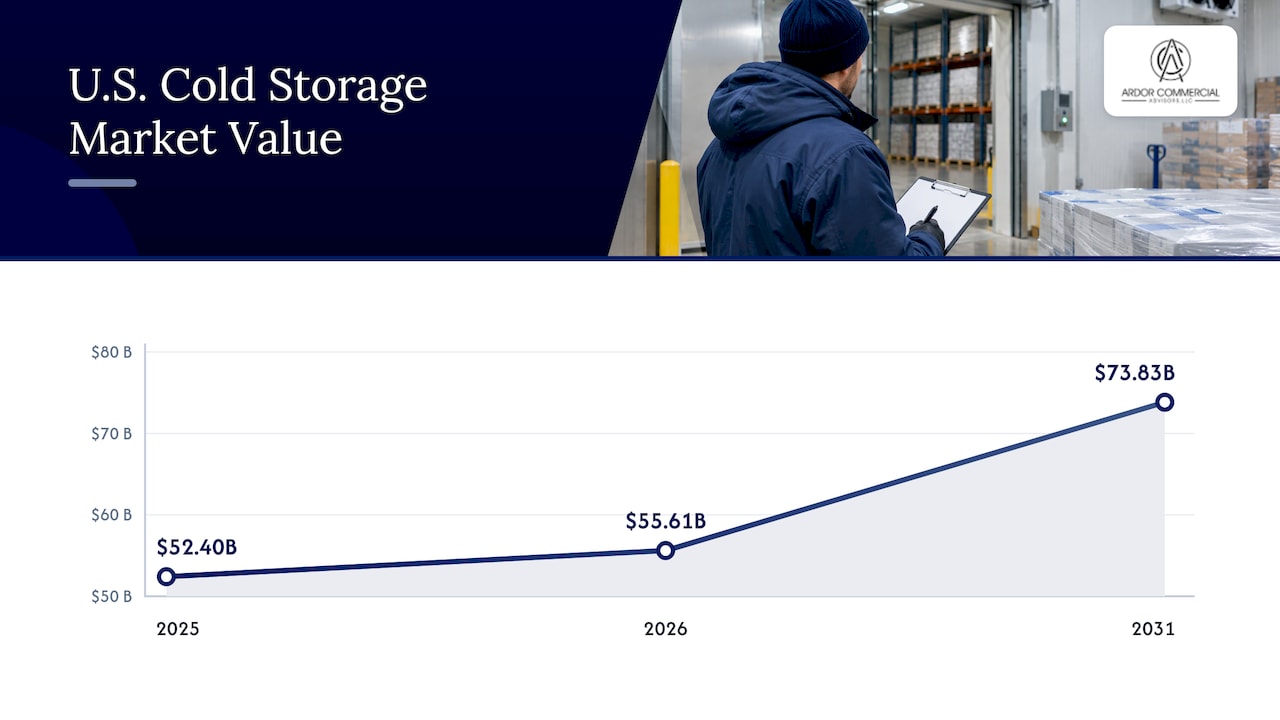
On the demand side, Mordor Intelligence valued the U.S. cold storage market at $52.40 billion in 2025 and projects growth from $55.61 billion in 2026 to $73.83 billion by 2031, a 5.83% compound annual rate. It points to a shift toward regional temperature-controlled food and pharmaceutical networks. Charlotte fits that pattern: it is a distribution crossroads with a large metro population and a growing healthcare sector.
For investors, our page on U.S. cold storage demand and DSCR guidance goes deeper on the demand data and how lenders size loans against it.
Public versus private cold storage: who your tenant is
The type of operator decides how the lease works. AEW’s logistics research explains the split:
| Public refrigerated warehouse | Private (single-tenant) cold space | |
|---|---|---|
| Pricing | Per pallet | Per square foot, usually net lease |
| Typical temperature | Mostly freezer | Mixed cooler and freezer |
| Location | Near where product originates | Closer to end consumers |
| Measured in | Cubic feet | Square feet |
For a Charlotte landlord, a private tenant such as a grocery distributor, a food manufacturer or a pharmaceutical logistics firm typically signs a longer net lease and often funds some of the build-out. For an owner-operator, the economics resemble running a service business as much as owning a building. That difference should shape the lease type you choose. Our guides to triple net leases and industrial lease types cover which costs land on the tenant and which stay with the owner.
What to evaluate in a Charlotte cold storage building
This is the checklist that separates a good asset from an expensive project.
Capacity: think in pallet positions
Operators size cold space by pallet positions, not square feet. Clear height sets how many rack levels fit, and insulated ceilings and evaporators hanging from the deck reduce usable height. A taller building holds more product in a smaller refrigerated footprint, which is why modern buildings with 36 feet or more of clear height are favored over older ones.
Refrigeration and power
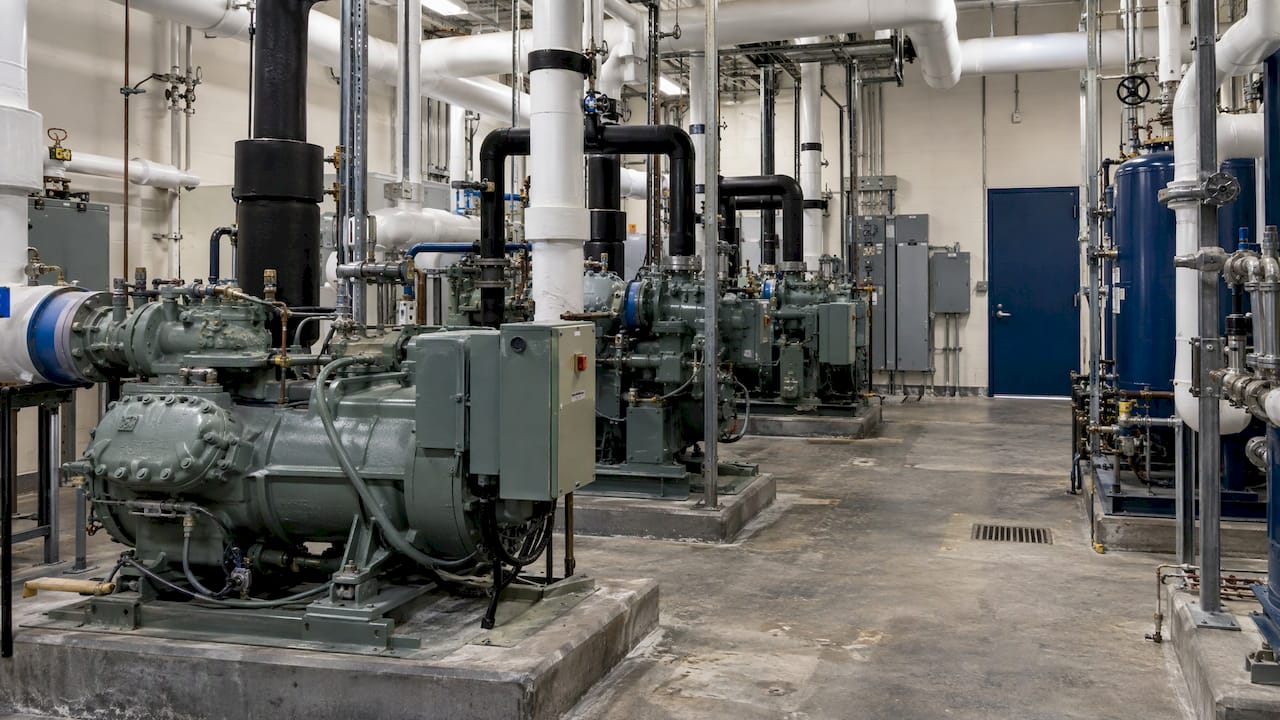
The refrigeration plant is the biggest line item and the first place old buildings fail. Ask for the age and capacity of compressors, condensers and evaporators, plus the service history. Confirm electrical capacity with the utility, since cooling loads are large and backup power matters when a failure puts inventory at risk. Construction costs reflect this: one 2026 industry source puts cold storage construction at about $130 to $350 per square foot, versus $85 to $150 for dry warehouse, with the spread driven by temperature class, clear height, automation and redundancy. Treat that as an order of magnitude for comparing against replacement cost, not a quote.
Building envelope and docks
Look at panel condition, floor heating in the freezer, dock seals and the count of dock doors against the throughput the tenant needs. Cold chain operators also look for features such as blast freezing, cross-docking and food-safety certification. Whether a building can be adapted for them affects both rent and resale.
Location
Trucks are the delivery method, so highway access to I-77, I-85 and I-485 drives value. Proximity to the Port of Wilmington and the Charleston ports matters for import and export cargo. Submarket choice changes everything; our Charlotte submarket guide compares where to buy, sell or refinance.
Lease structure
Look at term length, renewal options, who is responsible for refrigeration replacement, and what happens at lease end. A lease that leaves the owner with a worn-out plant and a specialized building is a different asset from one with a creditworthy tenant and a defined capital plan. Review the lease line by line. Our lease review service covers operating-cost pass-throughs, and our lease abstraction turns a long lease into the dates, rates and obligations you can model.
Buying and financing a cold storage asset
Specialized buildings make lenders look harder at the numbers. Debt service coverage ratio (DSCR) is net operating income divided by annual debt payments, and it sets how much a lender will loan. A cold asset with a long net lease to a strong tenant is easier to size than a vacant legacy building that needs new refrigeration. A few practical points:
- Underwrite the capital plan. Add the cost of refrigeration replacement and reserves into the cash flow, not only the rent.
- Model the downside. Run a vacancy scenario with the time and cost to re-tenant a specialized building, not a standard dry-warehouse downtime.
- Run the DSCR before you bid. Our DSCR loan sizing guide walks through the math.
- Check the exit. The buyer pool for a cold building is narrower than for dry industrial, so consider who your next buyer is.
- Plan the tax side. If you are selling another property to fund the purchase, the 1031 exchange timeline sets the deadlines you must meet.
Valuation is where many deals are won or lost. A discounted cash flow (DCF) model projects rent, expenses, capital spending and the sale price over a hold period and discounts them to today’s value. That is the right tool for a building with a big near-term capital need, and our commercial property valuation work includes DCF modeling.
Selling or leasing a cold storage building
An owner of an older cold building has three realistic paths: lease it as is, reinvest in upgrades and lease at a higher rate, or sell to an investor or operator. Because of the flight to quality, the upgrade path often decides the rent you can ask. Compare the cost of upgrades with the rent increase and the sale value you would get after them, rather than guessing.
A tenant has a parallel decision: lease a purpose-built cold building, take dry space and convert it, or use a public refrigerated warehouse and pay per pallet. For a tenant that needs only a modest footprint, per-pallet space avoids a long lease. For one with steady volume, a private lease gives control. Dry industrial rents for comparison are in our guides to warehouse lease rates in Charlotte and Charlotte industrial rents.
Our view: price the building, not the label
Cold storage gets talked about as one product, and it is not. A modern, high-clearance building with a long lease and a refrigeration plant that has years of life is a different investment from a 1980s box with a failing system, even if both are called cold storage. We start every industrial deal with the lease, the capital needs and the debt numbers, because those decide whether the property pays.
Charlotte’s market is thin, which makes careful comps and a defensible valuation more important, not less. When there are only a few relevant sales, an owner or buyer who does the analysis in advance negotiates from knowledge. Our advisors work on both sides, as landlord and tenant representatives, and that shapes how we look at risk: we ask what each party would ask of the other.
Jim
How Ardorcre can help
We are a commercial real estate brokerage in the Charlotte MSA handling sales and leasing of industrial, office, medical, retail and land property, with landlord and tenant representation, property management, lease analysis and valuation. If you own or want to buy an industrial building, or need space for a temperature-controlled operation, start with our commercial real estate services.
Owners weighing a sale can begin with a commercial property valuation. Tenants comparing options can look at tenant representation.
FAQ
Is cold storage a good investment in Charlotte?
It can be, when the building is modern, leased to a strong tenant and priced on its real capital needs. National vacancy rose to a 20-year high at the end of 2025, with modern space holding up better than legacy space. Run a DCF and a DSCR test on the specific building before you decide.
How much does cold storage space rent for compared with dry warehouse space?
Cold space rents at a premium because it costs far more to build and run. Rates vary by temperature zone, building age and lease type, and they change often. Ask for a current rate review for your submarket rather than relying on a national average.
What clear height do I need for cold storage?
Modern freezer buildings run 36 to 60+ feet clear, versus 32 to 40 feet for dry warehouses, according to AEW’s research. Taller buildings fit more pallets per refrigerated square foot. Conversions of older dry buildings are limited by the height they have.
Does Charlotte have much cold storage space?
Not a lot. A 2026 directory report lists 6 facilities in Charlotte and 54 statewide, and new capacity is arriving nearby, such as the Landis project. Because the market is thin, individual building specs and lease terms matter more than a market average.
Sources
- AEW Research: Cold Storage
- AEW Research: Logistics Today
- Food Logistics: U.S. cold storage sector navigating cyclical reset
- Salisbury Post: Landis industrial park delivery
- Rentech Digital: Cold storage facilities in North Carolina
- CarrierSource: Cold storage warehouses in North Carolina
- Vertical Cold Storage: Charlotte facility
- Mordor Intelligence: United States cold storage market
- Builder Muse: Cold storage facilities
- Lacuna Index: Real estate sector benchmarks