
Inside the City of Charlotte, a commercial property is taxed at a combined rate of about 78.57 cents per $100 of assessed value for fiscal year 2026-2027. That is the Mecklenburg County rate of 49.27 cents plus the city rate of 29.30 cents. Outside city limits you pay only the county portion, and a few areas add a municipal service district levy. The bigger variable for your next few years is the 2027 countywide revaluation, which resets the value those rates are applied to.
This guide shows how the bill is built, how to estimate it, what changes in 2027, how to appeal, and where taxes land in a lease.
TL;DR
- The 2026-2027 county rate is 49.27 cents per $100, and the city rate is 29.30 cents. Together, about 78.57 cents inside Charlotte.
- Estimate your bill by dividing assessed value by 100 and multiplying by the rate. A $2,000,000 building inside the city comes to about $15,714 a year.
- Mecklenburg County revalues every four years, and the next revaluation is in 2027. Review your income and expense data before the new notice arrives.
- Bills are due September 1, and the county’s 2026 bills avoid interest if paid by January 5, 2027. Interest cannot be waived.
- In a triple net lease, the tenant usually reimburses the tax, so a higher assessment hits your occupancy cost as well as the owner’s.
Table of Contents
- How the Charlotte commercial tax rate is built
- How to estimate your annual bill
- How Mecklenburg County values commercial property
- What to do before the 2027 revaluation
- How to appeal a commercial assessment
- When bills are due and what late payment costs
- Property taxes inside your lease
- Can you deduct commercial property taxes?
- Our perspective
- How we help Charlotte owners and tenants
- FAQ
- Sources
How the Charlotte commercial tax rate is built
Commercial property in Mecklenburg County is taxed on real property value (land and buildings) and, separately, on business personal property such as equipment and fixtures. The Office of Tax Administration lists and values all of it. Real property pays up to three layers.
| Layer | FY 2026-2027 rate per $100 of assessed value | Applies to |
|---|---|---|
| Mecklenburg County | 49.27 cents | Every parcel in the county |
| City of Charlotte | 29.30 cents | Parcels inside Charlotte city limits |
| Combined, inside Charlotte | about 78.57 cents | Charlotte parcels, before any district levy |
The county figure comes from the county’s published tax rate page. The city figure was reported by the Charlotte Observer when the city raised its rate from 27.41 to 29.3 cents. Local outlets such as Queen City Today put the combined figure at 78.57 cents.
A third layer matters for some addresses. Charlotte has municipal service districts, mostly in and around center city, that add a small extra levy to fund district services. If your parcel is in one, confirm the added rate with the county before you underwrite a deal.
Towns in the county such as Huntersville, Matthews, Mint Hill, Cornelius, and Pineville set their own rates. Charlotte’s numbers do not apply to a building there. Always check the parcel’s jurisdiction first.
How to estimate your annual bill
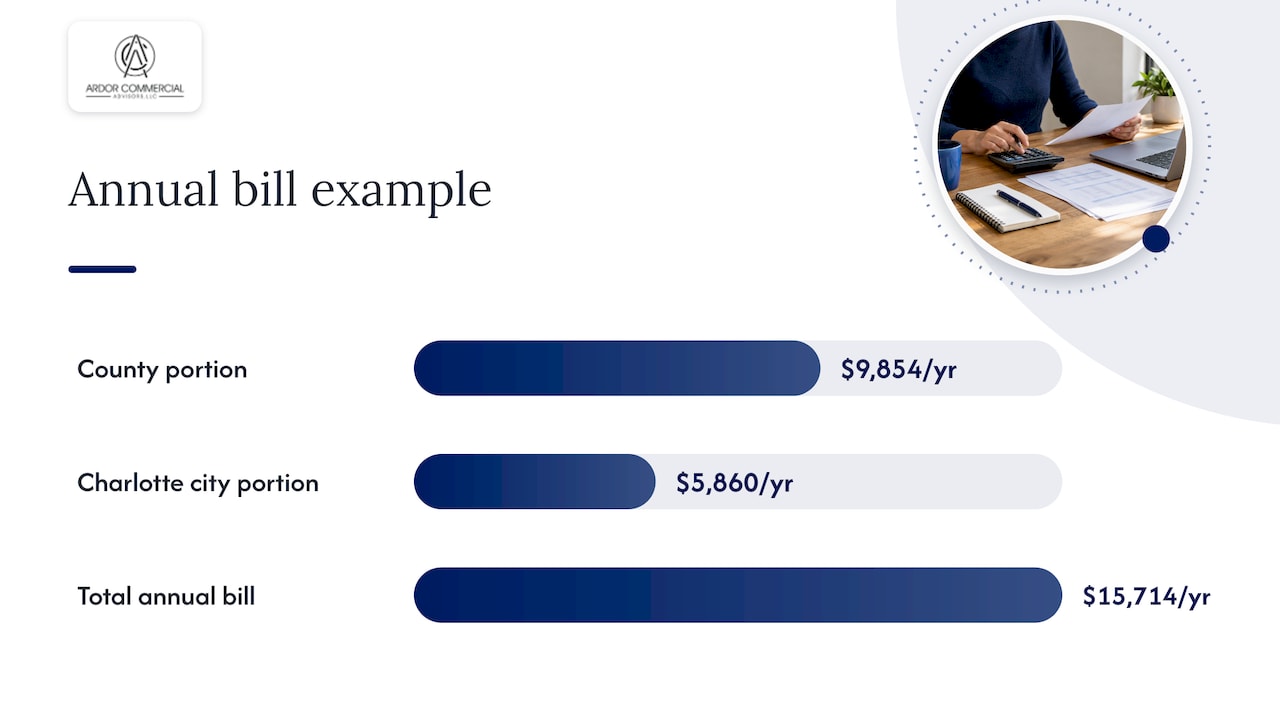
The county gives the method directly: divide the assessed value by $100, then multiply by the rate. For the county portion, that means multiplying by 0.4927.
Here is a worked example for a $2,000,000 medical office building inside Charlotte:
- Divide $2,000,000 by 100 to get 20,000.
- County: 20,000 × 0.4927 = $9,854.
- City: 20,000 × 0.2930 = $5,860.
- Total: $15,714 per year, or about $1,310 a month.
The same building in an unincorporated part of the county would owe just the $9,854 county portion, plus any other levy that applies there. That gap is real money when you compare two sites on a net operating income basis.
A few practical points when you run the math:
- Use the assessed value on the county’s record, not the price you are about to pay. A sale does not automatically reset the assessment between revaluations, but a new revaluation will reflect market value.
- Rates change every July with the budget cycle. The numbers above are for FY 2026-2027 only.
- Separate real property from business personal property. A dental or orthodontic practice with expensive equipment will also list that equipment for tax.
How Mecklenburg County values commercial property
The county assesses property at current market value. North Carolina law defines that as the price a willing and financially able buyer and a willing seller, neither under compulsion, would agree to. The county explains this on its revaluation page.
The county revalues on a four-year cycle, and the next one is in 2027. For commercial owners that matters more than a rate change of a cent or two, because values in office, medical, retail, and industrial have moved by different amounts since the last cycle. Industrial and medical buildings have generally been in demand, while some office buildings have faced higher vacancy and slower rent growth. Those shifts can produce uneven changes in assessed value from one property type to the next. Our read on the current office picture is in our Charlotte office market analysis.
Assessors typically lean on income, cost, and sales comparison approaches for commercial buildings. The income approach is where your own records can change the outcome. Capitalization rates, rent rolls, vacancy, and operating expenses all feed a value, and the same inputs are the ones you would use in a commercial property valuation.
What to do before the 2027 revaluation
You cannot control the county’s models, but you can control the file you hold. Before new notices arrive:
- Pull your current rent roll and a trailing 12-month operating statement. Note concessions, free rent, and any unusually high vacancy.
- List physical issues such as deferred roof work, functional obsolescence, or an environmental problem, with contractor estimates.
- Check the county record for errors. Square footage, building class, year built, and land size all drive value. A wrong square footage figure is the easiest fix.
- Gather comparable sales and leases for similar buildings in your submarket. Our submarket guide is a starting point for understanding where your building sits.
- Calendar the notice date. Your response window starts from the date on the notice, not the day you open the mail.
How to appeal a commercial assessment
The county’s process has two steps. First, you can request an informal review within 30 days of the date on your valuation notice, as described on the revaluation page. Second, you can present a formal appeal to the Board of Equalization and Review. The county’s property value appeals page explains that a taxpayer who receives a notice of value change has until the later of the Board’s adjournment date or the last date to appeal stated on the notice. Deadlines differ between revaluation years and other years, so read the notice itself and confirm the current schedule with the county.
What tends to persuade a reviewer is evidence about market value, not complaints about the bill:
- A recent appraisal or a sale of the property or a close comparable
- Actual income and expense figures for the building
- Documented vacancy or lease-up problems
- Photos and estimates for physical deficiencies
- Corrected property characteristics
File the informal review first when the issue is a clear data error. Go to the formal board when the disagreement is about value itself and you have the numbers to support a lower figure. If the amount at stake is large, consider an attorney who handles property tax appeals in North Carolina.
When bills are due and what late payment costs
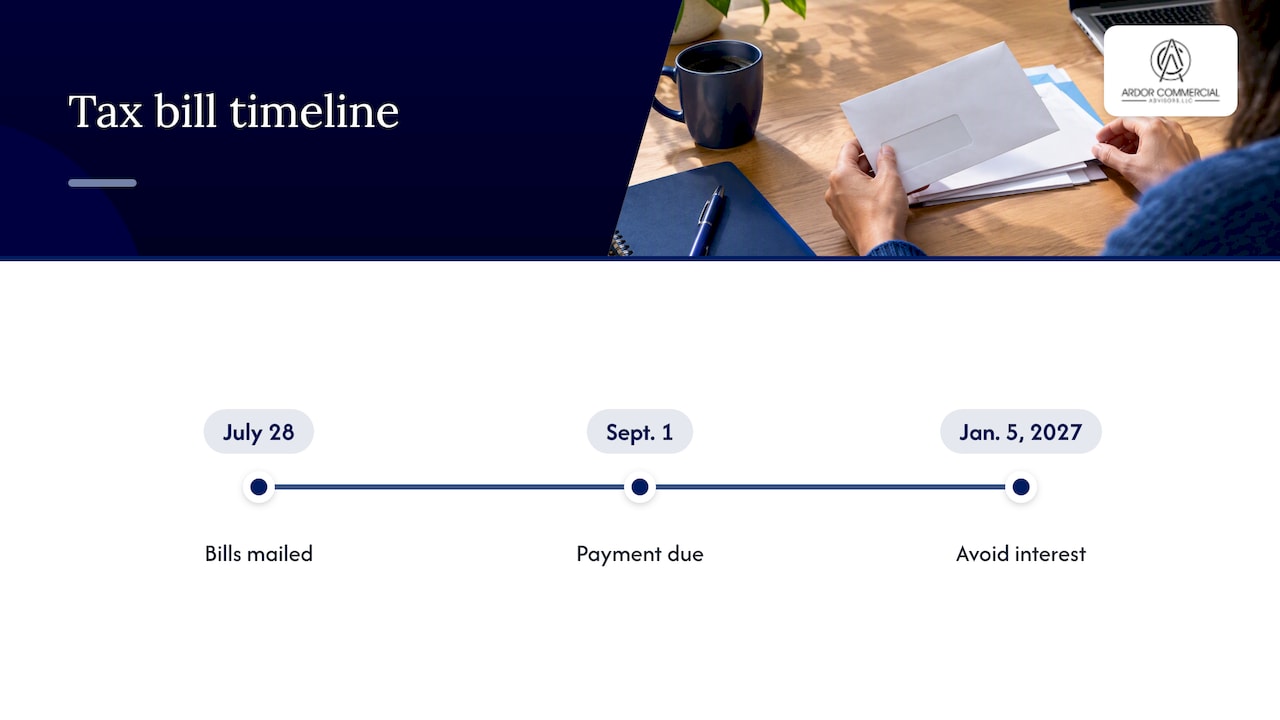
For 2026, Mecklenburg County mailed real and personal property bills on July 28 and set a due date of September 1. Taxes paid by January 5, 2027 avoid interest. Expect the same pattern in future years, and confirm exact dates on the county’s news page each summer.
Late payment is expensive, and there is little flexibility. Under North Carolina General Statute 105-381, the tax collector cannot waive interest on delinquent property taxes. The county also lists delinquent taxpayers and notes that unpaid taxes can lead to garnishment, levy, or foreclosure.
The county accepts payment online, by phone, and by mail. Card payments by phone or online carry third-party convenience fees, so owners with large bills often prefer bank payment options. See the county’s payment page for current methods.
If a lender escrows your taxes, check that the servicer paid the right parcel and amount. The county’s guidance for mortgage companies and mass payments is on the news page linked above. Paying by the due date is cheap insurance against a surprise interest charge.
Property taxes inside your lease
For tenants, the tax rate is a lease term as much as a government figure. In a triple net lease, you typically pay your share of taxes, insurance, and common area maintenance on top of base rent. An assessment increase flows straight through to you, often with a lag.
So when a landlord quotes a rate per square foot, ask what the estimated tax line is and what it is based on. Then ask:
- Is the tax estimate based on the current assessment or on a projected post-revaluation value?
- Does a sale of the building trigger a reassessment pass-through that your lease should cap or exclude?
- Does the lease let the landlord appeal, and do you share in any refund?
- Are tax reimbursements capped, or can they rise without limit?
- Is your pro rata share calculated on a fair denominator, including vacant space?
Industrial leases vary a lot here, and our guide to industrial lease types shows how the same rent can hide very different tax exposure. For multi-tenant office, retail, and medical buildings, annual reconciliation is where errors show up, which is why we offer lease review and CAM reconciliation analysis.
Owners should also build the tax line into their budget. A building that sells at one price and is reassessed higher can see expenses jump faster than rent. Our property management budget guide covers how to carry the tax line forward.
Can you deduct commercial property taxes?
Property taxes paid on business real estate are generally treated as a business expense for federal income tax, but the details depend on your entity type, whether you own or lease, how the property is used, and whether any part is capitalized rather than expensed. Tenants who reimburse taxes under a net lease should also ask their accountant how those payments are treated. Because the answer turns on your return, have your CPA confirm the treatment, and read current IRS guidance before you file.
Our perspective
Most owners we meet look at the tax rate and shrug, because it is set by a government and cannot be negotiated. The assessed value is a different story, and so is the lease language that passes the tax along.
When we advise an owner or investor, we look at taxes the way a buyer’s lender would: as a line in net operating income that moves the value of the building. A $2,000,000 building paying about $15,714 a year is carrying that cost into every sale and refinance. If the 2027 revaluation moves that number, your cap rate math moves with it.
For tenants, particularly medical and office practices signing multi-year leases, we read the tax and CAM provisions before the rent. Our tenant representation and lease review work are built to catch pass-through language that looks routine and is not.
Our approach is to bring local market data, a clear read of the lease, and a valuation you can defend to the table, whether you are buying, selling, leasing, or preparing to respond to a notice.
Jim
How we help Charlotte owners and tenants
We advise commercial owners, investors, and tenants across the Charlotte area on sales, leasing, property management, and advisory work. If you are weighing a purchase, we can model the tax line alongside income, debt, and expected value so the numbers reflect what you will actually pay. If you are a tenant, we review the lease terms that pass taxes through.
To talk through a property in Mecklenburg County, start with our commercial property valuation page or reach out through Ardorcre.
FAQ
How much are commercial property taxes in Charlotte?
Inside Charlotte city limits, the combined rate for fiscal year 2026-2027 is about 78.57 cents per $100 of assessed value, made up of the county’s 49.27 cents and the city’s 29.30 cents. A building assessed at $1,000,000 would owe about $7,857 a year at that rate. Properties in a municipal service district or in another town in the county can differ.
What is the Mecklenburg County property tax rate?
The county rate for fiscal year 2026-2027 is 49.27 cents per $100 of assessed value, according to the county’s Office of Tax Administration. It applies to all property in the county. City and town rates are added on top, depending on where the parcel sits.
When is the next revaluation in Mecklenburg County?
The county revalues property every four years, and the next revaluation is in 2027. Watch for your valuation notice, because the window for an informal review begins on the date printed on it. Gather income, expense, and comparable data now.
Does a sale of my building raise my taxes?
The assessment follows the county’s market value schedule, and revaluation is when the county resets values across the board. A sale price becomes a data point the county may consider. In a net lease, ask how a sale or reassessment is passed through to tenants, and have that spelled out before signing.
Can I negotiate my property tax bill?
You cannot negotiate the rate, but you can contest the assessed value through an informal review and, if needed, a formal appeal to the Board of Equalization and Review. Bring evidence of market value such as an appraisal, income and expense data, or comparable sales. Late interest on an unpaid bill cannot be waived.
Sources
- Tax Rates, Mecklenburg County Office of Tax Administration
- Mecklenburg property tax bills going up: Here’s how much, Charlotte Observer
- Charlotte property taxes 2026: Mecklenburg rates, due dates, Queen City Today
- Office of Tax Administration, Mecklenburg County
- Revaluation, Office of Tax Administration
- News, Office of Tax Administration
- 2024 Property Tax Payment Instructions for Mortgages and Mass Payments
- Delinquent Taxpayer Lists, Office of Tax Administration
- Pay Taxes and Fees, Office of Tax Administration