
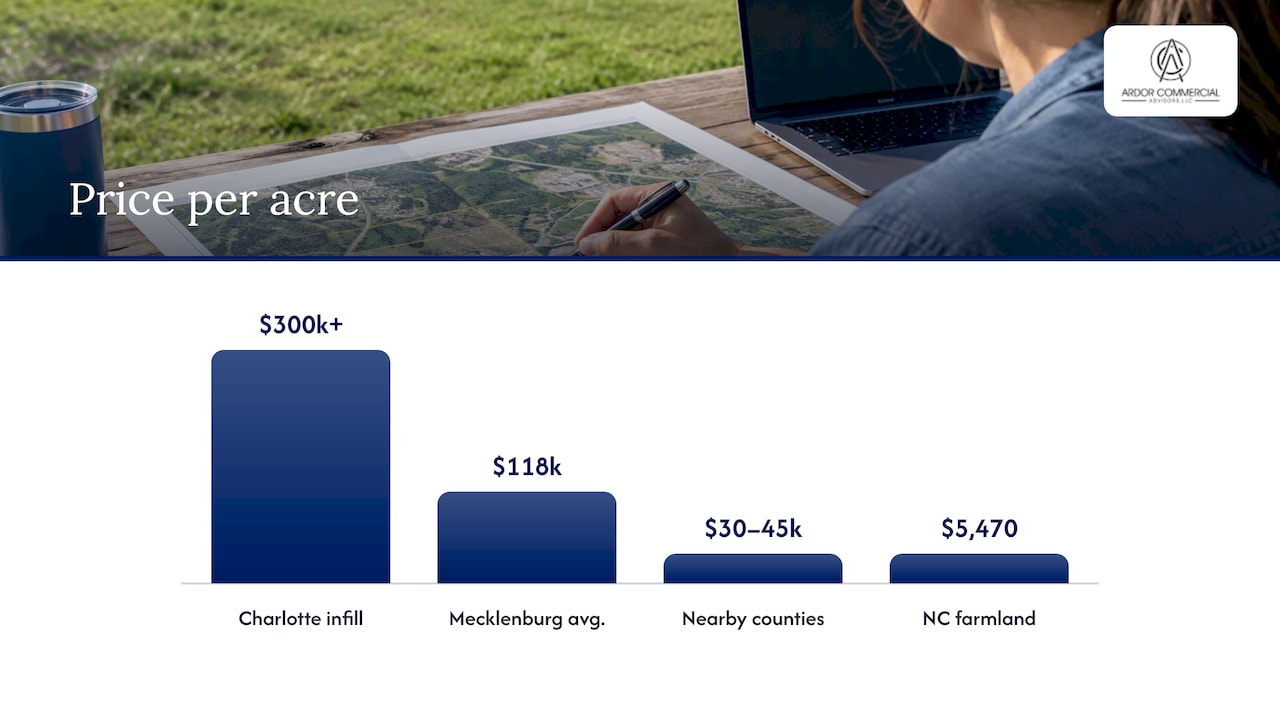
Land in Charlotte does not have one price. Late-2025 figures put Mecklenburg County at about $118,000 per acre, infill parcels inside city limits often above $300,000, and the surrounding counties between $30,000 and $45,000. Zoning, sewer access and location explain most of that spread. The sticker price per acre explains very little of it.
This guide is for owners, investors and operators (medical, office, retail and industrial) who want to know what land really costs in the Charlotte MSA and what sits on top of the purchase price.
TL;DR
- Average figures by county are a starting point. Mecklenburg averages roughly $118,000 per acre, while Cabarrus, Union, Iredell, Gaston and Lincoln run $30,000 to $45,000, according to late-2025 data.
- Infill parcels inside Charlotte often pass $300,000 per acre. Listing-site averages mix tiny lots with large tracts, so compare by zoning and utilities, not by headline numbers.
- Sewer capacity, stormwater fees and permitting often decide whether a parcel works. They can matter more than the price you pay for the dirt.
- The cheapest acre is rarely the cheapest project. Price the whole path from purchase to a permitted, connected, build-ready site.
Table of Contents
- What an acre costs across the Charlotte area
- Why commercial land sells at a premium
- Costs that sit on top of the purchase price
- Matching land to your use
- How to pick a submarket
- Our perspective
- Work with Ardorcre on your land search
- FAQ
- Sources
What an acre costs across the Charlotte area
The numbers below come from a single late-2025 market write-up. Treat them as typical ranges, not quotes for any specific parcel.
| Area | Typical price per acre (late 2025) |
|---|---|
| Infill parcels inside Charlotte city limits | Frequently above $300,000 |
| Mecklenburg County, average | About $118,000 |
| Cabarrus, Union, Iredell, Gaston, Lincoln counties | $30,000 to $45,000 |
| North Carolina farmland, statewide average | $5,470 |
The Henderson Properties market overview is the source for the first three rows. The farmland row comes from USDA NASS data for 2025 summarized here, which reports a 5.4% increase over the prior year.
The gap between $5,470 and $300,000 is the whole story of land pricing. Farmland is valued for what it grows. Charlotte land is valued for what can be built on it, and that depends on entitlements and infrastructure.
Why listing averages mislead
Search any listing portal for Charlotte land and you will see averages that differ by tens of thousands of dollars per acre from one site to the next. The reason is mix. A quarter-acre residential lot listed at $150,000 equals $600,000 per acre on paper. A 40-acre tract in the outer county might list for a fraction of that per acre. Whichever listings a site happens to include moves its average.
For a decision, build your own comparison set:
- Same zoning or same entitled use.
- Similar size, within a factor of two.
- Same utility status (public sewer, septic, or neither yet).
- Closed sales, not asking prices.
Mecklenburg County publishes tax parcel sales data through its GIS services, and the Office of Tax Administration values property for the county. Both help you check what comparable parcels sold for and how they are assessed.
Why commercial land sells at a premium
A build-ready commercial parcel is a different asset from agricultural land, even when they sit a few miles apart. The premium pays for zoning that allows your use, road access, utilities and a realistic path through permitting. For a plain-language explanation of how commercial-zoned versus agricultural land is valued in a different Texas market, that guide lays out the same logic.
In Charlotte, the premium is driven by scarcity. Market observers point to roughly 57,000 new residents a year as the engine of land demand, and note that buildable land inside Mecklenburg is getting scarcer and more expensive. That is why the so-called growth belt in Cabarrus, Union and Gaston counties draws so much investor attention.
Costs that sit on top of the purchase price
Two parcels at the same price per acre can differ by hundreds of thousands of dollars once you add what it takes to build. These are the items we see decide deals.
Sewer and utilities
In the Charlotte MSA, sewer capacity often dictates feasibility more than purchase price does. Outside the immediate city infrastructure, connection delays and costs can be significant. Confirm in writing whether public sewer is available to the parcel, who owns the line, and what capacity is committed before you spend on due diligence.
Stormwater and impervious surface
Mecklenburg County bases its storm water fee on a property’s impervious surface area, such as rooftops, driveways and walkways. A site plan with large parking fields and big roofs carries a higher ongoing fee, and ignoring stormwater discharge rules during design can lead to expensive engineering later. For industrial and retail users with large paved areas, this is a real line item in the pro forma.
Water, septic and permitting
County code enforcement has warned developers that private water permitting and backflow protection requirements catch people who bring in utility contractors late. Its quarterly bulletin on private water permitting is from 2019, so confirm current rules with the county before relying on it. If a parcel will use a septic system, check the county’s septic fee schedule and whether the soil can support the use you need.
A quick worked example
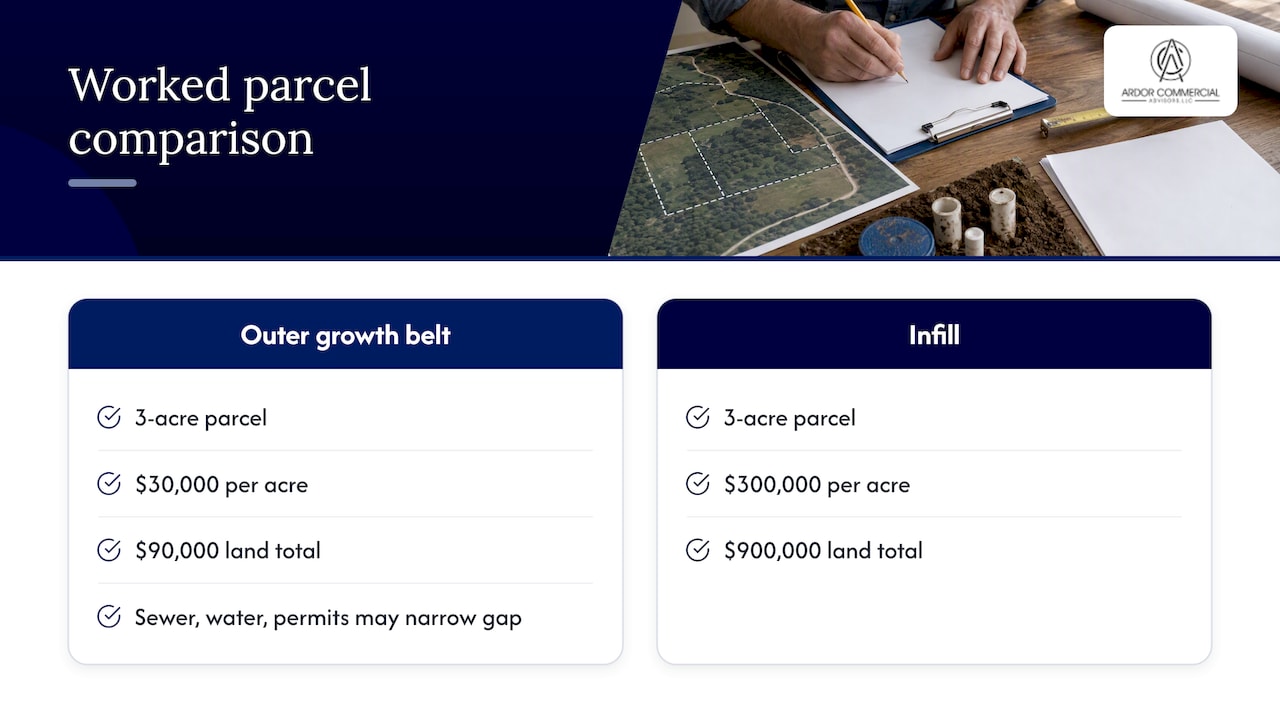
Say you compare two 3-acre parcels. Parcel A is in the outer growth belt at the low end of the county range, so $30,000 per acre means $90,000 for the land. Parcel B is an infill parcel at $300,000 per acre, or $900,000. Parcel B looks ten times more expensive. But if Parcel A needs a long sewer extension, a private water solution and months of added permitting, the carrying cost and the delay can erase much of the gap. And if your use needs to be near customers, patients or a labor pool, Parcel A may not work at any price. The point is to price the project, not the acre.
Matching land to your use
Medical and office users. Visibility, parking ratios and proximity to referral sources usually outweigh a lower land price. Many practices are better served by leasing or buying an existing building than by buying land to build on. Our Charlotte medical office demand piece covers how that market is moving.
Industrial users. Truck access, power, and sewer or stormwater capacity come first. Large speculative projects show where the market is going. One recent example is a 171,920-square-foot speculative industrial facility planned on a 17.3-acre site in Charlotte, reported in August 2025. If you lease industrial space instead, see our guide to industrial lease types before you compare costs.
Investors holding land. Land produces no income while you wait, so your return depends on appreciation, entitlement work or a future sale. Our Charlotte land development guide goes deeper on the development path, and the opportunity zones overview covers tax-advantaged areas. If you are selling land or a building and want to defer gains, read our 1031 exchange rules.
How to pick a submarket
Price per acre falls as you move away from uptown, but so do rents, buyer demand and exit options. Before you buy, ask three questions:
- Who will be the next buyer or tenant, and where would they look?
- What does the nearest recent comparable sale say about the exit?
- How will financing treat the parcel? Lenders often offer less leverage on raw land than on income-producing buildings.
Our Charlotte submarket guide compares where to buy, sell or refinance. For financing questions, see commercial mortgage rates and our DSCR loan sizing guide. DSCR is the debt service coverage ratio, which lenders use to size loans on income-producing property. Land that earns nothing has no DSCR to speak of, so lenders look harder at your other assets and your plan.
Our perspective
We work every day on the commercial side of the Charlotte MSA, and the pattern is consistent: buyers fixate on the per-acre number and underwrite the rest loosely. The better habit is to treat utilities, stormwater and permitting as part of the price from day one.
We also push clients to ask what the land is for before asking what it costs. A medical practice, a small-bay industrial owner and a long-term investor each need a different parcel, and the right acre for one is the wrong acre for the others. When a client brings us a parcel, we start with the end use, then work back to what the site must deliver, then compare against closed sales. That order saves money.
If a parcel has no clear path to sewer and permits, we would rather say so early than let you find out after closing.
— Jim
Work with Ardorcre on your land search
We handle land sales and commercial property across the Charlotte MSA, along with valuation and DCF modeling for owners and investors who want a defensible number before they buy or sell. To talk through a parcel or a sale, start at our land sales page or see the full list of commercial real estate services. We do not publish fixed prices, because fees depend on the transaction.
FAQ
How much is 1 acre of land in Charlotte, NC?
It depends on location and zoning. Late-2025 figures show Mecklenburg County averaging around $118,000 per acre, with infill parcels in the city often above $300,000. Surrounding counties typically run $30,000 to $45,000 per acre.
What is the cheapest land near Charlotte?
The outer growth-belt counties, such as Cabarrus, Union, Iredell, Gaston and Lincoln, are the lowest-priced in the metro, at roughly $30,000 to $45,000 per acre by late-2025 figures. Cheap land can still be costly to develop if it lacks sewer service or has difficult soils, so check utilities first.
How much does farmland cost in North Carolina?
USDA data for 2025 puts the statewide average farm real estate value at $5,470 per acre. Commercial-zoned or build-ready land near Charlotte sells for far more than that, because buyers pay for entitlements and infrastructure.
What hidden costs should I budget for when buying land in Charlotte?
Start with sewer or septic, private water permitting, and stormwater fees tied to impervious surface. Add engineering, survey and environmental due diligence. A local advisor and an early talk with county code enforcement can prevent surprises.
Sources
- Where Smart Investors Are Buying Land Near Charlotte, Henderson Properties
- North Carolina Farmland Value Calculator
- Impervious Mapping, Mecklenburg County GIS
- BDC Quarterly Bulletin, Mecklenburg County Code Enforcement
- Septic System Fee Schedule, Mecklenburg County Environmental Health
- Tax Parcel Sales layer, Mecklenburg County GIS
- Office of Tax Administration, Mecklenburg County
- Graham Park CLT industrial development, REBusinessOnline