
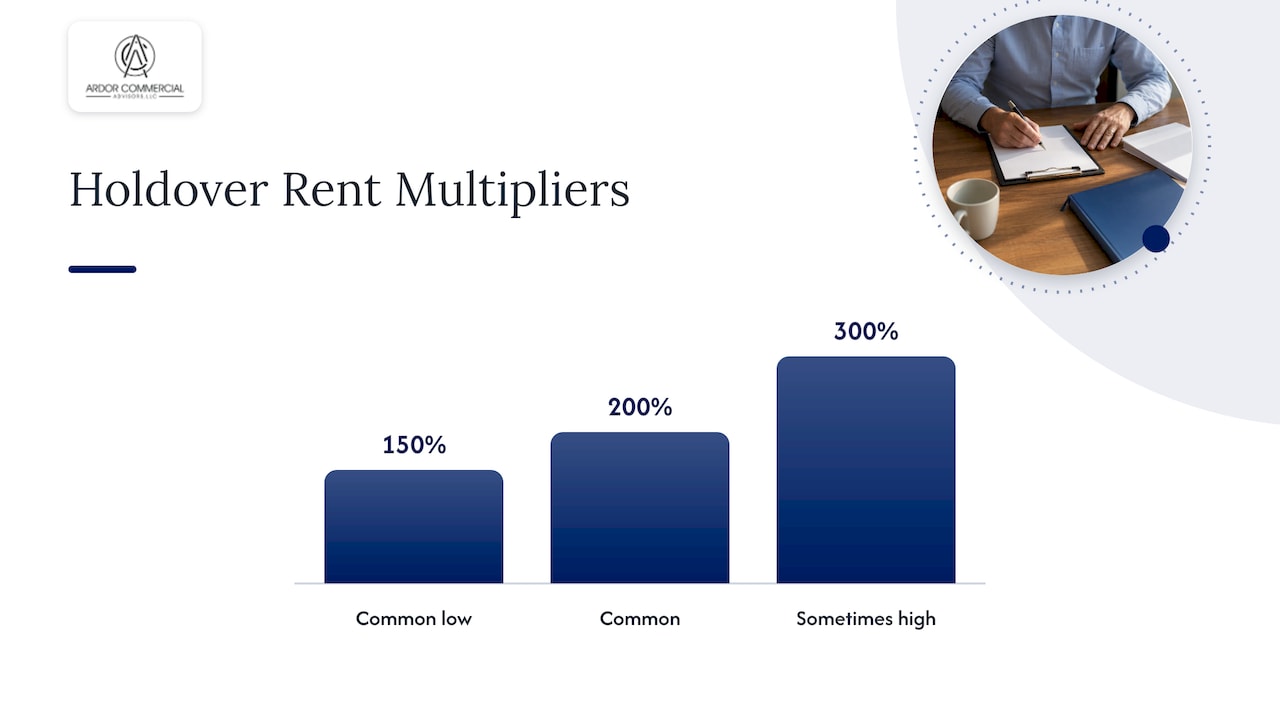
When a commercial tenant stays past the lease term, the governing lease clause controls what rent is owed, and without one, state law and the courts decide whether the landlord can collect a rent multiplier, pursue use and occupancy, or simply move toward eviction. Many clauses set holdover rent at 150% to 300% of the prior rate, while market-cited ranges run from 10% to 50% above contract rent. If you want the tenant out, do not accept a rent check; if you need a few extra days, get a short written extension instead of relying on silence.
TL;DR:
- Check whether the lease charges a full month for any partial holdover or prorates by day: $6,000 rent can mean $12,000 for ten days.
- Courts may uphold doubled base rent when it reasonably estimates anticipated losses, but may reject multipliers on utilities or other pass through costs.
- Without a holdover clause, landlords generally seek fair market use and occupancy rather than a contractual multiplier, while state law determines tenancy status.
- Tenants who need extra days should secure a written extension with a firm vacating date and per diem rate before the lease expires.
- Landlords seeking possession should refuse rent, document communications, and serve notices that meet local deadlines, because accepting payment can create a new tenancy.
Table of Contents
- What a holdover tenant is and how courts classify post-lease occupancy
- How holdover rent is determined: lease clause first, then default rules
- Court treatment and enforceability: liquidated damages vs penalties
- How to calculate holdover charges: proration, full-month claims, and use and occupancy
- Immediate checklist for landlords: preserve rights and avoid accidental renewals
- Immediate checklist for tenants: limit exposure and negotiate short holdovers
- Practitioner checklist for drafting enforceable holdover clauses
- Jurisdictional differences across the Charlotte market and North Carolina
- Impact of holdover rent on property valuation and investment decisions
- Strategies for tenant representation during holdover disputes
- Implications of holdover rent for CAM charges and reconciliation
- Tax considerations related to holdover rent payments
- Common holdover patterns we see in office and medical leases
- How we help with holdover clauses, lease review, and representation
- FAQ
- Sources
What a holdover tenant is and how courts classify post-lease occupancy
A holdover tenant is anyone who remains in a commercial space after the lease term ends without a signed renewal or new agreement. Courts generally place this occupancy into one of two legal buckets, and which bucket applies changes what remedies are available and what rent is owed.
A tenancy at sufferance arises when a tenant stays without the landlord’s consent. The landlord did not agree to the continued stay, but also has not yet forced the tenant out, and under this status the landlord can collect rent for the holdover period while still pursuing eviction. A tenancy at will, by contrast, exists when the landlord knowingly allows the tenant to continue occupying the space, typically on a month-to-month basis, with no fixed end date and shorter notice requirements for either side to terminate.
The distinction matters because it shapes what happens next:
- A tenant at sufferance has no enforceable right to stay and can be removed through eviction proceedings at any time.
- A tenant at will has a recognized, if informal, tenancy that usually requires proper notice before termination.
- Accepting rent from a tenant at sufferance can convert that occupancy into a tenancy at will or even a renewed lease term, depending on state law.
This last point is the one landlords trip over most often. According to Cornell’s Legal Information Institute, a landlord who accepts rent from a holdover tenant may inadvertently create a new tenancy, which can complicate or delay a planned sale, renovation, or re-tenanting. If possession matters more than collecting a check, refuse the payment and move straight to notice and holdover proceedings instead.
How holdover rent is determined: lease clause first, then default rules
The lease itself is the first and best place to look. Most commercial leases, especially office and medical leases negotiated by counsel, include an explicit holdover provision that spells out the rate, the calculation method, and what else the landlord can recover.
Typical clause structures include:
- A flat multiplier of base rent, commonly 150%, 200%, or sometimes as high as 300% of the prior monthly rate for each month or partial month of holdover.
- A per diem formula, which prorates the monthly multiplier into a daily rate for tenants who only need a handful of extra days.
- A “use and occupancy” clause that entitles the landlord to the fair rental value of the space rather than a stated multiplier.
- A tiered structure that steps up the multiplier the longer the holdover continues, discouraging indefinite delay.
Investopedia’s explanation of holdover tenancy notes that when a lease is silent, the legal effect of a continued stay, and whether accepting rent creates a month-to-month tenancy or restarts the full lease term, depends on state law. Some states default to a month-to-month arrangement at the prior rent rate. Others allow the landlord to treat the continued occupancy as a renewal of the full original term if the lease included an automatic-renewal provision that was never formally terminated.
Absent any clause, landlords are generally left pursuing actual damages or use and occupancy, calculated at fair market value, rather than a contractual multiplier. That is a meaningfully weaker position than having a drafted holdover clause, since the landlord then has to prove damages rather than simply pointing to a formula. This gap is exactly why lease abstraction matters well before the expiration date arrives. Pulling the holdover language, renewal notice deadlines, and rent escalation terms into a single summary during lease abstraction gives both sides clarity long before the last month of the term.
Court treatment and enforceability: liquidated damages vs penalties
Holdover clauses that double or triple rent are not automatically enforceable just because they are in writing. Courts evaluate them under the same doctrine used for liquidated damages generally: was the amount a reasonable pre-estimate of the landlord’s likely harm at the time the lease was signed, or is it functioning as a punishment designed to coerce the tenant out?
The core test asks two questions:
- Was the amount of damage difficult to estimate in advance, at the time the parties signed the lease?
- Is the stipulated amount reasonably proportional to the harm the landlord would likely suffer from a holdover, rather than wildly disproportionate?
A court decision addressing a double-rent holdover clause illustrates how this plays out in practice. The court upheld the doubled base rent because the landlord could show the amount was not grossly disproportionate to anticipated losses and the figure was set at the time of signing rather than invented after the fact. Notably, the same court declined to let the landlord double certain pass-through charges, like utility costs, on the theory that those were reimbursements rather than rent, and doubling them would have produced a windfall unrelated to actual harm. Courts frequently draw this line between “fixed rent” multipliers, which get the court’s deference, and “additional rent” charges, which face closer scrutiny.
Tenants pushing back on an inflated holdover bill often argue the clause operates as an unenforceable penalty, especially when the multiplier is extreme or when the landlord suffered no real harm from the short delay. Landlords strengthen their position by keeping multipliers in a defensible range, defining exactly which charges the multiplier applies to, and avoiding language that reads as punitive rather than compensatory. A clause that ties the multiplier to a reasonable estimate of re-leasing costs or lost opportunity tends to survive scrutiny better than one that simply picks a large number to scare tenants into leaving on time.
How to calculate holdover charges: proration, full-month claims, and use and occupancy
Whether a landlord can demand a full month’s rent for a few days of holdover, or only a prorated amount, comes down to the lease’s exact wording. Many holdover clauses state that any holdover, even a single day, triggers a full month at the multiplied rate. Others specify a daily or per diem rate, which prorates more fairly for short overstays.
Three short examples show how the math typically works:
- Daily proration: a tenant pays $6,000 per month in base rent and holds over for 5 days under a clause specifying 150% of the per diem rate. The per diem rate is $6,000 divided by 30, or $200. At 150%, the daily holdover rate is $300, so the tenant owes $1,500 for the five days.
- Full-month multiplier: the same $6,000 monthly tenant holds over for 10 days, but the lease states any partial month triggers a full month’s charge at 200% of rent. The tenant owes $12,000 for that month, regardless of actually occupying only a third of it.
- Use and occupancy ledger: with no holdover clause at all, a landlord seeks use and occupancy at fair market value, which an appraisal or comparable-lease analysis sets at $6,500 per month. The tenant owes $6,500 prorated for the actual days occupied, not a multiplied contract rate, because use and occupancy is a damages remedy rather than a contractual rent obligation.
Use and occupancy differs from contractual holdover rent in a key way: it is not tied to the lease’s rent figure at all. It is a court-recognized payment obligation based on the fair rental value of the space during the period of wrongful possession, and it applies whether or not the lease addresses holdover.
A 150% holdover multiplier on $6,000 base rent adds $9,000 for a full month of unauthorized occupancy, according to the standard multiplier ranges landlords commonly build into commercial leases. That gap between contract rent and holdover rent is the main financial lever landlords use to discourage tenants from overstaying.
Immediate checklist for landlords: preserve rights and avoid accidental renewals
The first 48 hours after a lease expires without a signed renewal set the tone for everything that follows; following a solid lease administration checklist for property managers can help ensure no rights are lost or accidental renewals occur. A few missteps here, especially accepting rent, can cost a landlord the ability to remove a tenant quickly.
- Do not accept any rent payment if your goal is possession; cash a check and you risk creating a new tenancy.
- Document every communication with the tenant in writing, including any verbal promises about move-out dates.
- Serve a written termination or holdover notice that complies with your state’s and municipality’s timing requirements.
- Decide your remedy path promptly: collect holdover rent under the lease clause, offer a short written extension, or begin eviction proceedings.
- Keep a dated file of notices, rent ledgers, and correspondence in case the matter proceeds to litigation.
Pro Tip: Calendar your lease expiration and renewal decision dates at least 120 days out so a holdover never becomes your only option; our renewal strategy guide walks through the NPV math for deciding early.
Consulting counsel makes sense as soon as a tenant indicates they will not vacate on time, rather than after weeks of informal back-and-forth. The earlier a landlord commits to a remedy, the stronger the paper trail supporting it.
Immediate checklist for tenants: limit exposure and negotiate short holdovers
If you know you will need extra time before a lease ends, the worst move is to say nothing and hope the landlord does not notice. A short written extension, negotiated before the term expires, almost always costs less than a holdover penalty triggered after the fact.
- Request a written short-term extension as soon as you know you will need extra days, and offer a fair per diem rate upfront.
- Confirm a firm move-out date in writing so the landlord has no reason to treat the stay as open-ended.
- Ask for an itemized breakdown of any holdover charge, and dispute line items that look duplicated, like utilities billed twice.
- Keep copies of every payment and piece of correspondence related to the holdover period.
- Bring in a tenant representative or attorney if the landlord demands a multiplier that seems disproportionate to the actual delay.
Tenants in medical practices often face this exact scenario when equipment installation or buildout at a new space runs late. A short, clearly priced extension protects the practice from both a disrupted move and an inflated holdover bill.
Practitioner checklist for drafting enforceable holdover clauses
Well-drafted holdover language heads off most disputes before they start, and our advisors see the same gaps repeatedly in office and medical leases. A clause should define the holdover period precisely, state the multiplier or per diem formula in plain numbers, specify which additional charges (CAM, utilities, taxes) the multiplier applies to, and include a short cure or notice window before penalties escalate.
- Define “holdover” as beginning the day after lease expiration, not after some informal grace period.
- State the multiplier and whether it compounds monthly if the holdover continues.
- List which charges get multiplied and which stay at the original rate.
- Cap the multiplier at a defensible level, generally 150% to 300%, to withstand a penalty challenge.
Pro Tip: Run a formal lease review before your tenant’s option deadline, not after, so holdover language gets tested while you still have negotiating leverage.
When clauses are unclear or missing entirely, a lease abstraction pass catches the gap early enough to fix it through an amendment rather than a dispute.
Jurisdictional differences across the Charlotte market and North Carolina
Holdover rules are set at the state level, so North Carolina’s default framework governs leases across the Charlotte metro area, though individual municipalities can add procedural wrinkles around notice service and local court filing requirements. Commercial leases signed anywhere in the region are still read first against their own clause language, since North Carolina courts generally honor a clearly drafted holdover provision rather than substituting a statutory default.
Where a lease is silent, North Carolina’s general landlord-tenant framework tends to treat continued occupancy with the landlord’s knowledge as a month-to-month tenancy at the prior rent rate, absent a more specific agreement.
Eviction procedure also varies by county court, affecting how quickly a landlord can move from notice to a hearing. Property owners working across several submarkets in the Charlotte MSA often find it worthwhile to standardize holdover language across their portfolio so remedies and timelines do not shift unpredictably from one building to the next.
Impact of holdover rent on property valuation and investment decisions
Holdover income looks like a windfall on a rent roll, but appraisers and lenders generally discount it or exclude it entirely when underwriting a sale or refinance. Holdover rent is, by definition, temporary and tied to a tenant who is supposed to be gone, so it does not represent durable, contract-backed cash flow the way a signed renewal does.
For an owner preparing to sell or refinance, a pattern of chronic holdovers across multiple tenants can signal a management problem to a buyer’s underwriting team: weak lease administration, inconsistent notice practices, or a building that struggles to retain or properly transition tenants. That perception can affect pricing even when the holdover rent itself was fully collected.
On the flip side, a single, well-documented holdover with a clean multiplier clause and prompt resolution rarely moves the needle on valuation. The bigger valuation factor is almost always whether the space gets re-leased quickly at market rent once the holdover tenant vacates. Owners evaluating a sale or refinance decision during an active holdover dispute benefit from a formal property valuation that separates one-time holdover income from the building’s underlying, stabilized cash flow.
Strategies for tenant representation during holdover disputes
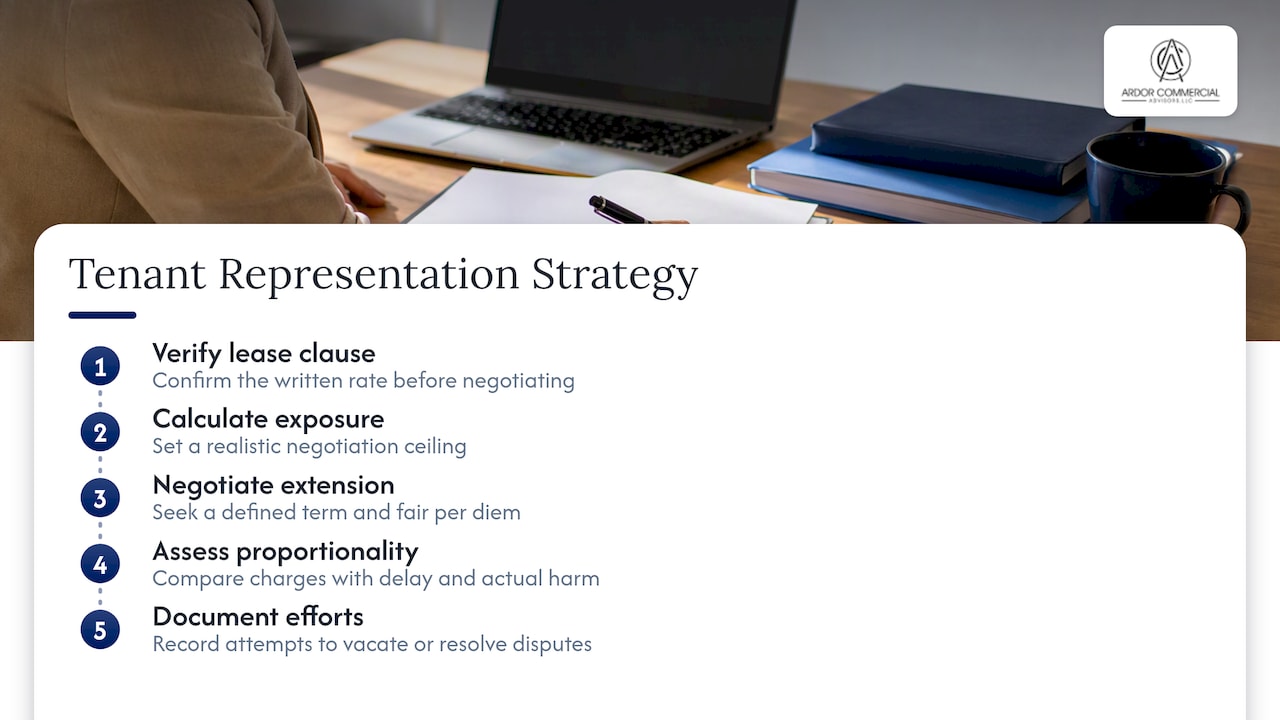
A tenant representative’s first move in a holdover dispute is usually to pull the lease and confirm exactly what the clause says before any negotiation starts, since landlords sometimes quote a holdover rate that does not match the actual contract language. Representatives then calculate the tenant’s realistic exposure under the clause as written, which gives the tenant a clear ceiling for negotiation rather than reacting to whatever number the landlord initially proposes.
From there, representation typically focuses on negotiating a short, defined extension at a fair per diem rate instead of letting the tenant drift into open-ended holdover exposure. Representatives also scrutinize any additional charges the landlord tries to multiply alongside base rent, since pass-through costs like CAM or utilities are frequently not meant to be included in a rent multiplier and courts have pushed back on that practice before.
When a landlord’s demand looks disproportionate to the actual delay, a tenant representative can raise the liquidated-damages-versus-penalty argument directly, backed by the lease’s own language and the timeline of the overstay. Early, documented communication from the tenant’s side, showing a good-faith effort to vacate or negotiate, also strengthens any later argument that a punitive multiplier should not apply.
Implications of holdover rent for CAM charges and reconciliation
Common area maintenance charges create one of the messier corners of a holdover dispute because CAM is a reimbursement for actual costs, not a profit-driven rent figure, and multiplying it the way base rent gets multiplied often does not hold up. The court decision on double-rent clauses discussed earlier drew exactly this line, allowing the landlord to double base rent while declining to let utility and pass-through charges be doubled in the same way.
Practically, this means landlords drafting holdover clauses should state explicitly whether CAM, taxes, and insurance reimbursements continue at the normal rate during holdover or whether some portion gets an adjustment, rather than leaving the multiplier’s scope ambiguous. Tenants reviewing a holdover bill should separate the base rent line from the CAM reconciliation line and confirm the landlord is not applying the rent multiplier to pass-through costs that were never meant to be multiplied.
Timing matters too. A holdover that spans a CAM reconciliation period can complicate the year-end true-up, since the reconciliation needs to account for actual costs incurred during the holdover window separately from the prior lease term’s figures. Clean recordkeeping on both sides avoids a dispute where the CAM reconciliation and the holdover rent calculation get tangled into one unclear number.
Tax considerations related to holdover rent payments
Holdover rent, whether collected under a contractual multiplier or as use and occupancy, is generally treated as ordinary rental income to the landlord in the year it is received, the same as any other rent payment. The multiplier itself does not change its character for tax purposes; a landlord collecting $9,000 in holdover rent reports that figure as income just as it would report base rent.
For tenants, holdover rent paid is typically deductible as an ordinary business expense, consistent with how base rent is treated, though a tenant disputing a holdover charge in litigation should track the timing of any settlement payment separately from routine rent for recordkeeping purposes. Where a dispute results in a negotiated reduction or refund, that adjustment affects the deduction in the year it is actually resolved rather than the year the original holdover occurred.
Owners and tenants navigating a holdover dispute that drags into a new tax year should loop in their accountant early, since the timing of payment, settlement, or write-off can shift which tax year the amount lands in. This is a general observation, not tax advice specific to any individual lease, and anyone facing a material holdover dispute should confirm treatment with a qualified tax professional before filing.
Common holdover patterns we see in office and medical leases
Medical and office tenants holding over almost never intend to breach their lease. Usually it is a buildout delay, a slow-moving landlord improvement, or a new space that is not quite ready, and they just need a week or two. The disputes that escalate are rarely about bad faith. They are about leases that never defined a per-diem rate or a short-extension path, so both sides end up arguing over a number neither can point to in writing.
The fix is almost always the same: negotiate explicit short-term extension language into the lease before signing, with a clear per diem figure, so a few extra days never becomes a legal fight.
— Jim
How we help with holdover clauses, lease review, and representation
Reading a holdover clause correctly, before it becomes a dispute, saves both landlords and tenants real money, and that is exactly where our lease review work starts. We pull the holdover language, renewal deadlines, and CAM terms into a single, plain-language summary so you know your exposure or your leverage well before the lease clock runs out.

For landlords managing office and medical buildings across the Charlotte MSA, our landlord representation team helps draft holdover clauses that hold up under the proportionality test courts apply, rather than language that looks tough on paper but collapses in a dispute. For tenants, our tenant representation advisors negotiate short extensions and fair per diem rates before a holdover becomes a legal bill. If you are staring down a lease expiration in the next few months, request a lease review to get the holdover language settled while you still have room to negotiate it.
FAQ
What happens when a commercial lease expires?
If the tenant vacates on the lease end date, nothing further is owed beyond final rent and any move-out obligations in the lease. If the tenant stays, the holdover clause controls the rent owed, and absent one, state law determines whether the stay becomes a month-to-month tenancy, a renewed term, or grounds for eviction.
What is the holding over period?
The holdover period is the span of time a tenant occupies a commercial space after the lease term has officially ended without a signed renewal. It can last a single day or extend for months if the landlord accepts rent or delays enforcement action, and the lease clause or state default law determines how rent accrues during that window.
What does it mean if a tenant is holding over?
A tenant holding over means they have not vacated by the lease expiration date and have not signed a new lease or renewal. Courts typically classify this as a tenancy at sufferance, meaning the landlord has not consented to the stay but also has not yet removed the tenant through eviction.
Who are the legal heirs of a deceased tenant?
Lease obligations generally pass to a deceased tenant’s estate, and the estate’s representative typically handles any remaining rent, holdover charges, or lease termination under the terms of the lease and applicable state probate law. Commercial leases often specify how a tenant’s death or dissolution is handled directly in the assignment or default sections of the agreement.
Can a landlord charge double rent during a holdover?
Yes, if the lease includes a clause specifying a doubled or multiplied rent rate for holdover, and courts have upheld such clauses when the amount reasonably relates to anticipated damages rather than acting as a pure penalty, as shown in a court ruling on a double-rent holdover clause. Without that clause, a landlord generally cannot demand a multiplier and instead pursues use and occupancy at fair market value.
Sources
- holdover tenant | Wex | US Law | LII
- Holdover tenant definition and effects — Investopedia
- LP v. LLC XYZ (2025) — court decision discussing enforceability of double-rent holdover clause