
Industrial leases generally fall into three frameworks: triple-net (NNN), gross (also called full-service), and modified gross. Under NNN, the tenant typically pays base rent plus property taxes, insurance, and common-area maintenance (CAM). Under a gross lease, the landlord absorbs those operating costs inside one rent figure. Modified gross splits the difference, usually through a negotiated base year or expense stop. The sections below break down each structure, the clauses that actually control your exposure, and how ASC 842 changes the accounting math for tenants.
TL;DR:
- Most industrial leases are structured as triple-net (NNN) or modified gross, with tenants often responsible for property taxes, insurance, and CAM, but actual liabilities depend on specific lease clauses.
- Absolute NNN leases push almost all costs onto tenants, including structural repairs and roof replacements, making lease language around capital expenses critical for cost control.
- Gross and modified gross leases transfer cost risks to tenants but provide budget certainty, with the latter involving a base year and expense caps that vary based on lease drafting.
- Lease clauses on permitted use, repair and capital expenditures, and audit rights significantly influence tenants’ true financial exposure, making detailed review essential before signing.
- ASC 842 now requires tenants to recognize lease liabilities on balance sheets for most leases over 12 months, with lease classification affecting financial ratios and underwriting considerations.
Table of Contents
- What Are the Main Industrial Lease Types?
- How Do Net Leases Divide Costs in Industrial Buildings?
- How Do Gross and Modified Gross Leases Work?
- Single-Tenant vs. Multi-Tenant Industrial Leases
- How Do You Calculate True Occupancy Cost Under CAM?
- Which Lease Clauses Actually Determine Your Liability?
- How Does ASC 842 Change Industrial Lease Accounting?
- What Red Flags Should You Watch for in an Industrial Lease?
- Why Lease Structure Drives Every Deal I Negotiate
- Get a Lease Reviewed Before You Sign
- Sources
- FAQ
What Are the Main Industrial Lease Types?
Every industrial lease boils down to how operating expenses get divided between landlord and tenant. The net lease family, gross leases, and modified gross structures cover the vast majority of warehouse, distribution, and light-manufacturing deals.
- Single net (N): Tenant pays base rent plus property taxes; landlord covers insurance and maintenance. Rare in industrial deals today.
- Double net (NN): Tenant pays taxes and insurance; landlord typically retains roof and structural maintenance.
- Triple net (NNN): Tenant pays taxes, insurance, and CAM on top of base rent. This is the dominant structure for single-tenant industrial buildings.
- Absolute NNN: Tenant assumes essentially all costs, including roof and structural repairs, turning the landlord into a passive capital investor.
- Gross/full-service: Landlord bundles taxes, insurance, and maintenance into one rent number. More common in multi-tenant industrial parks with shared systems.
- Modified gross: A negotiated middle ground, often built around a base year or expense stop, where the tenant pays increases above a set benchmark.
Percentage leases and ground leases show up occasionally in industrial contexts, usually for build-to-suit distribution centers or last-mile facilities on ground-leased parcels, but they remain the exception rather than the rule.
How Do Net Leases Divide Costs in Industrial Buildings?
A “NNN” label tells you almost nothing about your actual annual cost until you read the expense definitions inside the lease. Triple-net leases typically pass through property taxes, building insurance, and CAM to the tenant, but many industrial NNN leases go further, layering in management fees and capital reserve contributions as additional pass-throughs.
Expense categories that commonly land on the tenant’s side of the ledger include:
- Real property taxes and any special assessments
- Building and liability insurance premiums
- CAM items: landscaping, parking lot repair, snow removal, security
- Utilities for common areas and shared systems
- Landlord management fees, often 2% to 5% of gross rent
- Capital reserve contributions for future roof or paving replacement
Absolute NNN leases push further still. In a single-tenant warehouse deal, the tenant may be contractually on the hook for roof replacement, structural repairs, and even parking lot reconstruction. Industrial landlords favor this structure specifically because it turns the property into a bond-like investment with minimal operating responsibility, shifting lifecycle capital expenditures entirely onto the tenant.
Pro Tip: Never accept a CAM clause that references “capital improvements” without a dollar cap or an amortization schedule. Push for language that defines exactly what counts as a capital expense versus routine repair, and negotiate audit rights so you can verify landlord charges annually.
The real negotiation happens in the exclusions list. Ask for caps on annual CAM increases, carve-outs for landlord negligence, and explicit language excluding capital replacements from your reimbursement obligation. Practitioners consistently caution that lease labels are just starting points since the actual definitions of CAM, capital expenditures, and management fees inside the document determine what you owe. For a deeper walkthrough of NNN mechanics and typical exposure points, Ardorcre’s triple net lease guide covers the clause-level detail that separates a fair deal from an expensive surprise.
How Do Gross and Modified Gross Leases Work?
Gross leases flip the risk allocation. The landlord quotes one rent figure, absorbs taxes, insurance, and maintenance, and prices that risk into the rate. Tenants get budget certainty. Landlords take on the risk that operating costs rise faster than anticipated, which is one reason full gross leases are less common in industrial settings than in office buildings.
Modified gross leases split the difference, and they show up frequently in multi-tenant industrial parks. The standard mechanism is a base year or expense stop:
- The landlord sets a benchmark year (or a fixed dollar figure per square foot) covering operating costs.
- The tenant pays base rent plus their share of any increase above that benchmark in future years.
- Billing typically happens through estimated monthly payments with an annual reconciliation, similar to NNN but capped at a starting point rather than dollar one.
These arrangements are negotiated hybrids, and their actual liability depends entirely on how the base year and expense stop are drafted, not on the generic label attached to the lease. Tenants with tight capital budgets or thin margins often push for modified gross specifically because it caps their downside while still giving landlords some inflation protection. Ardorcre’s breakdown of must-have clauses in a modified gross lease walks through the drafting language that determines whether your base year actually protects you.
Single-Tenant vs. Multi-Tenant Industrial Leases
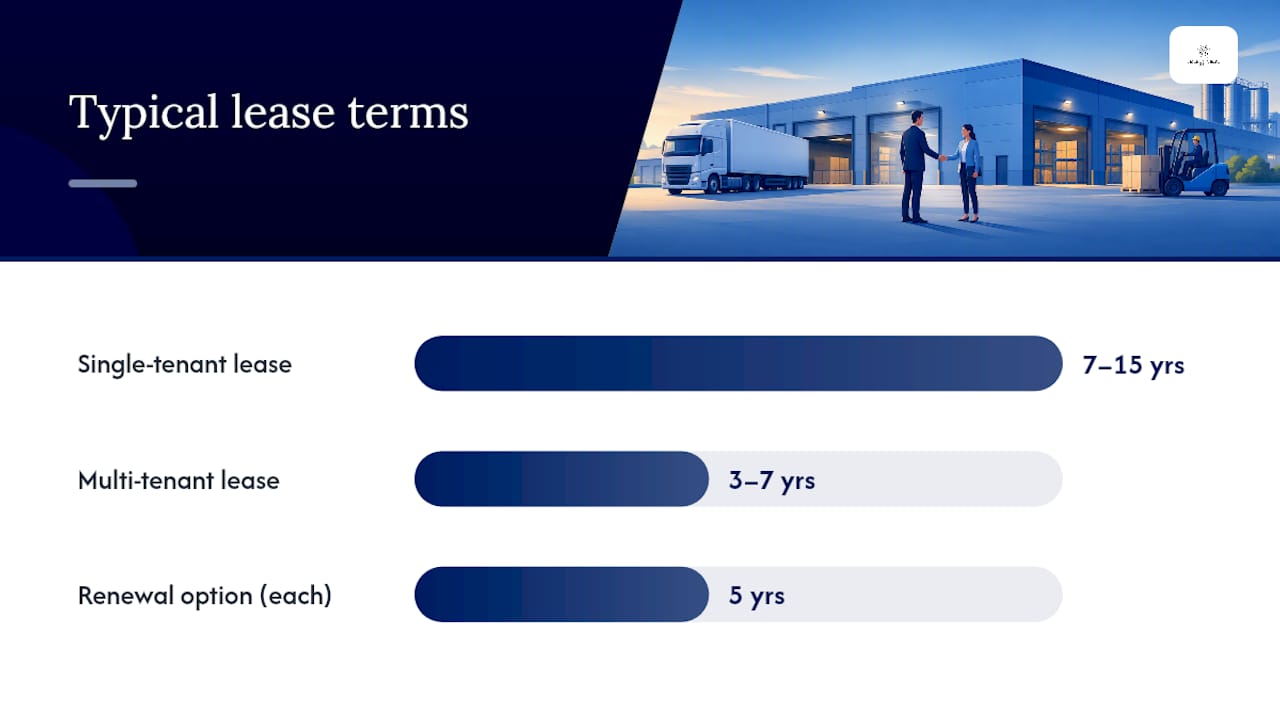
Building size and tenant count drive lease structure more than almost any other factor. Single-tenant industrial buildings, especially large distribution centers, gravitate toward absolute NNN because the landlord has no shared systems to manage and no reason to retain operating risk.
Multi-tenant industrial buildings work differently. Shared loading areas, common utilities, and joint parking make a clean NNN split harder to administer, so landlords more often use modified gross or modified NNN structures, keeping structural responsibility on their own side of the ledger.
- Single-tenant terms: Often 7 to 15 years, sometimes longer for build-to-suit facilities, with tenant-funded TI amortized into rent.
- Multi-tenant terms: Typically 3 to 7 years with renewal options, reflecting higher turnover and smaller footprints.
- TI allowances: Vary widely by market and tenant credit, but longer terms generally justify larger allowances since the landlord amortizes the cost over more years of rent.
- Renewal options: Common structures include one or two five-year options at fair market value or a fixed escalation formula agreed upfront.
Longer terms give tenants leverage to negotiate bigger improvement packages, since the landlord recovers that investment over a longer rent stream. For a detailed look at structuring those allowances so you don’t end up funding a shortfall out of pocket, see Ardorcre’s tenant improvement allowance playbook.
How Do You Calculate True Occupancy Cost Under CAM?
Base rent per square foot is only the starting point; to understand all potential expenses, business owners should consider commercial move cost factors explained which impact total occupancy costs. CAM turns a clean number into a moving target, and reconciliation is where most tenant disputes actually start.
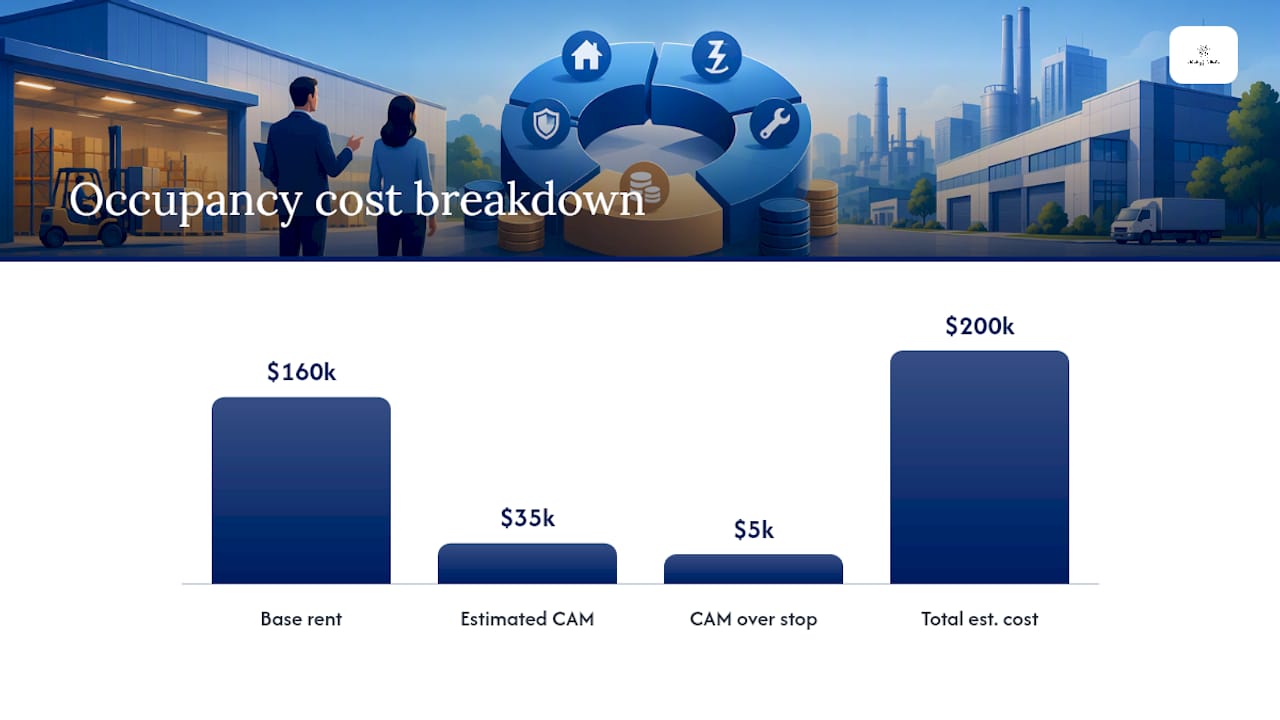
CAM typically includes landscaping, parking lot maintenance, common-area utilities, security, and property management, though the exact list varies lease by lease. Here’s a simplified worked example for a 20,000 square foot industrial space:
- Base rent: $8.00 per square foot annually = $160,000
- Estimated CAM: $1.75 per square foot = $35,000
- Base year expense stop set at $1.50 per square foot (modified gross structure)
- Tenant’s actual exposure above stop: $0.25 per square foot = $5,000
- Total estimated annual occupancy cost: $200,000, subject to year-end reconciliation
Landlords typically reconcile CAM annually, comparing estimated payments against actual costs and either billing the tenant for a shortfall or issuing a credit for overpayment. This is exactly where audit rights matter.
Pro Tip: Before signing, ask the landlord for the trailing three years of CAM statements for the building. A pattern of large “catch-up” reconciliations is a warning sign that estimated payments are being set artificially low to make the deal look cheaper upfront.
During underwriting, request the CAM ledger, the most recent property tax bill, the insurance certificate showing coverage limits, and any capital reserve study. Ardorcre’s CAM reconciliation and lease review service exists specifically to catch discrepancies before they turn into a six-figure surprise at renewal.
Which Lease Clauses Actually Determine Your Liability?
The lease type sets the framework, but individual clauses determine the dollar amount you actually pay. A handful of provisions deserve line-by-line attention before you sign anything.
- Permitted use: Should describe your specific operations (assembly, distribution, light manufacturing) rather than generic language, since vague permitted-use clauses create default risk if zoning or environmental rules shift.
- Repair vs. capital expenditure: Draft explicit definitions distinguishing routine repairs (tenant’s responsibility under NNN) from capital replacements (often negotiable or landlord-funded even in triple-net deals).
- TI scope and approval: Spell out what improvements qualify, who approves plans, and how allowances get disbursed, whether as reimbursement or direct payment to contractors.
- Assignment and subleasing: Look for reasonable consent standards rather than sole-discretion landlord approval, especially if your business might relocate or downsize before the term ends.
- Insurance and indemnity: Confirm coverage minimums match your actual risk profile, particularly for light-manufacturing tenants handling materials with higher liability exposure.
Public lease filings offer a useful model for what a well-documented industrial lease actually contains. One SEC-filed industrial lease exhibit shows how initial term, lease-year definitions, and commencement procedures typically get spelled out, which is a good template for reviewing your own commencement mechanics. If you’re considering an early exit down the road, Ardorcre’s guide on ending a commercial lease early covers notice periods and termination costs worth negotiating upfront rather than discovering later.
How Does ASC 842 Change Industrial Lease Accounting?
ASC 842 requires lessees to recognize most leases longer than 12 months on the balance sheet as a right-of-use asset and a corresponding lease liability. Leases that used to sit in footnotes now show up as real liabilities affecting leverage ratios.
Whether a lease gets classified as a finance lease or an operating lease hinges on five criteria: ownership transfer at lease end, a bargain purchase option, lease term covering a major part of the asset’s remaining life, present value of payments approximating the asset’s fair value, and whether the asset is so specialized it has no alternative use to the landlord.
- Finance lease classification generally means front-loaded interest expense and a larger balance sheet impact early in the term.
- Operating lease classification still creates an ROU asset and liability, but the expense pattern is typically straight-line.
- Lease structure and term length directly affect DSCR calculations, since lenders now factor the recognized lease liability into leverage and coverage ratio underwriting.
- Modeling lease payments, ROU amortization, and interest expense properly is essential before submitting to a lender, since these entries feed directly into coverage ratio math.
Getting this modeling right before a refinance or acquisition matters more than most tenants realize. Ardorcre’s lease abstraction service pulls the key financial terms out of a lease document specifically to feed into this kind of DSCR and underwriting analysis.
What Red Flags Should You Watch for in an Industrial Lease?
A few patterns show up again and again in problem leases, and they’re worth checking for before you sign anything.
- Vague CAM definitions that don’t list specific inclusions or exclusions
- Open-ended capital expenditure language with no dollar cap or amortization schedule
- Permitted-use clauses too generic to reflect your actual operations
- No audit rights on annual CAM or operating expense reconciliations
- Estoppel and cure-period language that favors the landlord in an acquisition scenario
Pro Tip: If a landlord resists giving you audit rights on CAM statements, treat that as a signal rather than a formality. Reasonable landlords rarely object to a tenant verifying its own bill.
Investors underwriting an acquisition should also confirm lease commencement mechanics and estoppel handling match what’s represented in the rent roll. When any of this gets murky, that’s the point to call in a CAM reconciliation review before closing.
Why Lease Structure Drives Every Deal I Negotiate
Lease structure isn’t paperwork. It’s the mechanism that decides who eats a roof replacement, who absorbs a tax reassessment, and whether your DSCR still pencils after a refinance. I’ve watched tenants sign what looked like a straightforward NNN deal and discover two years later they’d agreed to fund a $200,000 parking lot reconstruction because the capital expenditure exclusion was never negotiated.
The gap between what a lease label promises and what the clauses actually say is where deals get won or lost. Clients can get advisement through exactly that risk allocation, whether that means pushing back on a CAM definition or modeling how a lease liability hits DSCR under ASC 842. Read the definitions before you read the rent number.
— Jim
Get a Lease Reviewed Before You Sign
Reading a 40-page industrial lease against ASC 842 definitions and capital expenditure exclusions is not a side project. A brokerage team reviews industrial lease agreements regularly, and that repetition is exactly what catches a vague CAM clause or an uncapped capital exposure before you’re locked into it for a decade.
If you’re weighing an industrial space right now, Ardorcre offers lease review and CAM reconciliation analysis to pressure-test the numbers before you sign, along with tenant representation for negotiating the terms that actually matter. Landlords and investors get the same scrutiny in reverse, from lease abstraction to full commercial real estate advisory services covering leasing, sales, and property management across office, medical, retail, and industrial assets. Reach out to schedule a lease review before your next renewal or acquisition deadline.
Sources
- Who pays for what? Understanding key differences in triple net, gross and modified gross commercial leases – Holland & Knight
- ASC 842 complete guide – iLeasePro
- Industrial lease agreement exhibit (SEC filing) – FAMI Exhibit
FAQ
What Are the Four Types of Commercial Leases?
The four most commonly cited types are single net (N), double net (NN), triple net (NNN), and gross/full-service leases. Modified gross is sometimes counted as a fifth category, since it’s technically a hybrid built around a negotiated base year rather than a standalone structure.
What Are the Four Main Types of Leases?
In industrial real estate, the four main frameworks are net leases (N, NN, NNN, and absolute NNN), gross leases, modified gross leases, and, less commonly, ground or percentage leases for specialized build-to-suit deals. Each determines a different split of taxes, insurance, and maintenance between landlord and tenant.
What Are Typical Industrial Lease Terms?
Single-tenant industrial leases often run 7 to 15 years, sometimes longer for large build-to-suit distribution centers, while multi-tenant industrial space typically runs 3 to 7 years with renewal options. Longer terms generally support larger tenant improvement allowances since landlords amortize that cost over more years of rent.
What Are the Five Lease Classification Tests Under ASC 842?
The five criteria that determine finance lease classification are: whether ownership transfers at lease end, whether there’s a bargain purchase option, whether the lease term covers a major part of the asset’s remaining economic life, whether the present value of payments approximates the asset’s fair value, and whether the asset is so specialized it has no alternative use to the landlord. Meeting any one of these typically triggers finance lease treatment under ASC 842.
Who Typically Pays CAM Charges in an Industrial Lease?
Under triple-net structures, the tenant typically pays CAM charges directly as a pass-through on top of base rent. Under modified gross leases, the tenant usually pays only the increase above an agreed base year or expense stop, with Ardorcre’s CAM reconciliation service available to verify those charges before you sign or renew.