
A CPI rent increase clause raises rent by the change in a named Consumer Price Index over a set period, rather than by a flat percentage. Before you sign anything, name the exact index and measurement month, add a cap or collar if you need predictable budgeting, and run high-inflation and deflation scenarios through your model. Then get a real estate attorney to review the final language, because ambiguous compounding wording is where most disputes start.
TL;DR:
- Using a specific CPI series like CPI-U for the relevant metro area and including a lookback period ensures accurate rent adjustments aligned with published data.
- Caps, floors, and collars protect both tenants and landlords from unpredictable rent swings, but with different implications for long-term growth and risk.
- The choice between base-year and compounding methods significantly impacts rent trajectories over a lease term, with compounding often resulting in higher totals.
- Precise and comprehensive lease language, including escalation variables, caps, and substitution clauses, is essential to prevent costly disputes later.
- Running stress tests for high inflation, deflation, and catch-up scenarios allows tenants and landlords to assess real exposure to inflation risks before signing.
Table of Contents
- How Does a CPI Rent Increase Clause Actually Work?
- What Do Caps, Floors, and Collars Actually Protect?
- Base-Year Versus Compounding: How Much Does the Method Change Your Rent?
- What Belongs in a CPI Clause Before You Sign?
- How Do You Stress-Test a CPI Clause Before Signing?
- What Notice and Recordkeeping Rules Keep the Clause Enforceable?
- What Do CPI Rent Increases Mean for Lease Budgeting?
- How Does CPI Compare to Fixed Increases and Market Rent Reviews?
- Ardor CRE’s Perspective: Choosing the Right Clause for Office and Medical Tenants
- Get Your CPI Clause Reviewed Before You Sign
- Where to Verify CPI Figures and Drafting Language
- Sources
- FAQ
How Does a CPI Rent Increase Clause Actually Work?
Every CPI clause starts with two numbers: the base rent and the base index value, both locked in on the lease’s commencement date or a stated anniversary. When the adjustment date arrives, you compare the current published index to that base value, and the percentage change becomes your rent bump.
The index choice matters more than most landlords realize. The Bureau of Labor Statistics publishes several CPI series, and vague lease language (“the CPI”) invites arguments over which one applies. Name it specifically, such as CPI-U for the relevant metro area, or the national CPI-U if the property sits outside a major statistical area. The BLS itself recommends using the unadjusted series in contracts, since seasonally adjusted figures get revised for up to five years after first publication, while unadjusted numbers are final the day they post.
Publication lag is the other trap. BLS data typically posts 10 to 14 days after month end, so your lease needs a lookback, such as “the CPI-U for the month two months prior to the adjustment date.”
The math itself is simple:
- Take the current index value.
- Subtract the base index value.
- Divide by the base index value.
- Multiply by 100 for the percentage change.
- Apply that percentage to the base rent (or prior year’s rent, depending on your compounding method).
A base rent of $30 per square foot with a base index of 300 and a current index of 315 produces a 5% increase, pushing rent to $31.50.
What Do Caps, Floors, and Collars Actually Protect?
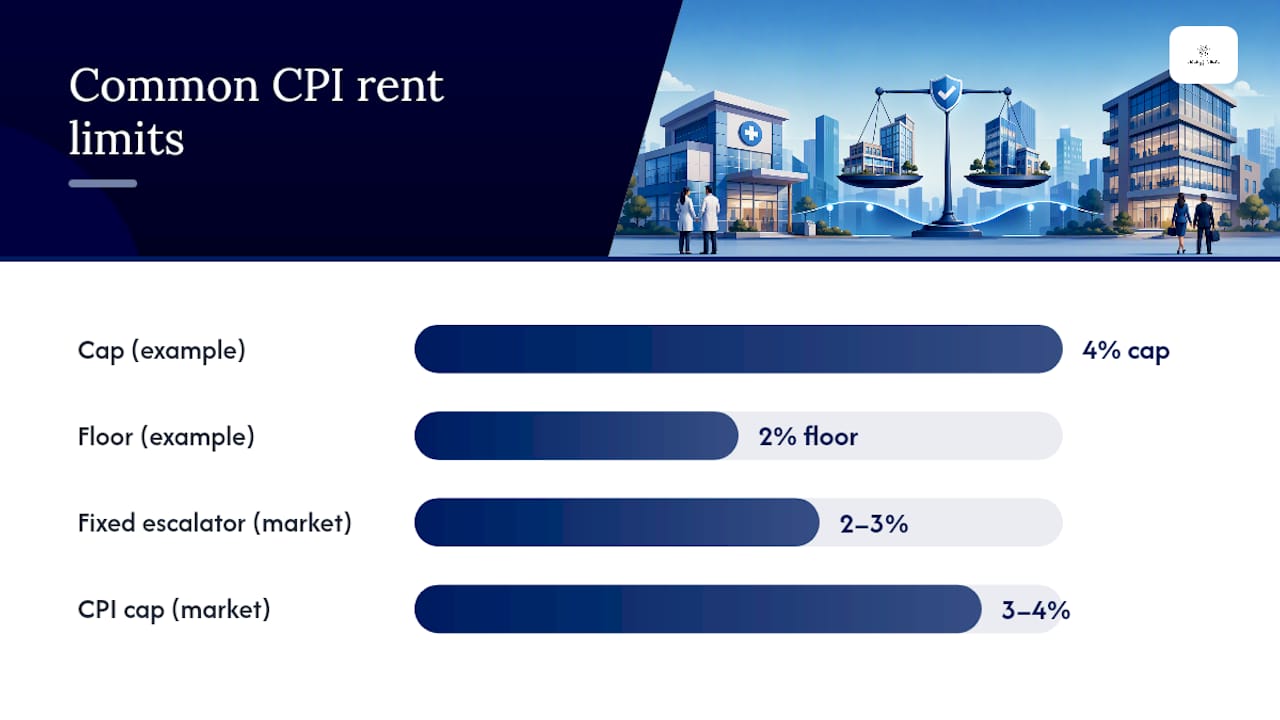
A cap limits how high your annual increase can go regardless of what CPI does; a floor guarantees a minimum increase even if CPI barely moves or turns negative; a collar combines both into a band. These three mechanisms exist because raw CPI rent increases can swing wildly, and each side wants protection from the tail risk that favors the other party.
- A 4% cap on a lease with 7% actual CPI growth caps the tenant’s exposure at 4%, leaving 3% unrecovered by the landlord that year.
- A 2% floor protects a landlord’s income during a low-inflation or deflationary stretch when CPI growth might land at 0.5% or less.
- A collar of 2% to 5% gives both sides a predictable range without eliminating the index link entirely.
The cumulative question is where deals get complicated. A cumulative, or banked, cap lets a landlord carry forward the portion of CPI growth that exceeded the cap in prior years, then apply it in a later period when there’s room under the ceiling. Banked caps protect landlord income over the long run but can hit tenants with a sudden multi-year catch-up spike. Tenants should push for non-cumulative caps whenever leverage allows.
Market practice generally lands fixed escalators around 2% to 3%, with CPI caps often negotiated into a similar 3% to 4% range when tenants want the inflation link but not the full exposure.
Pro Tip: Watch for “whichever is greater” language pairing a fixed floor with an uncapped CPI ceiling. That structure guarantees the landlord a minimum increase every year and still leaves the tenant exposed to a runaway inflation spike, with no ceiling working in their favor.
Base-Year Versus Compounding: How Much Does the Method Change Your Rent?
The method you choose changes the math dramatically over a 5 to 10 year term, even when the underlying CPI numbers are identical. Three approaches show up in commercial leases, and they produce very different rent trajectories.
Base-year (non-compounding): Every adjustment measures the current index against the original base index, not the prior year’s adjusted rent. Increases can plateau or even fall relative to the prior year if CPI growth slows.
Compounding: Each year’s increase applies to the previous year’s already-adjusted rent, not the original base. This is how mortgage-style compound growth works, and it accelerates rent faster than base-year math even at identical CPI rates.
Ambiguous or double-compounding: Poorly drafted clauses that don’t specify whether the increase applies to “base rent” or “then-current rent” can be read either way, and that ambiguity has produced disputes over dramatically inflated rent figures in long-term leases.
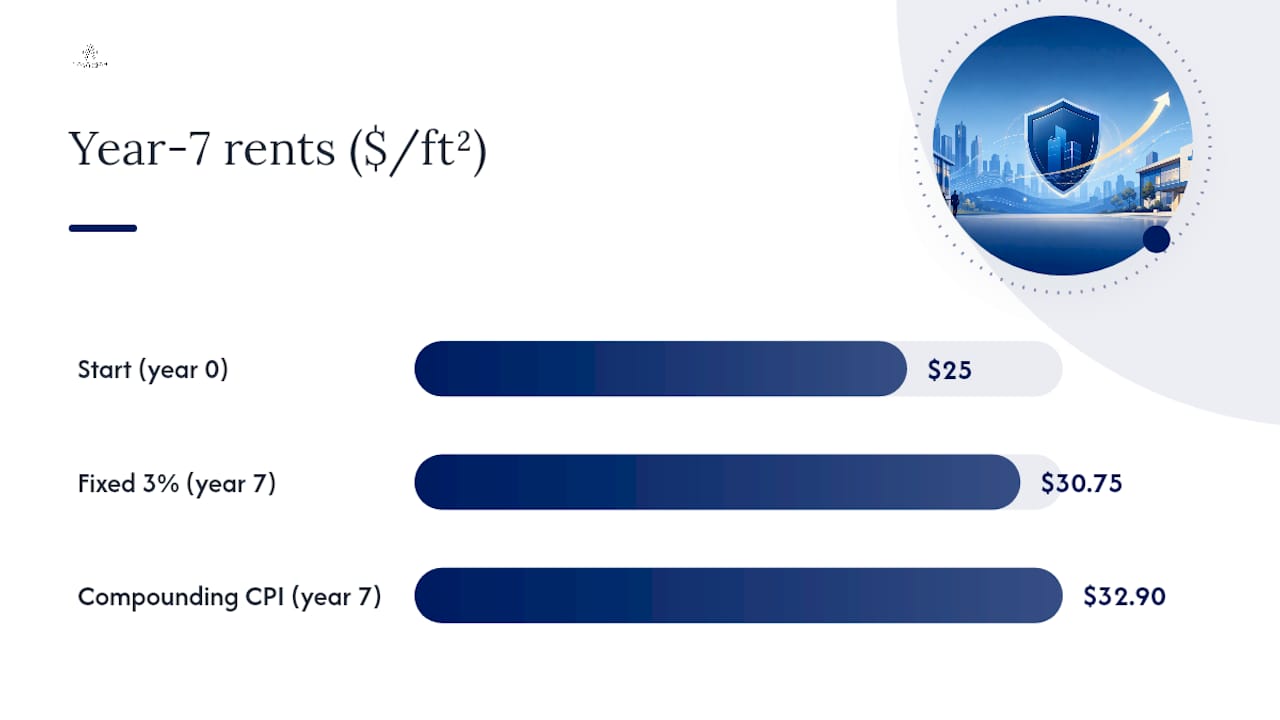
Here’s the comparison over a 7 year term at a starting rent of $25 per square foot, assuming 4% annual CPI growth:
- Fixed 3% step escalator: rent reaches roughly $30.75 by year seven, growing at a known, steady rate.
- Base-year CPI (non-compounding, applied to original base each year): rent tracks close to the fixed escalator most years but resets its comparison point annually.
- Compounding CPI applied to prior-year rent: rent reaches roughly $32.90, nearly 7% higher than the fixed escalator, purely from the compounding mechanic.
Combine compounding with a banked cap and the tenant’s year-eight rent jump can dwarf anything a fixed escalator would have produced.
What Belongs in a CPI Clause Before You Sign?
A defensible CPI clause names every variable instead of leaving room for interpretation. LegalClarity’s drafting guidance is blunt about this: ambiguity in any single element creates leverage for a dispute later, and that leverage almost always favors whichever party has better counsel when the argument starts.
Your clause checklist should specify:
- The exact CPI series and BLS code (for example, CPI-U, not-seasonally-adjusted, for the relevant metro area)
- Geographic scope: metro area index versus the national U.S. average
- The base index month and the measurement period each year
- The lookback window, typically one to two months, to account for publication lag
- Whether increases compound on prior rent or reset to the original base
- Cap and floor values, and whether the cap is cumulative or non-cumulative
- A substitution clause naming a successor index if the named series is discontinued or rebased
- Whether CPI escalations apply to base rent only, or also touch triple net charges
On negotiation tactics: tenants who want predictable budgeting should push for a fixed 2% to 3% escalator instead of pure CPI exposure, or at minimum a CPI clause capped in the 3% to 4% range. Landlords in strong markets can hold out for higher caps or reasonable floors that guarantee income during low-inflation years. For medical office leases specifically, where tenant revenue growth often can’t keep pace with a sudden rent jump, bring in counsel and a broker who has negotiated healthcare leases before signing anything. Reviewing your lease terms around a letter of credit alongside your escalation clause is worth doing at the same stage, since both affect your risk exposure if a tenant runs into trouble.
How Do You Stress-Test a CPI Clause Before Signing?
Run at least four scenarios before committing to any CPI structure, because lease structure determines how well the property actually holds up as an inflation hedge, and that only shows up when you model extremes, not averages.
- Baseline: 2% to 3% annual CPI growth, matching a normal decade.
- High inflation: 5% to 9% annual CPI growth, matching the 2021 to 2023 stretch when CPI spiked above 8% while many fixed escalators sat frozen at 2% to 3%.
- Deflation or stagnation: near-zero or negative CPI growth, testing whether your floor actually protects income.
- Banking-triggered catch-up: a low-growth stretch followed by a spike, testing what a cumulative cap dumps on the tenant in one adjustment.
Build your spreadsheet with columns for year, CPI rate, escalation percentage applied, resulting rent, cumulative rent paid, and present value of that rent stream discounted at your target rate. Track annual rent growth, cumulative rent over the full term, and present value impact on the deal. If the asset is leveraged, add a DSCR sensitivity column, since a high-inflation scenario that spikes rent might also strain a tenant’s ability to pay, which flows straight into your debt coverage. A DSCR sizing model built around these stress scenarios gives you a clearer read than a single baseline projection ever will.
What Notice and Recordkeeping Rules Keep the Clause Enforceable?
The math is only half the job. Timing and documentation determine whether your escalation actually holds up if challenged.
- Set your adjustment date with a built-in lookback, typically referencing the CPI figure published one to two months earlier, since BLS data posts with a lag after each month closes.
- Send a formal escalation notice every year with the calculation shown, including the base index, current index, and resulting rent, not just the new dollar figure.
- Treat a missed or late notice as a real risk. Courts and arbitrators have found that failure to send timely notice can amount to a waiver of that year’s increase.
- Write a substitution clause naming a successor index in advance, so a discontinued or rebased CPI series doesn’t force a renegotiation.
- Keep a running file of every notice sent, every calculation worksheet, and every tenant acknowledgment for the life of the lease.
What Do CPI Rent Increases Mean for Lease Budgeting?
A CPI clause turns your occupancy cost into a variable, not a constant, and that changes how tenants should build their multi-year budgets. A tenant with a five-year lease and a 4% cap should model rent at the cap in every high-inflation year, not the historical average, because assuming CPI will stay near 2% is exactly the mistake that caught tenants off guard during 2021 through 2023.
For medical office tenants, this matters even more because practice revenue rarely grows in lockstep with inflation. A physical therapy or dental practice can’t simply raise patient fees the way a retailer adjusts prices, so a rent line that jumps 6% or 7% in a single year eats directly into margin. Budgeting for the worst realistic case, not the expected case, protects against a cash crunch two or three years into a term.
Landlords face the mirror image. A capped or floored CPI clause smooths income for underwriting purposes, which matters when you’re pricing the asset for sale or working with a lender on refinancing. An owner deciding whether to sell or refinance a CMBS loan needs projected rent growth that a lender will actually underwrite, and an uncapped CPI clause with unpredictable swings makes that projection harder to defend. Multi-tenant buildings with staggered CPI clauses across different tenants add another layer of complexity, since NOI in any given year depends on which leases happen to hit their adjustment date during a high-inflation stretch.
How Does CPI Compare to Fixed Increases and Market Rent Reviews?
Three escalation methods dominate commercial leasing, and each shifts risk differently between landlord and tenant.
The landlord knows exactly what next year’s rent will be, and the tenant can budget years in advance. The tradeoff: during high-inflation stretches, fixed escalators lag real CPI growth badly, as landlords locked into 2021 and 2022 leases discovered when actual inflation ran well above their contractual bump.
CPI-based escalations track actual purchasing power loss, which protects landlord income during inflationary periods but exposes tenants to volatility. Adding a cap turns this into a hybrid: inflation protection with a ceiling on tenant exposure.
Market rent reviews, common in longer industrial and retail ground leases, reset rent to prevailing market rates at set intervals, often every five years. This method captures market appreciation that CPI might miss entirely (a hot submarket can outpace CPI by a wide margin) but it introduces appraisal disputes and requires arbitration language for when landlord and tenant can’t agree on market value.
For most office and medical leases under 10 years, a capped CPI clause splits the difference: better inflation protection than a fixed escalator, less volatility and dispute risk than a full market reset.
Ardor CRE’s Perspective: Choosing the Right Clause for Office and Medical Tenants
Office tenants with stronger negotiating leverage can sometimes accept a wider band in exchange for a longer term or below-market base rent. Either way, start modeling 12 to 18 months before a major lease decision, and bring your broker and attorney in early rather than after terms are already on paper. Our medical office leasing guidance covers timing and TI negotiation alongside escalation structure, since the two decisions affect each other more than most tenants realize.
— Jim
Get Your CPI Clause Reviewed Before You Sign
Reviewing lease language closely is critical, as a CPI clause with vague compounding wording or an uncapped index is the kind of detail that can result in significant costs over a long-term lease if unnoticed. We build lease abstracts that pull every escalation variable, cap, and substitution provision into one document, then run the scenario modeling, baseline, high-inflation, and banking catch-up, so you know your real exposure before you negotiate. Whether you’re a medical practice weighing a capped CPI clause against a fixed escalator, or a landlord deciding between selling and refinancing a building with CMBS debt coming due, that modeling changes the decision.
Our lease abstract service turns dense lease language into a clause-by-clause breakdown with redline suggestions, built specifically for office and medical deals in the Charlotte MSA. If you’re weighing whether to lease or buy as a medical professional, or considering a multi-tenant building purchase, that same abstract and modeling process applies. Reach out to get your current lease or a pending offer reviewed before your next signature.
Where to Verify CPI Figures and Drafting Language
Check current index values directly at the Bureau of Labor Statistics CPI database rather than relying on a secondhand figure in a lease proposal. The BLS’s own guide on writing escalation contracts walks through series selection and lookback timing in more technical detail than most lease templates cover, and it’s worth reading before your attorney finalizes clause language.
This article is general information, not a substitute for advice from a qualified financial advisor. Consult a qualified financial professional about your own circumstances before acting on anything here.
Sources
- U.S. Bureau of Labor Statistics — Consumer Price Index
- LegalClarity — Lease escalation clause types, caps and calculations
- Altus Group — CRE as an inflation hedge: How lease structure protects income
FAQ
What Is a CPI Rent Increase Clause?
It’s a lease provision that ties annual rent adjustments to the change in a named Consumer Price Index, such as CPI-U, over a defined measurement period, instead of using a flat percentage.
Which CPI Series Should a Commercial Lease Reference?
Most drafting guidance recommends naming the unadjusted CPI-U for the relevant metro area, since seasonally adjusted figures get revised for years after initial publication.
What’s the Difference Between a Cap and a Floor?
A cap limits how high your rent increase can go in a given year, while a floor guarantees a minimum increase even during low-inflation years; a collar combines both into one band.
Should Tenants Prefer Fixed Increases or CPI Clauses?
Tenants who need predictable budgeting generally prefer a fixed 2% to 3% escalator or a CPI clause capped around 3% to 4%, especially in medical office settings where revenue growth is constrained.
How Can Ardor CRE Help With a CPI Clause Negotiation?
Specialized services can provide lease abstract, scenario modeling, and tenant or landlord representation that translate CPI clause language into projected cash-flow outcomes before you sign or renew.