
Charlotte’s industrial market is tightening fast. Demand is outpacing new supply, vacancy is falling, and broker Q2 2026 reports from Avison Young, JLL, and Cushman & Wakefield all point in the same direction: the window for favorable lease terms is closing. Ardorcre’s local projection shows projected absorption of roughly 8 million sq ft against only about 4 million sq ft currently under construction, a gap that signals undersupply within 18–24 months. If you are an investor or tenant, the move is to accelerate site selection, lock in pre-leases where possible, and revisit underwriting assumptions before the next round of rent resets.
Table of Contents
- How the Charlotte industrial market looks right now
- Where bulk space actually exists today
- Who is leasing and what sectors are driving demand
- What the construction pipeline actually means for supply
- What the next 12–24 months look like
- Practical steps for investors and tenants right now
- How Charlotte’s industrial market got here
- How Charlotte compares to peer Southeastern markets
- How macroeconomic conditions are shaping Charlotte industrial real estate
- Which industrial subtypes are performing best
- Who owns Charlotte’s industrial properties
- How zoning and regulations affect industrial development in Charlotte
- Key Takeaways
- What the data is telling us about Charlotte’s industrial trajectory
- Ardorcre knows Charlotte industrial from the inside out
How the Charlotte industrial market looks right now
The table below pulls Q2 2026 headline metrics from Avison Young, JLL, and Cushman & Wakefield MarketBeat reports. Where broker figures converge, the consensus figure is shown; where they diverge, the range is noted.

| Metric | Q2 2026 Reading | QOQ Movement | YOY Movement | Primary Source |
|---|---|---|---|---|
| Vacancy rate | Moderating; below recent cycle peak | Declining | Declining | Avison Young / JLL |
| Net absorption (sq ft) | Positive; mid-box and infill leading | Improving | Positive trend | JLL / Cushman & Wakefield |
| Total availability | Tightening across most submarkets | Decreasing | Decreasing | Cushman & Wakefield MarketBeat |
| Bulk availability (≥100k sf) | Limited; concentrated in outer corridors | Stable to declining | Declining | Avison Young |
| Under construction (sq ft) | ~4 million sq ft | Flat to modest growth | Below absorption pace | Link Logistics projection |
| Deliveries | Phased; near-term pipeline thin | Moderate | Below demand | JLL |
| Average asking rent | Rising; infill commanding premium | Up QOQ | Up YOY | Cushman & Wakefield |
| Rent growth | Accelerating in infill; moderate in big-box | Positive | Positive | Avison Young / JLL |
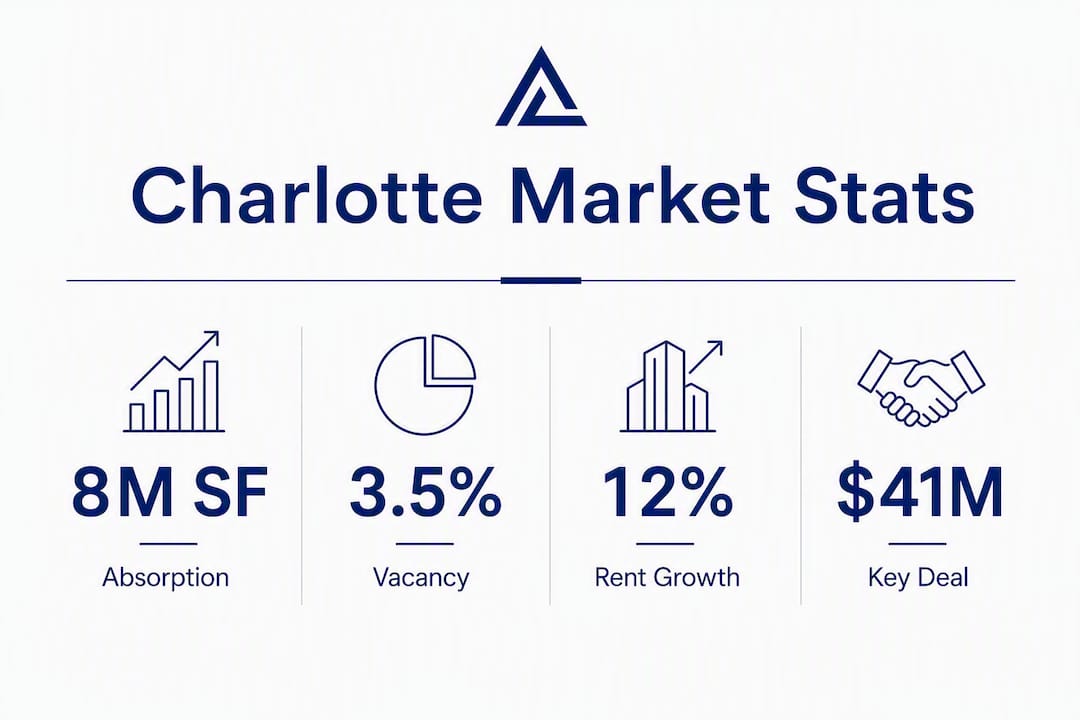
Sources: Avison Young Charlotte Industrial Market Report; JLL Charlotte Industrial Market Dynamics Q2 2026; Cushman & Wakefield MarketBeat Charlotte Industrial Q2 2026; Link Logistics industry projection.
The clearest story in the table is the absorption-to-construction gap. Rents are rising fastest in infill locations inside the MSA, where service-oriented users (HVAC contractors, parts distributors, last-mile carriers) need short drive times and cannot substitute outer-ring big-box space. Outer corridors still hold most of the remaining bulk product, but even that inventory is shrinking quarter over quarter.
Charlotte’s population and labor growth continue to feed consumer-goods and distribution demand, which keeps absorption elevated even when broader economic signals are mixed.
Where bulk space actually exists today
Bulk availability of 200,000 sq ft or more is concentrated in a handful of outer submarkets. Smaller mid-box product (50,000–150,000 sq ft) is spread more broadly but is leasing quickly.
Submarket breakdown by product size:
- North Charlotte / I-77 corridor: Retains some big-box options; historically strong for regional distribution given direct interstate access to I-77 north toward Virginia.
- East Charlotte / Monroe Road corridor: Mid-box inventory; popular with manufacturing relocations and regional 3PL operators.
- I-85 corridor (Concord / Kannapolis): The deepest remaining bulk supply. Large-format users still have options here, but the pipeline is thin and entitlement timelines are lengthening.
- Fort Mill / York County, SC: Cross-border submarket that captures Charlotte MSA demand with South Carolina tax incentives; bulk product exists but is being absorbed by e-commerce and automotive suppliers.
- Infill pockets (inside I-485): Virtually no large blocks remain. Small service-bay and flex-industrial product commands the highest per-square-foot rents in the MSA.
For tenants needing 100,000 sq ft or more, the I-85 corridor and Fort Mill are the realistic options today. Infill is effectively a sub-50,000 sq ft market at this point.
Pro Tip: If you need bulk space within 18 months, engage owner representatives now rather than waiting for a formal RFP process. In a tightening market, pre-lease conversations with developers who have shovel-ready pads move faster than open-market searches, and you can often negotiate expansion rights into the initial term before competing tenants enter the picture.
Who is leasing and what sectors are driving demand
Three demand categories are doing most of the work in Charlotte’s industrial leasing market right now: e-commerce fulfillment, regional manufacturing, and third-party logistics (3PL) operators.
E-commerce fulfillment users are pushing hardest into the I-85 corridor and Fort Mill, where large floor plates and trailer parking ratios support high-velocity sortation. Regional manufacturers, particularly automotive-adjacent suppliers and food-and-beverage processors, are relocating from higher-cost Northeastern markets and landing in the East Charlotte and Concord submarkets. 3PL operators are the most active mid-box tenants, typically leasing 75,000–150,000 sq ft on five-to-seven-year terms with one or two renewal options.
On the investment side, the Arrowridge Business Park transaction illustrates where private capital is moving. A four-building infill portfolio sold for $41.4 million, with each building running roughly 48,600 sq ft and the portfolio sitting at 97% occupancy. That pricing reflects strong investor appetite for stabilized, smaller-footprint infill assets where rent growth is most durable.
The sectors driving Charlotte industrial demand in 2026 are not speculative. E-commerce, 3PL, and manufacturing relocations represent committed, multi-year occupancy decisions. Tenants in these categories are signing longer initial terms and requesting expansion rights, which tells you something about their confidence in the market.
For tenants, the implication is direct: shorter lease terms are harder to negotiate than they were two years ago. Landlords with well-located product are pushing for seven-to-ten-year initial terms. If your business model requires flexibility, build early termination rights and expansion clauses into the LOI, not the lease negotiation.
Charlotte’s top-growth industries in technology, health care, and financial services also generate indirect industrial demand through local consumption and last-mile delivery volume, reinforcing the structural case for sustained absorption.
What the construction pipeline actually means for supply
Link Logistics projects absorption roughly double the amount of current construction activity in the Charlotte MSA. That two-to-one demand-to-supply ratio is the single most important number in this briefing.
Scheduled delivery timeline:
- Next 6 months: Primarily completions of projects already under construction; limited new starts given financing conditions. Expect modest relief in the I-85 corridor.
- Months 7–12: A few speculative big-box deliveries in Concord and Fort Mill. Pre-leasing activity on these projects is already underway.
- Months 13–18: The pipeline thins materially. Entitlement delays, rising construction costs, and land scarcity inside the MSA are slowing new starts. This is the window where undersupply becomes most acute.
Land constraints are real. Infill sites inside I-485 are largely built out, and the remaining developable parcels face longer entitlement timelines as Mecklenburg County and surrounding municipalities work through rezoning backlogs. Investors considering ground-up development should factor 18–24 months from land acquisition to certificate of occupancy in most outer submarkets, longer for infill. Ardorcre’s Charlotte land development guide covers entitlement timelines and zoning considerations in detail for investors modeling new construction.
What the next 12–24 months look like
The base case is undersupply. With absorption projected to outpace deliveries by roughly two to one, vacancy should continue declining through mid-2027 absent a significant demand shock. Rents will follow, particularly in infill and mid-box product where substitution options are limited.
Risk checklist for investors and tenants:
- Interest rates: Elevated financing costs are compressing cap rates and slowing new development starts, which paradoxically tightens supply further. Investors underwriting acquisitions today should stress-test at current rates, not forward-curve assumptions.
- Construction cost escalation: Material and labor costs remain elevated. Speculative developers are penciling deals carefully; some projects that looked viable six months ago have been shelved, which reduces near-term supply relief.
- Zoning and entitlement delays: Mecklenburg County’s rezoning process has lengthened. Projects requiring conditional rezoning can add 12–18 months to a development timeline.
- Demand shocks: A significant pullback in consumer spending or a reshoring reversal could soften absorption. This is the primary downside scenario, though current tenant activity does not suggest it is imminent.
Where Ardorcre’s local data and broker reports converge: all three major broker reports and Ardorcre’s internal tracking agree that the market is tightening and that infill assets are the most defensible investment. The one area of divergence is timing: JLL’s Q2 2026 report is slightly more cautious on the pace of rent growth in big-box outer submarkets, while Avison Young’s report is more bullish on near-term absorption.
Pro Tip: Model two scenarios: a base case where absorption tracks the Link Logistics projection and a downside where absorption drops 30%. If the deal still pencils in the downside, you have a defensible underwrite.
Practical steps for investors and tenants right now
The market data points to specific actions, not just general caution.
For investors:
- Underwrite to current market rents, not trailing comps. Asking rents are moving up quarter over quarter.
- Prioritize infill assets with strong occupancy. The Arrowridge transaction at 97% occupancy and $41.4 million is a useful pricing benchmark for small-to-mid infill portfolios.
- Review 1031 exchange timelines carefully. In a tightening market, replacement property identification windows are harder to meet when quality assets trade quickly.
- Stress-test cap rates at current financing costs before submitting LOIs.
- Consider triple net lease structures to pass through operating cost increases to tenants in a rising-cost environment.
For tenants:
- Start site searches 12–18 months before your required occupancy date. The days of finding quality space in 90 days are over in most Charlotte submarkets.
- Request expansion rights and a right of first refusal on adjacent space in your initial LOI. Landlords are more willing to grant these early in negotiations than after competing offers arrive.
- Evaluate Fort Mill and the I-85 corridor as alternatives if infill pricing is prohibitive.
- Get a lease abstract review before signing. In a landlord-favored market, lease language on rent escalations, operating expense caps, and early termination penalties deserves close scrutiny.
- Confirm submarket vacancy rates with a local broker before committing to a search area.
- Request landlord’s current rent roll and occupancy history for any building you are seriously considering.
- Ask specifically about planned rent escalations and whether the lease includes a CPI cap or fixed-step structure.
- Clarify who controls expansion space and what the trigger conditions are.
Pro Tip: Ask the landlord’s broker directly: “What other tenants are actively touring this space?” If they name two or more serious prospects, your negotiating leverage drops significantly. That one question tells you how fast to move.
How these metrics were compiled
Primary data sources (Q2 2026):
- Avison Young Charlotte Industrial Market Report (Q2 2026)
- JLL Charlotte Industrial Market Dynamics Q2 2026
- Cushman & Wakefield MarketBeat Charlotte Industrial Q2 2026
- Link Logistics industry projection (absorption vs. construction pipeline)
- Ardorcre internal market tracking and local transaction data
- Mecklenburg County permit records (entitlement and construction timelines)
Key assumptions:
- Bulk availability defined as single contiguous blocks of 100,000 sq ft or more.
- Net absorption measured on a net basis (move-ins minus move-outs), not gross leasing activity.
- MSA boundaries follow the Charlotte-Concord-Gastonia MSA as defined by the U.S. Office of Management and Budget, including Mecklenburg, Cabarrus, Union, Gaston, and York (SC) counties.
- Broker figures are as reported; where reports diverged, the range or consensus is noted rather than a single figure being presented as definitive.
A note on data reliability: Broker quarterly reports are the most current publicly available source for Charlotte industrial metrics, but they reflect different methodologies and building sets. Readers who need property-level data or custom submarket cuts should contact Ardorcre directly for a tailored data briefing.
Ardorcre’s Charlotte land development resource provides additional context on entitlement timelines and zoning classifications used in this analysis.
How Charlotte’s industrial market got here
The current tightening did not happen overnight. Charlotte’s industrial market spent much of 2020–2022 absorbing a wave of speculative construction triggered by pandemic-era e-commerce demand. By late 2022 and into 2023, vacancy ticked up as those deliveries hit the market faster than tenants could absorb them.
The correction was short-lived. By 2024, absorption had caught up with the delivery wave, vacancy began falling again, and asking rents resumed their upward trend. The 2025 cycle saw limited new starts, partly because construction financing tightened and partly because developable land inside the MSA was increasingly scarce. That supply restraint is what makes the current 2026 tightening more durable than the 2020–2021 spike: this time, the demand is structural and the supply response is constrained.
The long-run driver is Charlotte’s role as a regional distribution hub. Its position at the intersection of I-77 and I-85, combined with proximity to the ports of Charleston, Wilmington, and Norfolk, and the throughput capacity of Charlotte Douglas International Airport, makes it a natural consolidation point for Southeast distribution networks. That geography does not change regardless of interest rate cycles.
How Charlotte compares to peer Southeastern markets
Charlotte sits in a competitive tier with Atlanta, Nashville, and the Raleigh-Durham triangle as fast-growth Southeastern industrial markets. Industry overviews consistently list Charlotte among the leading emerging industrial markets in the Southeast, driven by its logistics positioning and labor availability.
Relative to Atlanta, Charlotte offers lower land costs and less congestion, which matters for logistics operators managing turn times. Atlanta’s sheer scale gives it more bulk product options, but the operational friction of metro Atlanta traffic is a real cost that Charlotte avoids. Nashville competes directly for manufacturing relocations, particularly automotive-adjacent suppliers, but Charlotte’s port access gives it an edge for import-dependent supply chains. Raleigh-Durham draws more technology-sector industrial users (life sciences, semiconductor supply chain), while Charlotte’s base skews toward distribution, 3PL, and general manufacturing.
For investors benchmarking cap rates, Charlotte has historically traded at a modest premium to secondary Southeastern markets and a discount to Atlanta and Dallas. That spread has been compressing as institutional capital has moved further down the market-size spectrum in search of yield.
How macroeconomic conditions are shaping Charlotte industrial real estate
The macro environment is a double-edged factor for Charlotte industrial investments in 2026. Elevated interest rates have raised the cost of acquisition financing and slowed speculative development starts, which tightens supply and supports rents. At the same time, those same rates are compressing cap rates and making it harder to underwrite acquisitions at prices sellers still expect based on 2021–2022 comps.
Inflation has pushed construction costs up materially from pre-pandemic baselines. Steel, concrete, and labor costs remain elevated, which raises the replacement cost floor for existing industrial assets and provides a natural support for valuations. Developers who can finance new construction are building in higher rent requirements to justify the cost, which pulls asking rents upward across the market.
Consumer spending patterns matter too. Charlotte’s industrial demand is heavily tied to last-mile delivery and regional distribution, both of which track consumer spending closely. A sustained slowdown in consumer spending would soften absorption, particularly for e-commerce-dependent tenants. The current data does not show that softening, but it is the variable most worth watching in quarterly broker reports.
Which industrial subtypes are performing best
Not all industrial product in Charlotte is performing equally. The market breaks into three meaningful tiers by product type.
Last-mile fulfillment and infill flex: The strongest performer by rent growth. Small-to-mid-bay product inside I-485 is commanding premium rents because there is almost no new supply and service-oriented users cannot substitute outer-ring locations. HVAC contractors, plumbing supply distributors, and last-mile carriers all need to be close to their customer base, and that demand is inelastic.
Mid-box distribution (50,000–150,000 sq ft): Active leasing, positive absorption, and rising rents. This is the most liquid segment of the market, with the broadest tenant demand base. 3PL operators, regional manufacturers, and food-and-beverage distributors all compete for this product type.
Big-box bulk (200,000+ sq ft): More supply exists here, primarily in the I-85 corridor and Fort Mill. Rent growth is positive but more moderate than infill. The risk for investors in this segment is that a single large tenant departure creates a significant vacancy event that takes time to backfill.
Manufacturing space deserves a separate note. Charlotte’s manufacturing sector, which includes automotive suppliers, aerospace components, and food processing, has been a steady demand source. These users tend to sign longer leases and make significant tenant improvements, which creates stickier occupancy but also means their space is harder to re-lease if they do vacate.
Who owns Charlotte’s industrial properties
Charlotte’s industrial ownership base is a mix of institutional REITs, private equity platforms, and local private investors. Large institutional owners hold most of the big-box outer-corridor product, while infill and mid-box assets are more fragmented, with significant private and family-office ownership.
The Arrowridge transaction at $41.4 million for a four-building infill portfolio is representative of how private capital is moving: targeting stabilized, smaller-footprint assets with strong occupancy rather than speculative big-box development. Institutional owners have been net sellers of non-core outer-corridor assets in some cases, recycling capital into infill where rent growth is more durable.
For tenants, the ownership landscape matters because it affects lease flexibility. Institutional owners typically have standardized lease forms and less flexibility on non-economic terms. Private owners are often more willing to negotiate lease structure, improvement allowances, and expansion rights, particularly for creditworthy tenants signing longer initial terms.
How zoning and regulations affect industrial development in Charlotte
Mecklenburg County and the City of Charlotte have been working through a significant zoning update cycle, and the implications for industrial development are real. The city’s unified development ordinance has introduced new industrial zoning classifications that affect where new industrial development is permitted and what uses are allowed by right versus by conditional approval.
Key points for developers and investors:
- By-right industrial zoning is increasingly scarce inside the MSA. Most remaining developable parcels require conditional rezoning, which adds time and cost to the entitlement process.
- Compatibility buffers between industrial and residential uses have been tightened, which reduces the buildable area on some infill sites and can make smaller parcels economically unviable for industrial development.
- Environmental review requirements for sites near waterways or in flood-prone areas add another layer of entitlement complexity, particularly in the Catawba River corridor.
- South Carolina submarkets (Fort Mill, Rock Hill) offer a different regulatory environment with generally faster entitlement timelines and active economic development incentives for industrial users.
Investors evaluating ground-up development should budget for a 12–18 month entitlement process in Mecklenburg County and longer for projects requiring conditional rezoning. The regulatory environment is one reason the construction pipeline is thinner than demand would otherwise support.
Key Takeaways
Charlotte’s industrial market in Q2 2026 is defined by a two-to-one demand-to-supply gap that will drive undersupply and rent growth through at least mid-2027 unless absorption slows materially.
| Point | Details |
|---|---|
| Demand outpaces supply | Projected absorption is roughly 8 million sq ft against only about 4 million sq ft currently under construction, according to Link Logistics and Ardorcre projections. |
| Infill commands premium rents | Inside I-485, small-to-mid-bay product has virtually no new supply and the highest rent growth. |
| Bulk space is outer-corridor only | Tenants needing 100,000+ sq ft must focus on I-85 corridor and Fort Mill; options are narrowing. |
| Entitlement risk slows new supply | Conditional rezoning in Mecklenburg County adds 12–18 months to development timelines. |
| Ardorcre advises on local execution | Ardorcre provides tenant representation, site selection, and lease negotiation for Charlotte industrial users. |
What the data is telling us about Charlotte’s industrial trajectory
The conventional wisdom on fast-growth Sun Belt industrial markets is that supply eventually catches up with demand and rents normalize. That is true in markets where land is abundant and entitlement is straightforward. Charlotte is not that market anymore.
The combination of MSA buildout, longer entitlement timelines, elevated construction costs, and tighter financing has created a structural supply constraint that is different in character from the cyclical tightening of 2020–2021. Back then, developers could respond quickly because land was available and financing was cheap. Today, neither condition holds inside the MSA. The outer corridors still have capacity, but the users who need infill locations cannot substitute outer-ring space, and that is where rent growth is most durable.
The risk I would flag for investors is overconfidence in the base case. The Link Logistics projection of 8 million sq ft in absorption versus 4 million sq ft under construction is a reasonable estimate, but it assumes continued consumer spending growth and no significant demand shock from the tenant categories driving most of the leasing activity. Stress-test that assumption before you close.
For tenants, the window to negotiate favorable terms is narrowing faster than most occupiers realize. The brokers I talk to in Charlotte are seeing multiple-offer situations on well-located mid-box product, which was not the case 18 months ago. If you have a lease expiring in 2027 or 2028, start the renewal or relocation conversation now.
Ardorcre knows Charlotte industrial from the inside out
Charlotte’s industrial market is moving fast, and the difference between a good deal and a missed one often comes down to local intelligence and execution speed. Ardorcre’s advisors work exclusively in the Charlotte MSA, covering industrial acquisitions, dispositions, tenant representation, landlord representation, site selection, and lease negotiation across every submarket discussed in this briefing.
Whether you are a tenant needing to lock in space before the pipeline tightens further, an investor evaluating infill acquisitions, or a landlord repositioning an asset in a rising-rent environment, Ardorcre brings the local transaction data and submarket relationships that national platforms cannot replicate. The firm’s advisors have direct visibility into off-market opportunities, pre-lease conversations with developers, and the ownership landscape across Mecklenburg, Cabarrus, Union, and York counties.
Contact Ardorcre to request a custom Charlotte industrial market briefing or to schedule a consultation with an advisor who covers your target submarket.
Primary sources and where to find full reports
The metrics and projections in this article draw from the following authoritative sources. Download the full reports directly for property-level data and submarket breakdowns.
- Avison Young Charlotte Industrial Market Report
- Cushman & Wakefield MarketBeat Charlotte Industrial Q2 2026
- Connect CRE: Arrowridge Business Park Transaction
- Ardorcre Charlotte Land Development Guide
To request Ardorcre’s full Charlotte industrial data package, a custom submarket brief, or a consultation with a local advisor, visit ardorcre.com.