
A property management budget is the annual financial plan that protects and improves Net Operating Income, calculated as Gross Operating Income minus Operating Expenses. Get that number right and you have a defensible asset value, a lender-ready income statement, and a clear signal to owners about where cash is going. Get it wrong and you are explaining emergency draws at the worst possible time.
Start here, today:
- Collect the last 12 months of bank and property management system transactions plus all current lease abstracts.
- Set per-door or per-square-foot revenue and vacancy assumptions grounded in your actual rent roll, not market averages.
- Open a maintenance reserve account and establish an owner-approval timeline before the draft goes out.
Ardorcre works through exactly this sequence with office, retail, medical, and industrial owners across the Charlotte MSA.
Table of Contents
- What does a property management budget actually include?
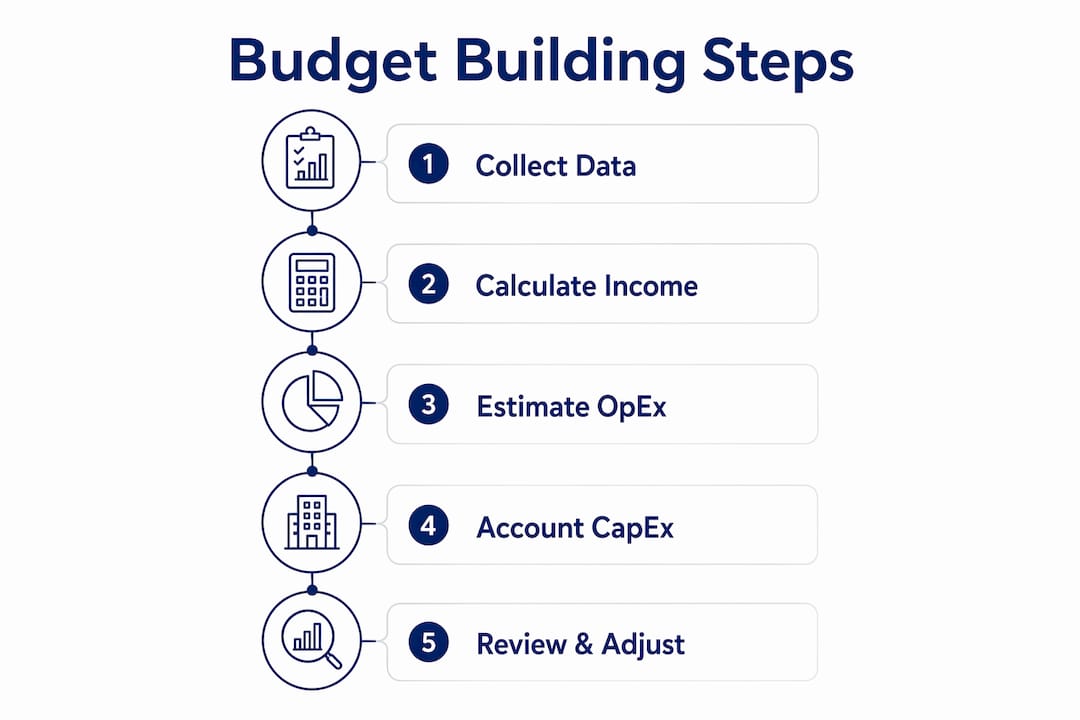
- How do you build a commercial property operating budget step by step?
- Per-door methodology: how do you scale budgets across a portfolio?
- How do you use the budget to protect and improve NOI?
- What are the most damaging property budgeting mistakes?
- Spreadsheets vs. commercial platforms: which tools fit your portfolio?
- How should you plan contingency funds and emergency reserves?
- How do you integrate market rent analysis into the budget?
- How do you budget for tenant turnover and vacancy?
- How do regulatory changes and compliance costs affect the budget?
- How do you control operational expenses during the fiscal year?
- Key Takeaways
- The budget discipline most owners skip
- Ardorcre’s property management and budgeting services
- Useful sources and further reading
What does a property management budget actually include?
Every defensible budget breaks into five sections: projected income, operating expenses, management fees, capital expenditures, and reserves.
Projected income covers scheduled base rent, percentage rent or other income, and a vacancy/credit loss deduction. That deduction is where most budgets go soft. Operating expenses split into fixed costs (property taxes, insurance, base utilities) and variable costs (maintenance, landscaping, janitorial). Management fees belong on their own line, not buried in overhead, so owners can see exactly what they are paying for.
CapEx is separate from OpEx for a reason. Replacing an HVAC unit in a medical office building is a capital event; servicing it quarterly is an operating expense. Mixing the two inflates OpEx ratios and distorts NOI. For lenders and appraisers, NOI drives valuation and loan sizing directly, so clean line-item separation is not optional.
A contingency line of 5–10% of total operating expenses rounds out the plan and keeps unplanned repairs from becoming owner surprises.
How do you build a commercial property operating budget step by step?
-
Data collection (October–November). Pull the last 12–24 months of bank transactions, vendor contracts, insurance renewals, and property tax bills. Add lease abstracts to capture scheduled rent escalations, expense recoveries, and pass-through structures. Abstracts are where most income forecasts fail: a triple-net lease with a 3% annual escalation in month seven changes your revenue line materially.
-
Draft the budget (November). Forecast each line using prior-year actuals as the baseline, then adjust for known changes: a lease expiring, a roof replacement scheduled, an insurance renewal that came in higher. Use a spreadsheet with columns for Month, Budget, Actual, Variance, YTD, and Notes. A simple scenario: a 20,000-sf retail strip with $18/sf base rent and a 7% vacancy assumption yields $334,800 in effective gross income. Add a $40,000 HVAC replacement in Q2 and your CapEx-adjusted cash flow drops sharply, which is exactly what the owner needs to see before it happens.
-
Owner review (December). Send the draft with a one-page summary: income assumptions, vacancy rate, reserve balance, and any major CapEx items. Flag every assumption explicitly.
-
Approval and finalize (January). Lock the budget, set the monthly monitoring cadence, and schedule a mid-year review if the portfolio has active lease-up or renovation activity.
Pro Tip: Use lease abstracts to capture contractual rent escalations and recoveries before you draft a single income line. A rent roll alone will miss mid-year step-ups and NNN reimbursements that can shift your income forecast by thousands.
Per-door methodology: how do you scale budgets across a portfolio?

Per-door budgeting applies consistent financial rigor across every asset and makes portfolio-level reporting possible without losing property-level accountability. For unitized assets like apartment-adjacent medical suites or multi-tenant industrial parks, per-door averages work well. For single-tenant office or large-format retail, per-square-foot is the cleaner metric.
The math is straightforward: calculate average operating expense per door or per square foot from prior-year actuals, multiply by the unit or area count to set the property baseline, then aggregate across properties for the portfolio view. The critical discipline is keeping property-level budgets separate from the management company’s own operating budget. Combining them hides underperformers and gives owners a false picture of where their money goes.
When you manage for multiple owners, each owner receives their own property-level annual projection. That is a non-negotiable for trust and transparency.
How do you use the budget to protect and improve NOI?
Track six KPIs every month: effective gross income, vacancy rate, operating expense ratio (OpEx divided by gross income), maintenance spend versus reserve balance, leasing cost per turnover, and NOI itself.
| Month | Budget | Actual | Variance | YTD Variance | Notes |
|---|---|---|---|---|---|
| January | — | — | — | — | Unit 4 vacant, lease-up in progress |
| February | — | — | ($200) | — | Partial rent received |
| March | — | — | — | — | Full occupancy restored |
A monthly variance report turns an owner statement into a financial management tool rather than a transaction log. When a line drifts more than 10% from budget, act: higher maintenance usually signals a deferred repair that needs a CapEx decision; unplanned vacancy triggers a leasing response; an insurance or tax spike requires a budget amendment and owner notification within the same reporting cycle.
What are the most damaging property budgeting mistakes?
- Relying on industry averages. Generic expense benchmarks ignore your property’s age, tenant mix, and local vendor pricing. Build from your own prior-year transaction history and adjust for scheduled items.
- Budgeting zero vacancy. Unless you can document three consecutive years of near-full occupancy, assume vacancy. Document the assumption and show it to the owner. A budget that assumes 100% occupancy destroys credibility the first month a tenant goes dark.
- Burying the management fee. Show it as its own line. Owners who cannot see the fee separately will eventually question every expense line instead.
- Skipping reserves. A maintenance reserve drawn down and replenished on a ledger is far easier to defend than a surprise repair invoice. Show the opening balance, draws, and closing balance every month.
- Freezing the budget mid-year. A budget that never gets amended after a major lease event or CapEx surprise is fiction by Q3. Schedule a formal mid-year review and update the forecast.
Spreadsheets vs. commercial platforms: which tools fit your portfolio?
A well-structured spreadsheet handles a single property or a small portfolio with direct owner oversight. The columns described above, Month through Notes, give you everything you need to run monthly variance reporting and present clean owner statements. Expense tracking platforms add predefined categories, property-level tagging, and tax-ready exports that reduce manual work as the portfolio grows.
The migration trigger to a commercial platform is usually one of three things: crossing 100–200 doors, recurring mid-year variance alerts that take too long to investigate manually, or the need for owner-facing dashboards across multiple properties. Yardi and AppFolio are the two most widely used US platforms at that scale. For a direct comparison of their feature sets and pricing, Ardorcre’s Yardi vs AppFolio breakdown covers the key decision points. Automated bank and PMS data syncing also enables scenario analysis, such as modeling a contractor versus a full-time hire, without rebuilding the spreadsheet from scratch.
Pro Tip: Run two full budget cycles in a consistent spreadsheet format before migrating to a platform. The discipline of a standardized process matters more than the software, and platforms are easier to configure when your categories and reporting cadence are already locked in.
How should you plan contingency funds and emergency reserves?
Budget a contingency line of 5–10% of total operating expenses and treat it as a real cash reserve, not an accounting entry. For commercial assets, separate the contingency (unplanned operating surprises) from the CapEx reserve (planned capital replacements). An industrial building with aging dock equipment needs a funded CapEx reserve with a drawdown schedule; a retail strip with newer construction needs a smaller one. Show both balances in every owner report, with opening balance, draws, and replenishment. Owners who see a reserve being managed proactively rarely question a repair invoice. Owners who see a zero reserve balance and then get a $30,000 HVAC bill lose confidence fast.
How do you integrate market rent analysis into the budget?
Start with your current rent roll and lease abstracts, then layer in market data. For Charlotte-area office properties, local market trends in asking rents and concession packages directly affect what you can project for renewals and new leases. The budget income line should reflect contractual rent for in-place leases and market rent for vacant or expiring space, discounted by a realistic lease-up timeline. Never use a single market average for the whole property. A medical office suite re-leasing at market commands a different rate than a ground-floor retail space in the same building.
How do you budget for tenant turnover and vacancy?
Turnover costs belong in the budget as a line item, not a surprise. For each lease expiring in the budget year, estimate: downtime between tenants (typically 3–6 months for commercial space depending on asset type), tenant improvement allowance, leasing commission, and any free-rent concession. Aggregate those costs and spread them across the months they will hit. A portfolio-level vacancy rate assumption should reflect your actual trailing average, not a wish. Document it, show it to the owner, and revisit it at mid-year if leasing velocity changes.
How do regulatory changes and compliance costs affect the budget?
Compliance costs are a real and growing line item for commercial owners. ADA accessibility upgrades, fire code updates, energy benchmarking requirements (increasingly common in larger US metros), and local business license or inspection fees all belong in the budget. The practical approach: review your jurisdiction’s regulatory calendar annually and flag any known compliance deadlines in the CapEx plan. For properties near Charlotte’s land development activity, zoning changes and infrastructure assessments can also create unexpected cost exposure. Build a compliance review into the data-collection phase of your budget cycle, not as an afterthought.
This article provides general information about property budgeting and is not a substitute for advice from a qualified accountant, attorney, or financial advisor for your specific situation.
How do you control operational expenses during the fiscal year?
Monthly variance review is the core discipline. Beyond that, three techniques make a real difference. First, lock vendor contracts at the start of the year with fixed pricing where possible; open-ended service agreements invite cost creep. Second, use real estate management team structures that assign clear ownership of each expense category, so no line goes unreviewed. Third, flag any line that exceeds budget by more than 10% in two consecutive months as a formal action item, not just a note. Waiting until Q4 to address a drifting utility line or a maintenance overrun means you are managing the damage, not the cause.
Key Takeaways
A property management budget built from prior-year actuals, per-door baselines, and funded reserves is the single most reliable tool for protecting NOI and maintaining owner trust.
| Point | Details |
|---|---|
| NOI is the north star | Budget every line to protect Gross Operating Income minus Operating Expenses; that formula drives valuation and loan sizing. |
| Per-door or per-sf baselines scale | Use property-specific actuals, not industry averages, to set baselines that hold up across a growing portfolio. |
| Reserves must be visible | Show opening balance, draws, and replenishment every month; owners who see a managed reserve rarely question repair invoices. |
| Variance tolerance of 10% | Any line drifting more than 10% from budget for two consecutive months needs a formal response, not just a note. |
| Ardorcre for budget-ready management | Ardorcre provides owner-facing annual budgets, monthly variance reporting, and lease abstracting for Charlotte MSA commercial properties. |
The budget discipline most owners skip
Most property owners focus on the annual budget draft and then treat it as a done document. The real work is the monthly variance review, and most managers do not do it rigorously enough. A budget that gets reviewed quarterly is already three months behind the problem.
The other thing that gets skipped: the mid-year amendment. Markets shift, tenants leave, insurance renews at a higher rate. A budget that does not get updated after a material event is misleading by design. Owners deserve a revised forecast, not a year-end explanation for why actuals missed the January projection by 20%.
The firms that build owner trust over time are the ones that show up every month with a variance report, a clear explanation for every line that moved, and a revised projection when the facts change. That discipline is what separates a property manager from a financial partner.
Ardorcre’s property management and budgeting services
Consistent monthly variances, a portfolio crossing 100 doors, a refinancing on the horizon, or simply no internal bandwidth for the accounting work: these are the signals that it is time to bring in a professional. Ardorcre provides owner-facing annual budgets, monthly variance reporting, lease abstracting, capital planning, and NOI validation for refinancing across office, retail, medical, and industrial properties in the Charlotte MSA.
The process starts with a budget audit: Ardorcre reviews your current income and expense structure, identifies gaps in reserve planning or lease abstraction, and delivers a clean property-level budget ready for owner review. Contact Ardorcre directly to schedule that first conversation and get a budget framework that holds up with lenders and owners alike.
Useful sources and further reading
Ardorcre resources:
- Lease Abstract: The Commercial Real Estate Professional’s Guide — explains how lease abstracts feed accurate income forecasting
- Yardi vs AppFolio: Which Platform Fits Your Portfolio? — platform comparison for owners evaluating a move from spreadsheets
- DSCR for Commercial Real Estate: Loan Sizing Guide — how NOI and debt service coverage interact for loan sizing
- The Value of Exceptional Property Management — Ardorcre’s approach to management and owner communication
Industry references:
- Buildium: The Go-To Guide for Property Management Budgeting — per-door methodology and scalable budgeting process
- LandlordDoc: Operating Budgets in Property Management — step-by-step data collection, contingency guidance, and monitoring cadence
- Starch: Annual Operating Budget for Property Founders — automation and scenario analysis using bank and PMS data syncing