
A modified gross lease splits the cost of running a building between landlord and tenant: you pay a base rent plus your negotiated share of specific operating expenses, while the landlord absorbs the rest. It sits between a full-service gross lease, where the landlord eats nearly everything, and a triple net lease, where you eat nearly everything. Most multi-tenant office and medical office buildings use some version of it, and the fine print on which expenses you share decides whether you got a fair deal.
TL;DR:
- The actual expenses passed through under a modified gross lease depend heavily on the lease’s expense categories, base year setup, and whether costs are grouped or itemized.
- Tenants should review the landlord’s past operating statements to verify the base year costs and ensure pass-throughs reflect true operating expenses, especially if the base year was artificially low.
- Using pro-rata shares based on rentable square footage and understanding expense stop versus base year mechanisms are crucial to estimating actual pass-through costs accurately.
- Negotiating audit rights, expense caps, clear exclusions, and reconciliation schedules can help tenants control and verify pass-through costs effectively.
- The perceived predictability of a modified gross lease can be misleading if lease language groups expenses opaque or sets a low base year, increasing unpredictable costs over time.
Table of Contents
- What Is a Modified Gross Lease, Exactly?
- How Expense Pass-Throughs Actually Work
- What This Looks Like in Real Numbers
- Pros and Cons for Tenants and Landlords
- Negotiation Checklist: Clauses to Request Before You Sign
- Approach to Lease Review for Office and Medical Tenants
- Lease Term Lengths and What Renewal Really Means Here
- Legal and Jurisdictional Considerations Worth Knowing
- Who Carries More Risk: Tenant or Landlord?
- How Tenants Can Verify and Control Pass-Through Costs
- Why the “Predictable Lease” Pitch Deserves More Scrutiny
- Get Help Reviewing Your Lease Before You Sign
- Sources
- FAQ
What Is a Modified Gross Lease, Exactly?
A modified gross lease is a hybrid structure: you pay a set base rent, and the landlord handles most day-to-day operating costs, but you take on a defined slice of specific expenses like common area maintenance, property taxes, or insurance increases. That’s the core distinction in the gross vs net lease conversation. A full-service gross (FSG) lease bundles everything into one rent number. NNN pushes taxes, insurance, and maintenance onto you almost entirely. Modified gross lands somewhere in between, and where exactly depends entirely on the lease document in front of you.
There’s no industry-standard version of this lease. One landlord’s “modified gross” might mean you only cover utility overages. Another’s might mean you’re responsible for CAM, taxes, and insurance above a base year, which functionally resembles NNN with better packaging.
Before signing anything, check which categories typically show up in the expense split:
- Common area maintenance (janitorial, landscaping, parking lot repairs)
- Property taxes and building insurance
- Utilities for shared spaces (or your suite, if separately metered)
- HVAC maintenance and repair, especially in medical suites with specialized equipment
- Management fees and administrative costs
The label on the lease means almost nothing. The expense schedule attached to it means everything.
How Expense Pass-Throughs Actually Work
Two mechanisms determine when you start paying, and how much: the base year and the expense stop. A base year locks in a snapshot of operating costs during your first year of occupancy (or another negotiated year). The landlord absorbs those costs at that level for the life of the lease. Anything above that baseline gets passed to you, typically prorated by your share of the building’s square footage.
An expense stop works differently. Instead of a base year snapshot, the lease sets a fixed dollar amount per square foot, say $8.50, that the landlord covers. You pay whatever operating costs exceed that number, regardless of when the lease started. Expense stops give landlords a cleaner ceiling to underwrite against, and tenants a clearer number to model.
Here’s the mechanic that trips up most tenants:
- Pro-rata share math. Your percentage of shared costs is based on your square footage divided by the building’s total rentable square footage, not usable square footage. A building remeasured using a different standard (BOMA 2017 vs an older method) can quietly shift your share.
- Grouped vs. individual expense treatment. Some leases lump CAM, taxes, and insurance into one bucket with a single stop. Others itemize each category separately. Grouped expenses give the landlord flexibility to offset a spike in one category against savings in another, which usually favors the landlord, not you. PropertyMetrics notes that grouping vs. itemizing materially changes how much visibility a tenant actually has into what’s driving the increase.
- Submetering. If your suite has heavier usage (a medical practice running imaging equipment, for instance), ask whether utilities are submetered to you directly rather than folded into the building-wide pro-rata pool.
Pro Tip: Ask for the base year’s actual operating statement before you sign, not just the stated dollar amount. A base year set artificially low (a building that was half-vacant that year) inflates your future pass-throughs even if the lease terms look fair on paper.
What This Looks Like in Real Numbers
Numbers make the base year and expense stop concepts concrete. Take a 3,000 square foot office suite in a multi-tenant building, and a similarly sized medical suite with heavier utility and HVAC demands.
The medical tenant pays more not because the base rent differs, but because specialized HVAC load and equipment often get billed as a separate line item outside the standard CAM pool. That’s common in imaging suites, surgical centers, and practices running sterilization equipment.
If the base year absorbed only the original tax bill, both tenants see their pass-through jump accordingly, prorated by their share. This is exactly why modeling total occupancy cost across the full lease term, not just year one, matters more than comparing base rents alone.
Pros and Cons for Tenants and Landlords
For tenants, the appeal is predictability without full exposure. You know your base rent won’t move, and your pass-through exposure is capped to specific categories rather than the entire operating budget. The downside: if the landlord under-forecasts a base year or groups expenses opaquely, your “predictable” lease starts producing unpredictable bills by year two or three.
For landlords, modified gross leases shift some inflation risk to tenants without scaring off prospects with a scary NNN quote. It’s an easier lease to market in secondary office and mixed-use buildings where tenants expect some version of full service. The tradeoff: landlords take on more administrative work tracking, allocating, and defending expense categories across multiple tenants, especially when suites have different usage profiles.
Where modified gross tends to outperform pure gross or NNN on total cost:
- Multi-tenant office buildings with moderate expense volatility
- Mixed-use properties where retail and office tenants have different CAM needs
- Secondary markets where NNN structures scare off smaller tenants but pure gross overexposes the landlord
Where it tends to underperform: buildings with major deferred maintenance, where “above base year” costs balloon fast and tenants absorb increases they never priced into their budget.
Negotiation Checklist: Clauses to Request Before You Sign
Every modified gross lease negotiation should run through the same short list. Miss one of these and you’re negotiating blind.
- Audit rights. You need contractual language allowing you (or a hired accountant) to inspect the landlord’s supporting invoices for pass-through charges, within a defined window after reconciliation. Without this, you have no way to verify what you’re being billed.
- Gross-up clause. In a partially occupied building, variable costs like janitorial and utilities should be “grossed up” to what they’d be at full occupancy, so a half-empty building doesn’t dump a disproportionate share onto the tenants who are actually there. Get specific about which expenses are subject to gross-up and what occupancy denominator the calculation uses.
- Expense caps. Negotiate an annual cap (often 3% to 5%) on controllable expenses like janitorial and landscaping. Uncontrollable costs like taxes and insurance typically stay uncapped.
- Clear exclusions. Capital expenditures, structural repairs, and leasing commissions for other tenants should be explicitly excluded from your pass-through pool.
- Reconciliation timing. Get a defined schedule for when the landlord reconciles estimated vs. actual expenses, and how overpayments get refunded or credited.
- Administrative fee caps. Some leases tack on a management fee (often 3% to 15% of operating expenses) as its own line item. Cap it or negotiate it out.
Red flags to watch for: vague language like “all operating expenses as reasonably determined by landlord,” no audit rights whatsoever, and expense categories grouped together with no per-item breakdown. For medical tenants specifically, nail down who’s responsible for HVAC servicing on specialized equipment, how biohazard or specialized waste disposal gets billed, and whether your tenant improvement allowance timeline lines up with your buildout schedule.
Pro Tip: If a landlord resists adding audit rights, treat that resistance itself as information. A landlord confident in clean books rarely fights over the right to inspect them.
Approach to Lease Review for Office and Medical Tenants
Reviewing a modified gross lease starts with a full lease abstraction: pulling every expense clause, cap, and exclusion into a single readable document instead of leaving it buried across forty pages. From there, comparing the stated base year against actual historical operating statements catches inflated baselines before they cost you money for the next five years.
For tenants already occupying a space, a CAM reconciliation review checks whether the landlord’s actual billed pass-throughs match what the lease allows. Deciding whether to handle a lease negotiation solo or bring in representation usually comes down to lease complexity and dollar exposure: a single-suite renewal might not need it, but a multi-year medical office lease with equipment-heavy CAM terms almost always benefits from a second set of eyes.
Lease Term Lengths and What Renewal Really Means Here
Modified gross leases in office and medical buildings typically run 3 to 7 years for smaller suites, with anchor or larger tenants sometimes signing 10-year terms tied to significant tenant improvement allowances. Medical tenants often push for longer terms because of the buildout cost involved in outfitting exam rooms, imaging suites, or specialized plumbing; a shorter term doesn’t justify that capital investment.
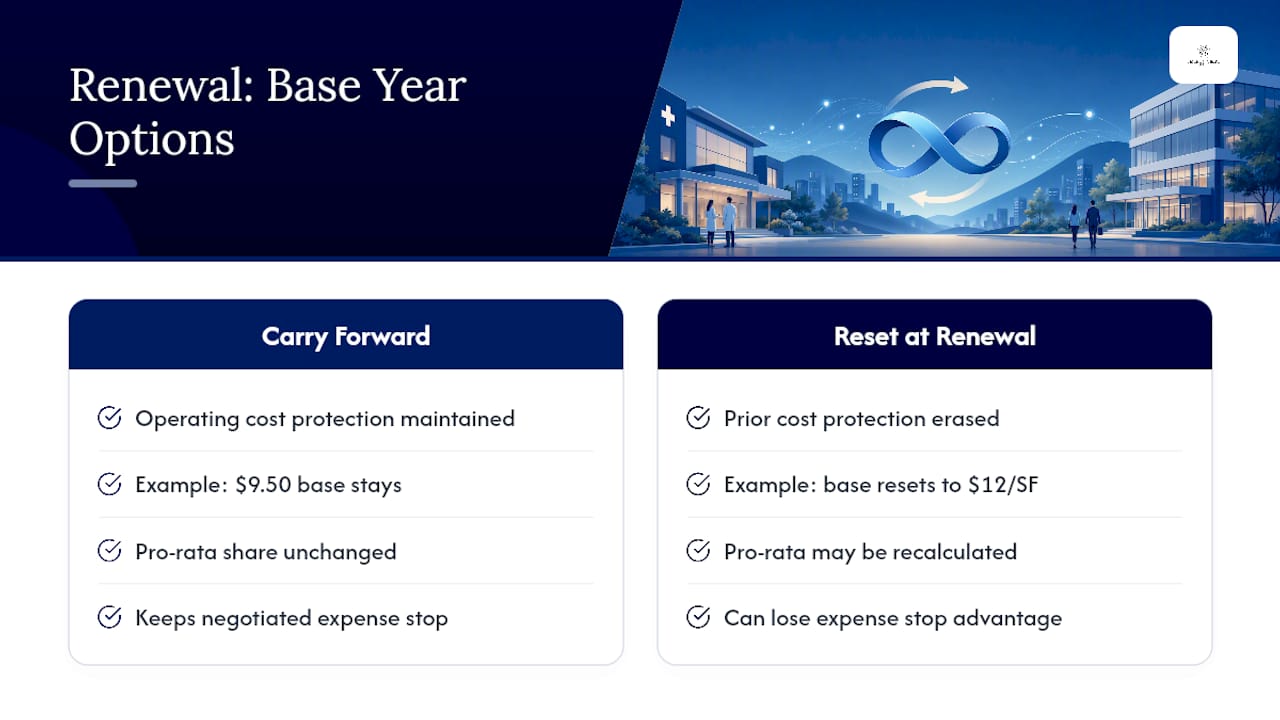
Renewal options deserve more scrutiny than they usually get. A renewal clause that resets your base year to current operating costs at the time of renewal effectively erases any cost protection you built up over the original term. If your base year was $9.50/SF in year one and operating costs climbed to $12/SF by year five, a base year reset at renewal means you’re now absorbing pass-throughs from a much higher floor going forward.
Ask specifically whether the renewal option carries the original base year forward or resets it. Also check whether your pro-rata share recalculates at renewal, particularly if the building has since added square footage, converted common space, or if the property was remeasured under a different standard. A tenant who negotiated a strong expense stop in year one can lose that advantage entirely if the renewal language doesn’t carry the same protections forward.
For tenants weighing whether to renew, expand, or relocate at the end of a term, it’s worth modeling both scenarios: staying under a reset base year versus the cost of a new build-out elsewhere. That comparison often reveals that a modest rent increase on renewal still beats the capital cost of relocating a medical practice.
Legal and Jurisdictional Considerations Worth Knowing
Lease law is largely a matter of contract, which means the specific language in your lease controls far more than any general legal doctrine. There’s no federal standard defining “modified gross lease,” so courts interpreting a dispute look almost entirely at what the document itself says about expense categories, caps, and audit rights.
That said, jurisdiction still matters in a few practical ways. Some states have adopted specific measurement standards (like BOMA) for calculating rentable square footage that get incorporated by reference into lease disputes over pro-rata share. Others have case law addressing what counts as a “reasonable” operating expense when a lease uses vague language instead of an itemized list. Local commercial landlord-tenant statutes can also affect notice periods for rent increases, reconciliation disputes, and remedies if a landlord fails to provide requested audit documentation.
None of this replaces having an attorney review lease language specific to your state before signing a multi-year commitment. What legal review can’t substitute for, though, is a clear-eyed read of the actual numbers behind the lease. Holland & Knight’s analysis points out that legal clarity in expense definitions is what prevents most disputes from reaching a courtroom in the first place. Lease disputes over CAM charges rarely hinge on complicated legal theory. They hinge on whether the tenant understood, at signing, exactly what “operating expenses” meant.
Who Carries More Risk: Tenant or Landlord?
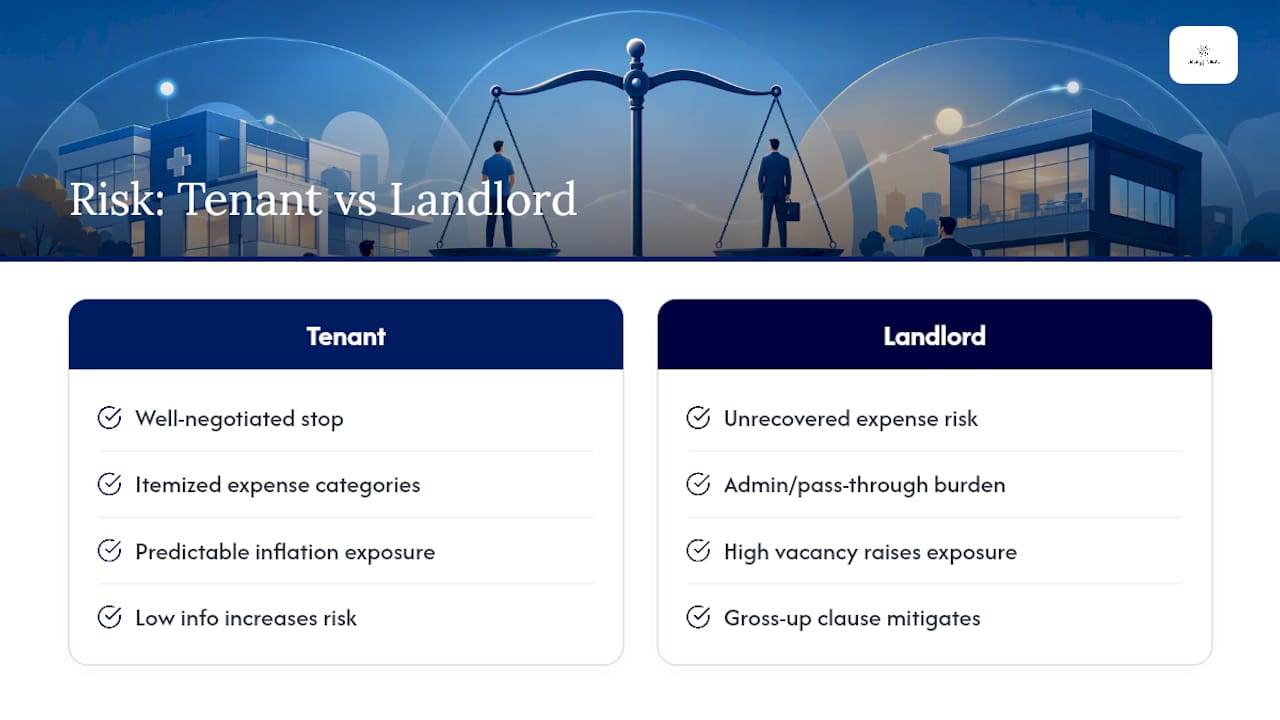
The risk split under a modified gross lease depends almost entirely on where the base year and expense stop get set, and how expenses are grouped. As one industry analysis puts it, the core trade-off is cost certainty for tenants against risk transfer for landlords, with the specific lease terms deciding how far the needle swings each direction.
A tenant with a well-negotiated expense stop and itemized categories carries limited, predictable risk, mostly tied to inflation on a narrow set of controllable costs. A tenant who signed a lease with a low or artificially inflated base year, grouped expenses, and no audit rights carries risk that looks a lot like a full NNN lease, without the rent discount that usually comes with NNN.
Landlords, meanwhile, carry the risk of unrecovered expenses when actual costs run below the base year assumption during underwriting, and administrative risk from tracking and defending pass-through calculations across a mixed tenant roster. A building with high vacancy carries extra risk for landlords too: fixed costs like security and common-area utilities don’t shrink just because fewer tenants are splitting them, which is exactly why gross-up clauses exist in the first place.
The honest answer to “who has more risk” is: whoever negotiated with less information. Tenants who never ask for the base year operating statement, and landlords who never model expense volatility before setting a stop, both end up exposed in ways a few hours of due diligence would have prevented.
How Tenants Can Verify and Control Pass-Through Costs
Verification starts before you sign, not after you get billed. Request the landlord’s actual operating expense history for the past two to three years, not just the projected base year figure. If a landlord doesn’t share it, treat that as a negotiating data point.
Once you’re in occupancy, exercise your audit rights on a regular schedule rather than waiting for a bill that looks wrong. An annual reconciliation review, even a light one, catches billing errors before they compound across a multi-year term. Mondaq’s breakdown of expense recovery structures recommends tenants request a defined reconciliation schedule and the right to inspect supporting invoices within a limited time window after receiving a reconciliation statement.
Practical controls worth negotiating:
- A cap on year-over-year increases in controllable expenses
- The right to request itemized backup documentation, not just a summary total
- A defined dispute resolution process if you flag a discrepancy
- Explicit exclusion of capital expenditures from your operating expense pool
For tenants managing multiple locations or a larger footprint, a standing CAM reconciliation review built into your annual lease management routine catches drift before it becomes a five-figure surprise at renewal.
Why the “Predictable Lease” Pitch Deserves More Scrutiny
Modified gross leases get marketed to tenants as the predictable, low-hassle option, and that pitch is only half true. The base rent is predictable. The pass-through exposure underneath it is only as predictable as the lease language defining it, and most tenants never read that language closely enough to know the difference.
What gets underestimated most is how much power sits in the base year assumption. A landlord can offer what looks like a generous modified gross deal while quietly setting the base year at a level that guarantees pass-throughs climb fast. Tenants who compare lease offers on base rent alone, without pulling the actual operating expense history behind the base year, are comparing incomplete numbers.
The advice I’d push back on hardest is the idea that modified gross is automatically the “safe middle ground” between gross and NNN. It can be. It can also be a triple net lease wearing a friendlier label, depending entirely on how expenses are grouped and capped. Medical tenants especially should prioritize the HVAC and specialized equipment language before anything else. That’s where the real cost surprises tend to live, not in the standard CAM pool.
— Jim
Get Help Reviewing Your Lease Before You Sign
A lease that looks predictable on the surface can still carry real expense risk once you dig into the base year and pass-through language, and catching that before signing is far cheaper than disputing it two years in. Some advisors work with office and medical tenants on this kind of review, combining lease abstraction with CAM reconciliation analysis to flag inflated base years, grouped expense traps, and missing audit rights before they cost you.
Beyond lease review, Ardorcre’s tenant representation services cover negotiation on your behalf, from expense caps to gross-up language to renewal terms that don’t quietly reset your protections. If you’re weighing a renewal, a relocation, or a new medical office buildout, start with a lease review through Ardorcre’s full service lineup before you sign anything new.
Sources
- Understanding Modified Gross Leases: Definition, Benefits, and Calculations — Investopedia
- Who Pays For What? Understanding Key Differences In Triple Net, Gross And Modified Gross Commercial Leases — Mondaq
- Modified Gross Lease — PropertyMetrics
- Who Pays for What? Understanding Key Differences in Triple Net, Gross and Modified Gross Commercial Leases — Holland & Knight
FAQ
What Are the Disadvantages of a Modified Gross Lease?
The main disadvantage is unpredictability disguised as predictability: your base rent is fixed, but pass-through expenses can climb quickly if the base year was set low or expenses are grouped without itemization. Tenants without audit rights also have limited ability to verify whether billed charges match actual costs, which is why the PropertyMetrics negotiation guidance stresses requesting clear definitions and caps upfront.
What Is the Difference Between Modified Gross and NNN?
Under NNN, tenants pay base rent plus nearly all operating expenses (taxes, insurance, and maintenance) in full, prorated by their share of the building. Under modified gross, the landlord absorbs baseline costs and tenants only pay increases above a set point, giving tenants more cost predictability and landlords more risk exposure.
What Is the Difference Between a Full-Service Gross Lease and a Modified Gross Lease?
A full-service gross (FSG) lease bundles nearly all operating expenses into one flat rent number, with the landlord absorbing cost increases. A modified gross lease carves out specific expense categories, usually above a base year or expense stop, and passes those increases to the tenant instead.
Is a Gross Lease Good for Tenants?
A full-service gross lease is generally favorable for tenants who want maximum budget predictability, since the landlord absorbs nearly all expense volatility. The tradeoff is usually a higher base rent than you’d see under a modified gross or NNN structure, since the landlord prices that risk into the rent itself.