
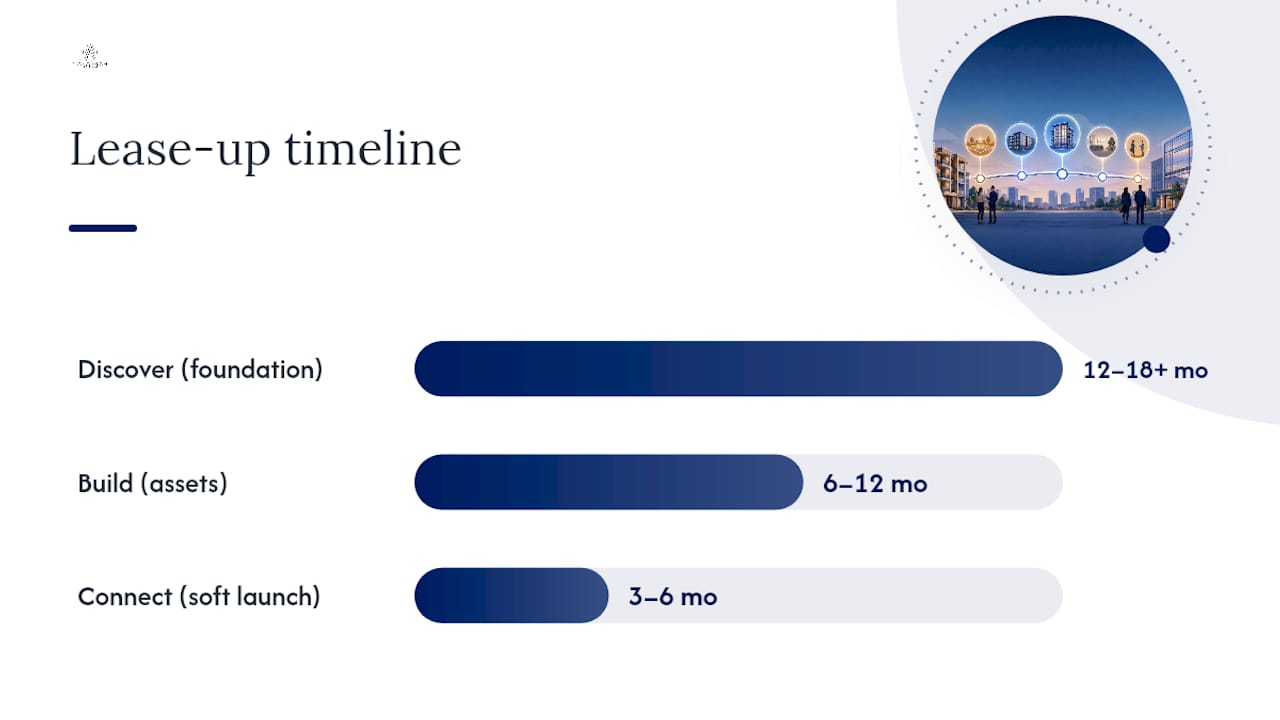
Start planning 12 to 18 months before opening and organize the work into four phases: Discover, Build, Connect, and Sustain. Prioritize a ready website, live listings, and a fast lead-to-lease follow-up system before spending on ads. Properties that follow this sequence typically reach stabilization inside 6 to 18 months instead of dragging into a second budget year.
TL;DR:
- Proper lease-up planning begins 12 to 18 months before opening, with a focus on establishing a website, brand, and demand data in the Discover phase.
- The Build and Connect phases involve creating assets, finalizing staffing, choosing a CRM, and launching listings gradually as occupancy targets are approached.
- Effective marketing relies on sequencing channels: paid social and display build awareness early, while search captures demand once listings and site are live; retargeting then optimizes conversions.
- Pricing decisions during lease-up should be aligned with initial rent assumptions, with concessions targeted to underperforming units and gradually phased out as occupancy increases.
- Weekly tracking of leads, tours, applications, and leasing pace is essential to identify and address potential slowdowns before they impact stabilization.
Table of Contents
- What Is the Right Lease-Up Timeline, and When Should It Start?
- Which Marketing Channels and Creative Actually Fill Units?
- How Should You Price Units and Structure Concessions?
- What Staffing and Lead-Response Standards Convert Leads Into Leases?
- How Do You Measure Whether the Lease-Up Is on Pace?
- Why Does Expiration Distribution Matter More Than Absorption Speed?
- How Much Should a Lease-Up Budget Actually Cost?
- How Do You Benchmark Against the Competitive Market?
- What Keeps Residents and Tenants After the Lease-Up Ends?
- What Legal and Compliance Issues Come Up During Lease-Up?
- An Ardor CRE Practitioner’s Perspective on Office and Medical Lease-Ups
- How Ardor CRE Supports Your Lease-Up From Planning to Stabilization
- Sources
- FAQ
What Is the Right Lease-Up Timeline, and When Should It Start?
A lease-up strategy only works if the calendar behind it is real. Waiting until a few months before your certificate of occupancy to build a marketing plan is the single most common reason absorption stalls. Successful teams start 12 to 18 months out, long before a single unit or suite is move-in ready, and they break the work into four distinct phases rather than one long marketing push.
Discover (12 to 18+ months before opening). This is the foundation phase, and skipping it costs you later. Claim your domain and Google Business Profile, lock your brand name and logo, and start collecting competitive rent and concession data. This is also when a waitlist or priority list should open, even with nothing but a name, a rendering, and an email signup form. Early interest lists give you a ready pool of leads the moment units become available, and they let you gauge demand for specific floor plans before you finalize pricing.
Build (6 to 12 months out). Now the tangible assets come together: professional renderings, floor plans, a coming-soon landing page, and photography or video plans for the finished spaces. This is also the phase to finalize your leasing office staffing plan and select a CRM. Teams that wait until Connect to pick a CRM usually end up bolting one on mid-launch, which is worse than starting with a simpler system on day one.
Connect (3 to 6 months out). This is the soft-launch window. Listings go live on ILS platforms, paid campaigns turn on at a modest budget, and the leasing office starts booking tours, even if the building is still under construction. Discoverability surfaces like your Google Business Profile and mapped listings function as conversion tools here, not just visibility. If a prospective tenant searches your address and finds nothing claimed, you lose them before they ever call.
Sustain (post-stabilization). Once you cross roughly 90 to 95% occupancy, the job shifts from acquisition to retention and steady-state marketing. Budgets drop, but they don’t go to zero. You still need enough spend to backfill normal turnover.
Readiness checklist before you scale paid spend:
- Domain registered, Google Business Profile claimed and verified
- Coming-soon or pre-leasing landing page live with lead capture
- Tracking and analytics installed (call tracking, form tracking, UTM structure)
- Floor plans, renderings, and at least one virtual tour asset ready
- CRM selected and lead-routing rules configured
- Leasing staff hired and trained on tour scripts before the soft launch
Medical office and traditional office lease-ups follow the same phase structure, but the Build phase needs an added layer: coordinating tenant improvement timing with staged occupancy. A medical practice waiting on a TI buildout has a much longer runway need than a retail or apartment tenant, and promising a move-in date your construction schedule can’t support will cost you the lease later even if it fills a pipeline number now.
Which Marketing Channels and Creative Actually Fill Units?
Different channels do different jobs, and confusing them wastes budget. Paid social and display build awareness in the Discover and Build phases when nobody is searching for you by name yet. Paid search takes over once demand exists, capturing renters or tenants actively typing “apartments near [neighborhood]” or “medical office space for lease.” Sequencing awareness before intent capture matters because launching search ads before your listings and site are ready just burns money on clicks that bounce.
ILS platforms and map listings handle discoverability. Retargeting closes the loop, bringing back the visitor who toured your landing page three times but never booked a tour.
1. Build the creative stack before you spend on distribution. You need high-resolution renderings, a 3D or video virtual tour, accurate floor plans with dimensions, and short-form video cut for social feeds. For office and medical assets, add a neighborhood or corridor page that speaks to commute patterns, parking, and nearby complementary tenants (a lab-adjacent suite near a hospital campus, for instance, sells itself differently than a standalone strip location).
2. Structure campaigns by segment, not by platform. A single generic campaign wastes reach. Break paid search and social into at least four buckets: branded terms (your project name), neighborhood terms (submarket plus property type), floor-plan or suite-size terms (two-bedroom, 1,500-square-foot suite), and competitor-adjacent terms for renters or tenants comparing you against a nearby property.
3. Refresh creative on a fixed schedule, not when someone notices fatigue. Practitioner guidance recommends refreshing ad creative every 30 to 45 days and reviewing budget allocation every two weeks. Ad fatigue shows up as rising cost-per-click and falling click-through rate long before anyone on the team feels it anecdotally, so put the review on the calendar rather than waiting for a gut check.
4. Route retargeting to the specific asset that drove the first visit. A visitor who viewed your two-bedroom floor plan page should see two-bedroom retargeting ads, not a generic “now leasing” banner. Specificity in retargeting creative consistently produces a tighter cost per lead than generic remarketing.
Pro Tip: Set a recurring calendar block, every other Monday, to pull cost-per-click, cost-per-lead, and conversion rate by campaign segment. If a segment’s cost-per-lead has climbed for two consecutive periods while lease volume from that segment hasn’t, that’s your signal to pause and reallocate before the whole month’s budget follows the trend.
Neighborhood and amenity positioning should also reflect what renters and tenants actually prioritize, not just what looks good in a rendering. National research on rental housing preferences from the Harvard Joint Center for Housing Studies is a useful check on whether your messaging matches what’s actually driving demand in a given submarket, rather than assumptions baked in at the design stage.
For office and medical assets specifically, your creative sequencing looks a little different. Renderings matter less than floor plans with usable square footage callouts, parking ratio details, and proximity to hospital systems or complementary practices. A gastroenterology group evaluating a suite cares more about loading dock access and imaging equipment weight tolerances than about lobby finishes. Build that into your asset list from the start rather than retrofitting it after the first round of tours falls flat.
Cadence matters as much as content. A campaign that launches strong in month one and then goes stale by month three is common, and it’s almost always a resourcing problem, not a strategy problem. Assign a single owner responsible for the 30 to 45 day creative refresh cycle, and hold that person to the calendar even during the busiest leasing weeks.
How Should You Price Units and Structure Concessions?
Set your opening price close to your underwriting assumption and let real leasing velocity tell you whether to hold or adjust, not the other way around. Pricing during lease-up serves a dual function: it validates whether your pro forma rents are realistic, and it calibrates how fast units fill relative to your absorption target.
If the first two to three weeks of Connect-phase leasing produce strong tour-to-lease conversion at your asking price, hold steady. If tours are happening but leases aren’t closing, that’s a pricing signal before it’s a marketing signal, and dropping rent before you’ve diagnosed the actual objection (unit condition, competitor pricing, concession gap) wastes margin you didn’t need to give up.
Concession rules that protect the rent roll:
- Scope concessions to specific unit types or floor plans that are lagging, not the entire property across the board.
- Use time-boxed move-in specials (one to three months free, or reduced deposit) rather than a permanent rent reduction that resets your effective rent baseline for every future renewal.
- Model the cost. A two-month concession package on a 250-unit project is often materially cheaper than carrying those same units vacant for several additional months of negative cash flow.
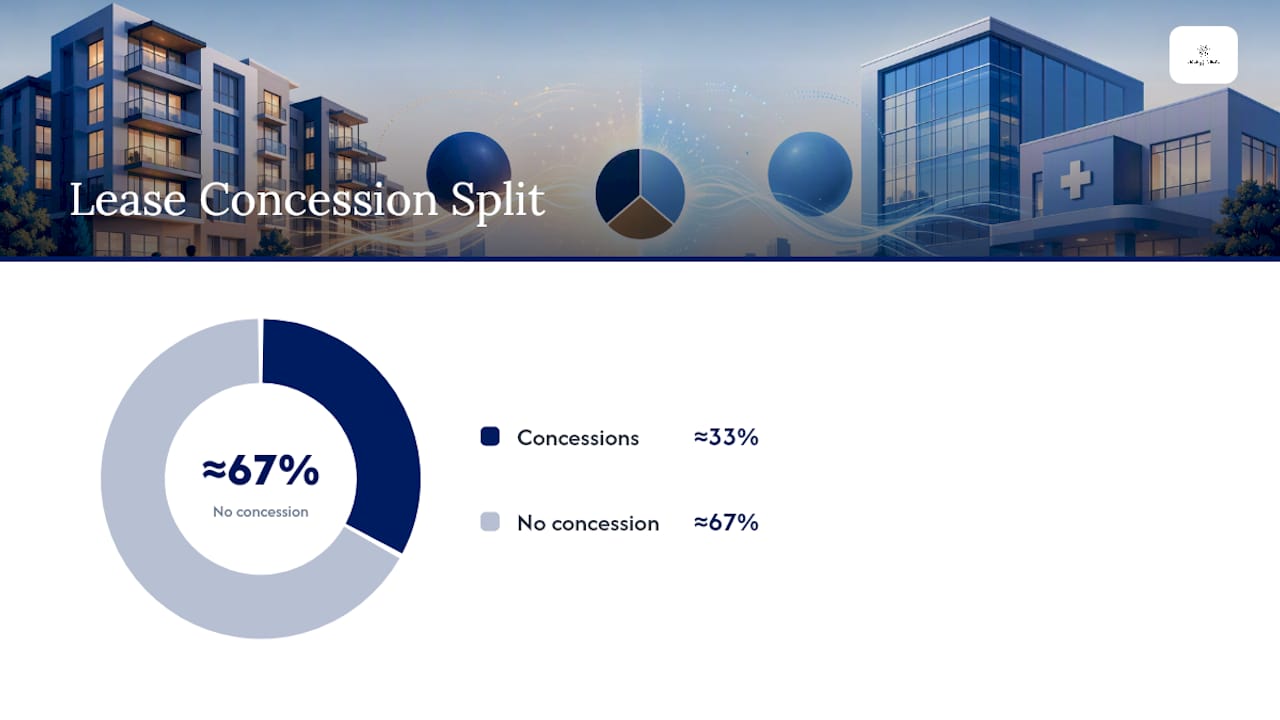
- Watch your concession-to-lease ratio weekly. If more than roughly a third of new leases require a concession to close, that’s a market or pricing signal worth revisiting, not just a leasing-team execution issue.
- Pull concessions back gradually as occupancy climbs past the 70 to 80% range, rather than cutting them all at once, which can create a visible cliff that slows the final push to stabilization.
Lease-term structuring is where most operators leave value on the table. Offering a uniform 12-month term to every early leaser feels simple, but it concentrates your renewal exposure into one tight window a year later. Vary the offered terms deliberately (some 13-month, some 15-month leases during the early absorption push) so your expiration calendar spreads out naturally instead of clustering.
The insight from move-in special design holds for office and medical assets too, with one adjustment: concessions there more often take the form of extra tenant improvement allowance or free rent during a buildout period rather than a straight rent discount, since the buildout timeline is usually the actual point of friction, not the headline rent.
What Staffing and Lead-Response Standards Convert Leads Into Leases?
Staffing should scale with the phase, not arrive all at once. During Discover and early Build, one leasing manager can handle waitlist growth and vendor coordination. By the Connect phase soft launch, you need dedicated leasing agents on-site or fielding calls, because lead volume jumps fast once listings go live and paid campaigns turn on.
Lead response is the highest-leverage metric most teams underinvest in. A lead that waits more than five minutes for a response during business hours starts losing intent, and by the next business day, a meaningful share have already toured a competing property. Automated acknowledgment (a text or email confirming receipt within seconds) buys you time while a human follows up, but it’s not a substitute for that human follow-up happening within the hour.
Tour formats should be flexible, not one-size-fits-all:
- Self-guided tours using smart-lock or keypad access work well for daytime prospects who want a quick look without scheduling around staff availability.
- Virtual tours (live video walkthroughs or pre-recorded 3D scans) convert out-of-market renters and relocating tenants who can’t visit in person before deciding.
- In-person guided tours remain the highest-converting format for prospects already close to a decision, and they matter even more for office and medical suites where questions about loading access, electrical capacity, or parking ratios need a knowledgeable answer on the spot.
Give every leasing agent a written tour script that covers the same core selling points (unit or suite features, community or building amenities, application steps, and current concession terms) so conversion doesn’t depend entirely on which agent happens to answer the phone.
CRM discipline separates a lease-up that hits pace from one that quietly falls behind. Score leads by source and engagement (did they tour, did they request a floor plan, did they start an application) so your team spends time on the leads most likely to close instead of chasing every form fill equally. Also audit your landing pages for basic friction points: a form asking for ten fields before a prospect can even see pricing will suppress your lead volume regardless of how good the ad creative driving traffic there is.
Pro Tip: Test your own lead form once a month, from a phone, not a desktop. Slow load times and clunky mobile forms quietly kill a large share of lease-up leads, and most teams never notice because they’re testing from an office computer with a fast connection.
How Do You Measure Whether the Lease-Up Is on Pace?
A lease-up isn’t a campaign you launch and check on quarterly. It’s an operating discipline that needs weekly visibility, because the gap between “on pace” and “three months behind” often shows up gradually in the weekly numbers long before it’s obvious in a monthly summary.
Core metrics to track every week:
- Leads to tours: what share of inbound leads actually schedule and complete a tour
- Tours to applications: what share of completed tours submit an application
- Applications to signed leases: your final conversion checkpoint, and the one most affected by pricing or credit-approval friction
- Cost per lease: total marketing spend divided by signed leases in the period, tracked by channel so you know where the efficient dollars are going
- Absorption rate: units or suites leased per week (or month) relative to total inventory, compared against the pace needed to hit your stabilization target date
Closing the loop from lead to signed lease is non-negotiable for this to mean anything. A report that stops at form fills tells you traffic volume, not whether that traffic is turning into revenue.
Run this reporting weekly during Connect and the first stretch of Sustain, then shift to bi-weekly once absorption stabilizes. A useful trigger: if two consecutive weekly reports show absorption tracking behind your modeled pace to stabilization, that’s the point to revisit pricing, concessions, or channel mix, not three months later when the shortfall has compounded.
Why Does Expiration Distribution Matter More Than Absorption Speed?
Filling every unit fast feels like a win, until 40% of your leases all expire in the same six-week window a year later and you’re running a second full lease-up during your worst seasonal leasing months. Early lease-term choices shape your rent roll’s long-term exposure far more than most first-time lease-up teams anticipate.
1. Recognize the risk during the Connect phase, not after. If your leasing team defaults every prospect to a standard 12-month term because it’s the easy conversation, you’re building a concentration problem into the calendar without meaning to.
2. Stagger terms deliberately using pricing as the lever. Offer a modest rent reduction or extra concession value for tenants who accept a 15 or 18-month term instead of 12, and a smaller one for 13 or 14-month terms, spreading your renewal dates across a wider window.
3. Model the difference before you commit to a leasing pace policy. A 200-unit lease-up that signs 150 leases in a concentrated 10-week window with uniform 12-month terms faces a renewal cliff exposing roughly three-quarters of its rent roll in the same 10-week window a year later. The same 150 leases signed with staggered 12 to 18-month terms spread that exposure across five to six months instead, giving leasing staff breathing room and reducing the odds of a simultaneous vacancy spike.
The NPV-based approach to tenant retention that works for medical and office assets applies the same logic in reverse: retaining an existing tenant at a modest concession is almost always cheaper than re-leasing the space, which is exactly why the expiration calendar you build during lease-up determines how much retention work you’ll need to do 12 months out.
How Much Should a Lease-Up Budget Actually Cost?
Lease-up budgets get underfunded most often in the Discover and Build phases, where nothing is visibly happening yet and it’s tempting to defer spend. That’s backwards. Domain and brand setup, professional renderings, a coming-soon site, and CRM licensing are fixed costs you’re paying regardless of when the first lease signs, so deferring them only compresses your Connect-phase timeline later.
Build your projection in three buckets: pre-launch setup (branding, website, renderings, CRM, signage), ongoing marketing spend during Connect and early Sustain (paid media, ILS listing fees, photography refreshes), and concession cost modeled against your target absorption pace. That third bucket is the one teams most often leave out of the initial budget, then scramble to fund mid-lease-up when velocity lags.
A useful budgeting discipline: model concession cost at three absorption scenarios (on-pace, one month behind, three months behind) before you open leasing. If a three-month delay would require concession spend that erodes your projected first-year net operating income past what your underwriting can absorb, that’s a signal to revisit pricing assumptions now, not after the shortfall shows up in a monthly P&L. A property management budget framework built around these scenarios keeps ownership and leasing staff aligned on what “off pace” actually costs in dollars, not just in weeks.
How Do You Benchmark Against the Competitive Market?
Your pricing and concession decisions are only as good as the competitive set you’re measuring against, and that set needs updating more often than most teams do it. A rent comp pulled during the Discover phase eighteen months earlier is close to useless by the time you’re setting Connect-phase pricing, because two or three competing properties have likely adjusted rents, added concessions, or leased up entirely in the interim.
Build a live competitive tracking sheet during Build and update it at least bi-weekly once Connect starts. Track asking rent by floor plan or suite type, current concession offers, occupancy or “units remaining” signals from competitor listing pages, and any amenity or service changes. For medical and office assets, extend that tracking to available square footage, parking ratios, and tenant improvement allowances being offered nearby, since those variables often matter more to a prospective tenant than headline rent per square foot.
Benchmarking isn’t just defensive. If your competitive set is running heavier concessions than you are and your absorption pace still holds steady, that’s useful evidence you may be able to hold price rather than following the market down reflexively. The goal is a standing comparison you update on a rhythm, not a one-time snapshot from your original underwriting.
What Keeps Residents and Tenants After the Lease-Up Ends?
Reaching stabilization doesn’t end the work. It shifts the job from acquisition to retention, and the habits you build during lease-up either set up smooth renewals or create a second wave of vacancy right when your marketing budget has already been cut back for the Sustain phase.
Start retention conversations well before a lease’s expiration, not in the final 60 days. For multifamily, that means renewal offers at 90 to 120 days out with pricing that reflects genuine market conditions rather than an automatic maximum increase. For medical and office tenants, retention is closer to an ongoing relationship: check in on space needs, flag upcoming lease-term decisions early, and address maintenance or building-service issues before they become a reason to shop competing space.
The tenant retention modeling that compares the net present value of a renewal concession against the cost of re-leasing applies just as directly here as it does to expiration-distribution planning. A partner resource on managing tenant turnover offers additional practical tactics worth reviewing if your Sustain-phase retention process still leans heavily on informal, ad hoc outreach rather than a structured renewal calendar.
What Legal and Compliance Issues Come Up During Lease-Up?
Fair housing compliance applies to every piece of marketing and every leasing conversation from the moment your coming-soon page goes live, not just after the first resident moves in. Advertising language, photography choices, and even which amenities get featured in ads can create fair housing exposure if messaging implies a preference for or against a protected class. Review ad copy and creative with that lens before it launches, not after a complaint arrives.
Application and screening criteria need to be documented and applied consistently across every applicant, every time, with no informal exceptions made under leasing-pace pressure. Concession offers should also be applied evenly within a stated policy window rather than negotiated case by case, which creates both a fair housing risk and a rent-roll inconsistency that’s hard to unwind later.
For office and medical assets, lease documentation carries additional weight: estoppel certificates, tenant improvement allowance terms, and any co-tenancy or exclusivity clauses need careful drafting before a suite is marketed as available, not retrofitted after a tenant is already in negotiation. A lease abstract that clearly captures TI obligations, renewal options, and expiration terms up front prevents disputes that otherwise surface months into occupancy, when they’re far more expensive to resolve.
An Ardor CRE Practitioner’s Perspective on Office and Medical Lease-Ups
Most lease-up advice is written for garden-style apartments, and it shows. Medical and office assets don’t behave the same way, because the tenant’s decision timeline is driven by build-out, not by move-in convenience.
At Ardor CRE, we apply NPV-based tenant retention modeling and detailed lease abstracts specifically to reduce vacancy exposure in medical and office buildings, where a single suite sitting empty for an extra quarter can outweigh a year of marketing spend. That means timing TI allowances against a realistic construction schedule instead of a hopeful one, structuring lease terms so a medical group’s equipment and licensing timelines actually align with occupancy dates, and verifying estoppel certificates carefully before any assumption financing or resale conversation happens. Teams that skip that verification step often discover mismatched lease terms only after a deal is already under contract. If your building needs advisory support during planning or pre-leasing, our medical office leasing resources walk through the timing questions worth asking first.
— Jim
How Ardor CRE Supports Your Lease-Up From Planning to Stabilization
This commercial real estate partner supports office and medical property owners requiring more than a generic marketing checklist during lease-up. The advisory team can handle commercial leasing, tenant and landlord representation, lease review, lease abstraction, and building tenant retention models tailored to medical and office assets.
Reach out during the Discover phase if you’re still finalizing timing and TI strategy, during Connect if pre-leasing needs a second set of eyes, or the moment absorption starts tracking behind your modeled pace. For clients considering buying a multi-tenant building or evaluating CMBS loan options including sale, refinancing, or DSCR requirements, the advisory team can assist with these decisions in coordination with the lease-up plan. Visit our commercial real estate services page to see the full scope of what we handle, and get in touch to start with a lease-up readiness review before your next phase deadline hits.
Sources
- Strategies for a Successful Multifamily Lease-Up | MRI Software
- Lease Up Marketing | Pre-Leasing Marketing & Multifamily Lease Up – OuterBox
- From dirt to doors: How to launch a lease-up marketing campaign that fills fast | Digible
- Lease-Up Strategy: How To Build Occupancy Without Creating Future Exposure | Rentana
FAQ
How Long Does a Lease-Up Take?
Most multifamily and office lease-ups reach stabilization within 6 to 18 months of opening, depending on unit count, market conditions, and how well the pre-leasing phase was executed. Properties that start planning 12 to 18 months before opening tend to land at the faster end of that range because the marketing and operational groundwork is already in place before leasing begins.
What Is a Lease-Up Risk?
Lease-up risk is the exposure created when a property leases quickly but on terms that hurt it later, most commonly through concentrated lease expirations, over-discounted rents, or concessions that erode the property’s projected income. The core discipline is balancing absorption speed against long-term rent-roll health rather than optimizing for fastest fill alone.
What Are the Five P’s of Property Management?
Definitions vary by source, but a common version covers People, Property, Processes, Promotion, and Profit, referring to tenant relationships, physical asset upkeep, operational workflows, marketing, and financial performance. It’s a general framework for property management rather than a lease-up specific standard.
What Should You Avoid Saying to a Landlord or Property Manager During Lease-Up Negotiations?
Avoid stating a hard move-in deadline or maximum budget early in a negotiation, since it removes your leverage to negotiate concessions or lease-term flexibility. For office and medical tenants, avoid confirming a buildout timeline verbally before it’s documented in the lease, since verbal TI assurances that don’t match the signed lease terms are a common source of disputes later.
How Does Ardor CRE Help During a Stalled Lease-Up?
Ardor CRE reviews pricing, lease terms, and tenant retention modeling to identify why absorption has slowed, then works with ownership on tenant representation, lease abstraction, or landlord representation depending on where the gap is. Current service details and how to get started are available through our services overview.