
Debt yield is net operating income divided by loan amount, expressed as a percentage: it is the lender’s rate-independent measure of how quickly it could recoup its loan if it had to take the property back. Unlike debt service coverage ratio or loan-to-value, it ignores interest rate, amortization, and market cap rates entirely. Lenders use it as an underwriting floor, and borrowers who understand it can calculate their own maximum loan size before they ever sit down with a bank.
TL;DR:
- Lenders typically require a debt yield of at least 8%, with office properties often needing a higher minimum due to lease rollover and tenant risk.
- Calculations should be run twice using both trailing and stabilized NOI to account for potential lease-up effects and avoid misestimation.
- Debt yield remains stable regardless of interest rate changes, making it a reliable measure of a property’s income relative to loan size.
- Avoid mixing current and stabilized NOI when calculating debt yield, and exclude non-recurring income or expenses to ensure accuracy.
- Sector-specific insights, such as lower debt-yield floors for credit-tenant medical offices and tighter conditions for short-term single-tenant industrial buildings, guide risk assessment.
Table of Contents
- How do you calculate debt yield?
- Why lenders rely on debt yield for loan sizing
- Debt yield vs. DSCR and LTV: when to use each
- What counts as a good debt yield by property type
- Common pitfalls when calculating debt yield
- What Jim looks for in medical office, office, and industrial deals
- The part of debt yield most borrowers get wrong
- How we help you apply debt yield to a real deal
- FAQ
- Sources
How do you calculate debt yield?
The formula is simple: debt yield = net operating income ÷ loan amount, multiplied by 100. The hard part is making sure both inputs are clean before you run the math.
- Verify net operating income using trailing twelve-month actuals, not a broker’s pro forma.
- Confirm the proposed loan amount, including any future funding or earn out.
- Divide NOI by the loan amount.
- Multiply by 100 to express it as a percentage.
Worked example: a medical office building generates $480,000 in annual NOI. A lender proposes a loan size consistent with a debt yield slightly above typical minimums.
Reverse calculation: if a lender requires a minimum 9% debt yield and the property’s NOI is $480,000, the maximum loan size is calculated by dividing NOI by the required percentage. This is how many lenders actually size the loan, working backward from NOI rather than forward from purchase price.
Pro Tip: Always run the calculation twice, once with trailing NOI and once with stabilized NOI, so you see the full range a lender might quote.
The choice between current and stabilized NOI matters more than most borrowers expect; understanding how commercial mortgage rates affect underwriting floors can provide additional clarity on loan sizing models like debt yield (see Commercial mortgage rates for CRE investors: what to expect). A building with recent lease-up or a rent bump coming next quarter will show two very different debt yields depending on which NOI a lender chooses to underwrite.
Why lenders rely on debt yield for loan sizing
Debt yield exists because interest rate and amortization can disguise real risk. A 30-year amortization schedule makes a loan look safer than a 25-year one on a DSCR basis, even when the dollar exposure is identical. Debt yield strips that distortion out: it only asks what percentage of the loan amount the property’s income replaces each year.
- It gives lenders a rate-independent floor that does not shift when rates move.
- It functions as a direct check on how fast a lender could recover principal through operating income alone.
- It converts cleanly into a maximum loan size: required debt yield becomes NOI divided by that target percentage.
- It varies by capital source, with banks, CMBS conduits, and life insurance companies each applying their own minimums based on risk appetite.
The Comptroller’s Handbook on Commercial Real Estate Lending treats debt yield as a component of prudent underwriting, including minimum debt-yield standards tied to loan limits and amortization criteria. That regulatory recognition is part of why the metric has become a standard underwriting checkpoint rather than a niche calculation.
Debt yield vs. DSCR and LTV: when to use each
Debt service coverage ratio measures NOI against the actual annual debt service (principal and interest), so it answers “can this property pay its mortgage this year?” Loan-to-value compares loan amount against appraised value, answering “how much equity cushion protects the lender if the collateral has to be sold?” Debt yield answers neither question directly. It asks what percentage of the loan itself the income would replace annually, independent of rate or term.
- DSCR moves with interest rates and amortization; debt yield does not, which is why lenders use the second to cross-check the first.
- LTV depends on appraised value, which can be volatile or subjective; debt yield depends only on NOI and loan amount, both of which are harder to manipulate.
- A sound underwriting rule: a loan should clear both a minimum DSCR and a minimum debt-yield floor, with LTV used separately as a collateral check.
- Quick mental model: DSCR multiplied by the loan constant approximately equals debt yield, letting an underwriter estimate one metric from the other before building a full model.
For a deeper walk-through of coverage ratios and how lenders size loans around them, see our guide to DSCR-based loan sizing.
What counts as a good debt yield by property type
Institutional lenders commonly look for debt yields in a range that reflects prudent underwriting, though the exact floor depends on the lender’s program and the asset’s risk profile. Federal Reserve research on recent commercial real estate distress found that loans with particularly low debt yields showed higher rates of extension and distress, with the effect most pronounced in office collateral.
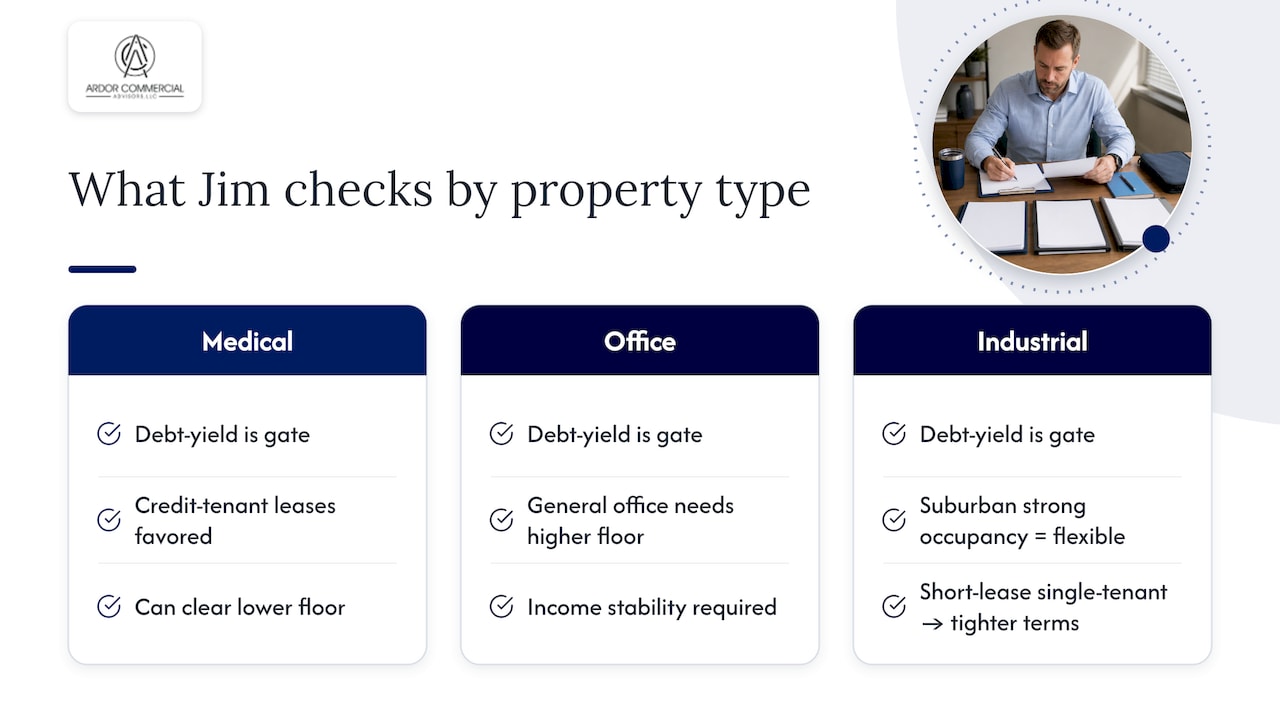
Office assets generally need a higher debt yield cushion than stabilized multifamily or industrial properties because lease rollover risk and tenant improvement costs are harder to predict. A few factors push the required floor higher regardless of property type:
- Recourse versus nonrecourse structure changes how much cushion a lender demands.
- Short remaining lease terms or a single-tenant concentration raise perceived risk.
- Elevated current vacancy, even if temporary, tightens the minimum debt yield a lender will accept.
A single debt-yield number should always be read alongside lease rollover schedule and tenant credit quality, not in isolation.
Common pitfalls when calculating debt yield
The most frequent error is mixing current and stabilized NOI without disclosing which one is being used. A property with a rent step scheduled for next year will produce two different debt yields depending on that choice, and lenders will often underwrite to the more conservative figure.
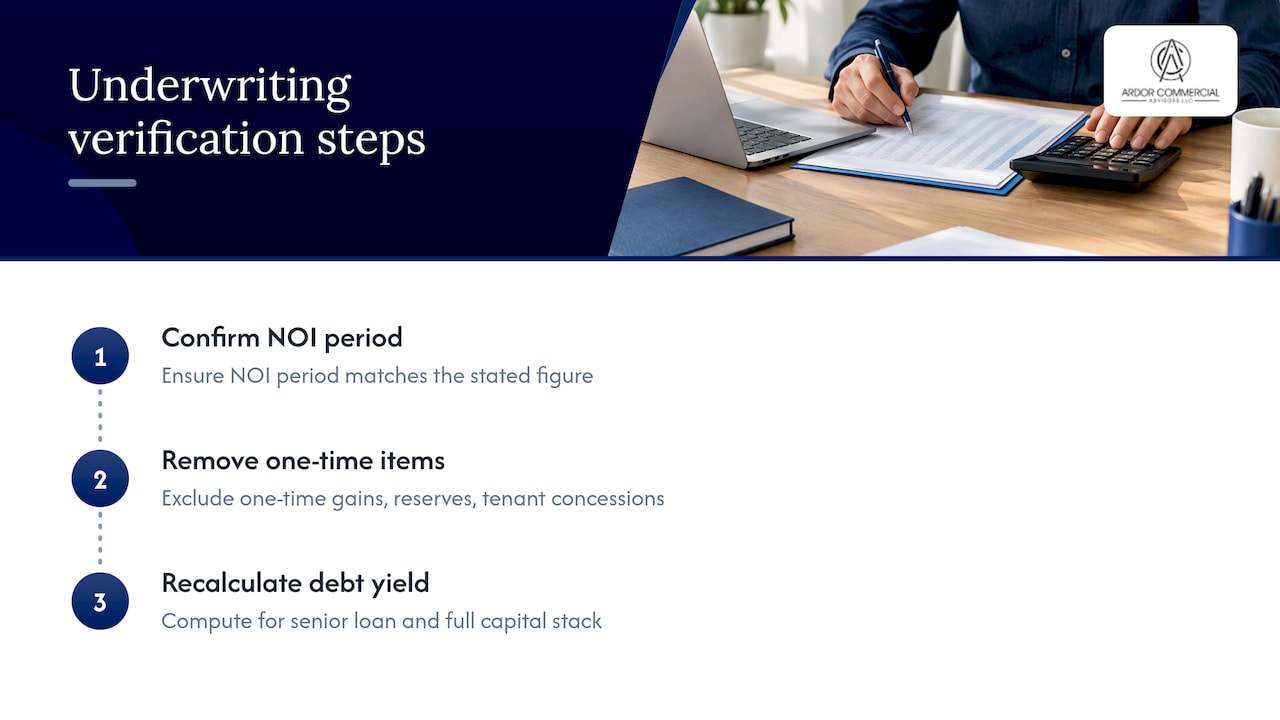
Add-backs and exclusions also shift the number. One-time gains, deferred maintenance reserves, and temporary tenant concessions should typically be excluded from NOI used for debt yield, since they do not reflect sustainable income. Loan structure adds another layer: mezzanine debt, subordinate financing, or interest-only periods change the effective exposure a lender is measuring, even when the senior debt yield looks healthy on its own.
A short verification checklist underwriters use: confirm the NOI period matches the stated figure, check for excluded one-time items, and recalculate debt yield against both the senior loan alone and the full capital stack.
Pro Tip: When a deal includes mezzanine or preferred equity, ask for debt yield calculated against total leverage, not just the senior loan, before you compare it to a published benchmark.
What Jim looks for in medical office, office, and industrial deals
A fast pass or fail screen: multiply DSCR by the loan constant and compare the result to the lender’s stated debt-yield floor. If the two numbers diverge sharply, something in the NOI or loan terms needs a second look before the deal moves forward.
Medical office with long-term, credit-tenant leases can often clear a slightly lower debt-yield floor than general office space, since income stability offsets the risk. Suburban industrial, by contrast, tends to earn more lender flexibility when occupancy and lease terms are strong, but a single-tenant building with a short remaining term often needs the opposite: added recourse, tighter covenants, or a smaller loan size.
Debt yield is the one number I check before I even open a rent roll. If it doesn’t clear the lender’s floor, every other assumption in the deal needs to get more conservative.
For deeper modeling on coverage ratios and valuation inputs that feed into debt yield, see our pages on DSCR-based loan sizing and commercial property valuation.
— Jim
The part of debt yield most borrowers get wrong
Most explainers treat debt yield as a formula to memorize rather than a negotiating tool. That misses the point.
It ignores that office and industrial assets carry different practical floors even within that range, and it says nothing about how recourse or lease term can move the number a lender actually requires. Readers who stop at the formula and skip the sector nuance end up surprised at the term sheet stage.
Prioritize this: calculate debt yield both ways, forward from NOI and backward from a target loan size, before you commit to a purchase price or a refinancing structure. That single habit catches more deal-killing surprises than any amount of rate shopping.
How we help you apply debt yield to a real deal
Running the math is one thing. Knowing how a specific lender program will treat your NOI, your tenant mix, or your lease rollover is another. We offer commercial property valuation and DCF modeling to help owners and investors stress-test NOI before a lender does it first, along with tenant and landlord representation for deals where lease structure directly affects the debt yield a bank will accept.

| Service | What it supports |
|---|---|
| Commercial property valuation and DCF modeling | Validating NOI inputs before underwriting |
| Tenant and landlord representation | Lease terms that may affect debt yield and loan sizing |
| Lease review and CAM reconciliation | Confirming income used in debt yield calculations |
If you are weighing a purchase, refinance, or lease restructuring in the Charlotte MSA, our full services overview is the place to start.
FAQ
What is considered a good debt yield?
Federal Reserve research found loans below roughly 8% debt yield showed notably higher distress and extension rates, especially in office collateral.
What does 8% debt yield mean?
An 8% debt yield means the property’s net operating income equals 8% of the loan amount, so the lender could theoretically recoup the loan through eight years of income at that rate. It tells a lender how exposed it is independent of interest rate or amortization term.
What does the debt yield tell you?
Debt yield tells a lender how much cushion exists between a property’s income and its loan size, without any distortion from interest rate or amortization schedule. A low debt yield signals the loan is large relative to income, which raises the risk of default or forced refinancing.
Is it better to have a higher or lower debt yield?
A higher debt yield is better for the lender and generally signals a safer loan, since it means income covers a larger share of the loan amount. Borrowers want the highest debt yield their NOI can support without over-leveraging, since it also tends to unlock better loan terms.
How does debt yield differ from DSCR and LTV?
Debt yield measures income against loan amount only, while DSCR measures income against actual debt service and moves with interest rates. LTV measures loan amount against appraised value, so it depends on valuation rather than income, which makes debt yield the more stable of the three for cross-checking risk.
Sources
- Comptroller’s Handbook: Commercial Real Estate Lending
- Determinants of Recent CRE Distress: Implications for the Banking Sector