
Break it by going dark and a landlord can pursue damages, recapture the space, or invoke liquidated damages. Courts, though, usually resist ordering a tenant to physically reopen, leaning instead toward monetary remedies over hands-on supervision of someone else’s business.
TL;DR:
- Courts prefer monetary remedies over forcing tenants to reopen, making specific, measurable lease language crucial for enforcement.
- Valid continuous operation clauses often specify days, hours, staffing, inventory benchmarks, or reference comparable tenants, not just occupancy.
- Landlords push for strict operation requirements to prevent vacancy effects that damage foot traffic, lender confidence, and tenant mix, especially with percentage rent deals.
- Tenants should negotiate carveouts for closures due to casualty, remodeling, or franchisor mandates, and set appropriate notice and cure periods to avoid automatic defaults.
- Enforcement of these clauses is difficult, with courts hesitant to involuntarily order reopening, emphasizing the importance of clear language and documented closures.
Table of Contents
- What Does a Continuous Operation Clause Actually Require?
- Why Landlords Push So Hard for This Clause
- Sample Clause Language You’ll Actually See in Leases
- What Happens When a Tenant Goes Dark
- How Tenants Should Negotiate Before Signing
- When Continuous Operation Clauses Collide With Radius Restrictions
- How Courts Actually Rule on These Disputes
- Drafting Checklist Before You Sign or Renew
- Ardor CRE’s Take on Medical and Office Leasing Realities
- Balancing Landlord Protection With Tenant Reality
- Get Your Lease Reviewed Before You Sign or Renew
- Sources
- FAQ
What Does a Continuous Operation Clause Actually Require?
A continuous operation clause spells out an ongoing duty to trade, not merely to occupy. It differs sharply from a basic hours-of-operation clause, which just tells a tenant when the doors need to be unlocked. The continuous version goes further, tying the tenant’s obligation to inventory levels, staffing, and sometimes a “comparable operator” benchmark measured against similar businesses in the market.
Continuous operations clauses commonly require tenants to operate during specified days and hours and to maintain merchandise consistent with what a comparable retailer would stock. Watch for these recurring elements:
- Specific required operating days and hours, sometimes referencing the center’s own posted hours
- Minimum staffing or merchandise/stock-level requirements
- A “comparable operator” standard measuring performance against similar tenants
- Silence on an express operating duty, which some courts will still read as an implied covenant when base rent is low and percentage rent is a major revenue source for the landlord
That last point trips up a lot of tenants who assume no explicit clause means no obligation. Courts weighing an implied continuous-operations duty look at whether percentage rent makes up a meaningful share of total rent, not just whether the lease uses the word “continuous.”
Why Landlords Push So Hard for This Clause
A vacant storefront does more damage than lost rent from one tenant. It signals trouble to shoppers, other tenants, and lenders watching the property’s performance.
Landlords write continuous operation language into leases for reasons that go well beyond one tenant’s rent check:
- Foot traffic depends on every anchor and shop staying active, so one dark storefront can trigger a domino effect of departures
- Lenders underwriting the property track occupancy and sales performance, and a going-dark tenant spooks refinancing conversations
- Tenant mix curated during leasing (a coffee shop next to a salon next to a boutique) collapses when one piece goes quiet
- Percentage rent deals give landlords a direct financial stake in the tenant actually selling something, not just holding the lease
Practice notes from commercial real estate attorneys describe this rationale directly: landlords write these clauses to avoid the vacancy domino effect and protect lender confidence in the property’s income stream. The stronger the percentage rent component, the harder landlords will push for an ironclad operating covenant.
Sample Clause Language You’ll Actually See in Leases
Clause repositories show a range of drafting styles, from loose hours requirements to strict no-going-dark language. Here are the common variants you’ll run into during lease review:
- Hours-only clause: “Tenant shall keep the Premises open for business to the public during the hours of [X] to [Y], [days of week], throughout the Term.”
- No-going-dark clause: “Tenant shall not cease operations, vacate, or abandon the Premises for more than [X] consecutive days without Landlord’s prior written consent.”
- Merchandise/stock standard: “Tenant shall maintain inventory and staffing levels comparable to similarly situated tenants operating [use type] businesses within the trade area.”
- Percentage rent tie-in: “Tenant acknowledges that continuous operation is a material inducement for Landlord’s agreement to accept reduced Minimum Rent in exchange for Percentage Rent.”
Sample clause libraries offer dozens of variations worth comparing before you accept boilerplate language. Landlords typically place exclusive-use restrictions in a separate exhibit rather than burying them in the main body, which makes cross-referencing easier during a dispute.
What Happens When a Tenant Goes Dark
Breaching a continuous operation covenant rarely ends the relationship on day one, but it opens the door to a menu of landlord remedies. Default notices, lease termination, recapture of the space, and liquidated damages tied to a percentage of prior sales all show up in real leases.
Some leases go further and pull in gross sales from a tenant’s other locations to calculate damages, which catches multi-unit retailers off guard. Base rent typically stays due even during a closure. Additional rent items like CAM charges sometimes get abated during documented casualty or remodeling closures, but that relief is the exception, not the rule, and it needs to be negotiated into the lease up front rather than assumed.
- Tenants facing a dispute should document the closure reason immediately (casualty, remodel, franchisor mandate) to preserve any defense
- Notice and cure periods, if the lease includes them, usually give 10 to 30 days before a default becomes actionable
- Continuing to pay base rent during a temporary closure often preserves negotiating leverage even when a full defense isn’t available
Frustration-of-purpose defenses rarely succeed for temporary closures. Courts have consistently rejected pandemic-era closure defenses where the tenant retained possession or could operate in a limited capacity. If you’re a tenant weighing whether to walk away entirely, understanding the cost of an early exit matters as much as understanding the operating covenant itself.
How Tenants Should Negotiate Before Signing
The single biggest mistake tenants make is treating the continuous operation clause as boilerplate; it isn’t. Every word in this section becomes leverage for one side or the other the moment something goes wrong.
- Push for explicit carveouts covering casualty, government-mandated closures, remodeling, and franchisor-required shutdowns
- Cap remedies at actual damages or a defined liquidated-damages formula rather than open-ended recapture rights
- Insist on written notice and a real cure period, typically 15 to 30 days, before any default is declared
- Tie the operating standard to a defined comparable set of tenants rather than a vague “similar businesses” phrase
- Negotiate a specific number of allowed inventory-related or renovation closure days per lease year
Pro Tip: Ask for a graduated remedy structure instead of an all-or-nothing default. Notice, then a cure window, then a monetary penalty, then recapture as the last resort protects both sides and avoids expensive litigation over a short closure.
Medical and office tenants have a legitimate case for broader carveouts. Credentialing delays, staffing shortages, and patient scheduling create foreseeable closure scenarios that a retail-focused clause never anticipates, so a “comparable operator” test built for a shopping center rarely fits a physician’s practice.
When Continuous Operation Clauses Collide With Radius Restrictions
A continuous operation requirement and a radius restriction can pull a tenant in opposite directions. The tenant must stay open at this location while simultaneously being barred from opening a competing location within a defined radius, which can freeze a business model that depends on expansion or relocation.
- Landlords face real policing burdens monitoring compliance with exclusive-use and radius clauses across a portfolio
- Failing to enforce a radius violation against one tenant can waive the landlord’s right to enforce it against another
- Overlapping restrictive covenants can unintentionally block a tenant’s expansion or pivot plans that seemed unrelated to the original lease negotiation
The fix on both sides is the same: use a dedicated exhibit listing every exclusive use and radius restriction in the property, and define the landlord’s policing duty as “commercially reasonable efforts” rather than an absolute guarantee. That exhibit-based approach keeps both parties’ expectations traceable if a dispute ever reaches a courtroom.
How Courts Actually Rule on These Disputes
Judges are consistently reluctant to order a tenant back into daily operation. Forcing a business to reopen means ongoing court supervision of staffing, inventory, and hours, which most judges see as impractical and outside their proper role.
- Courts typically favor monetary damages over injunctive relief when a tenant abandons operations
- Some jurisdictions will enforce an unambiguous written covenant by injunction, but that outcome stays the exception rather than the rule
- Judges weighing an implied duty to operate look at base rent level, the weight of percentage rent, lease term length, and whether the tenant holds sublet or fixture removal rights
Court reluctance to order continuous supervision pushes most landlords toward graduated remedy structures rather than betting on an injunction. The practical lesson for drafters is straightforward: if you want real enforcement leverage, put the covenant in writing with specific, measurable terms. Vague language invites a fight over interpretation instead of a clean breach determination.
Drafting Checklist Before You Sign or Renew
Run through this list before finalizing any lease with an operating covenant, whether you’re representing the landlord or the tenant. For a practical guide, check out this lease extension agreement checklist to help with lease amendments and extensions.
- Define “continuous operation” with specific days, hours, and any merchandise or staffing benchmark
- List every exception explicitly: casualty, remodeling, franchisor mandate, force majeure, and permitted short closures
- Set a defined notice period and cure window, not an open-ended “reasonable time” standard
- Cap remedies with a liquidated-damages formula or damages ceiling instead of unrestricted recapture rights
- Cross-reference the operating covenant against any exclusive-use or radius exhibit in the same lease
- Document every temporary closure in writing at the time it happens to avoid a later waiver argument
- Attach a formal exhibit listing exclusive uses rather than relying on scattered references in the lease body
Roughly a third of lease disputes involving operating covenants trace back to vague or missing definitions of “continuous” rather than an outright refusal to operate, which is why the drafting stage matters more than the litigation stage. Getting a lease abstraction done before you sign flags these gaps while you still have negotiating leverage, not after a dispute lands on your desk. If percentage rent is a major component of the deal, ask for a formal market comparability review before agreeing to a strict operating standard.
Ardor CRE’s Take on Medical and Office Leasing Realities
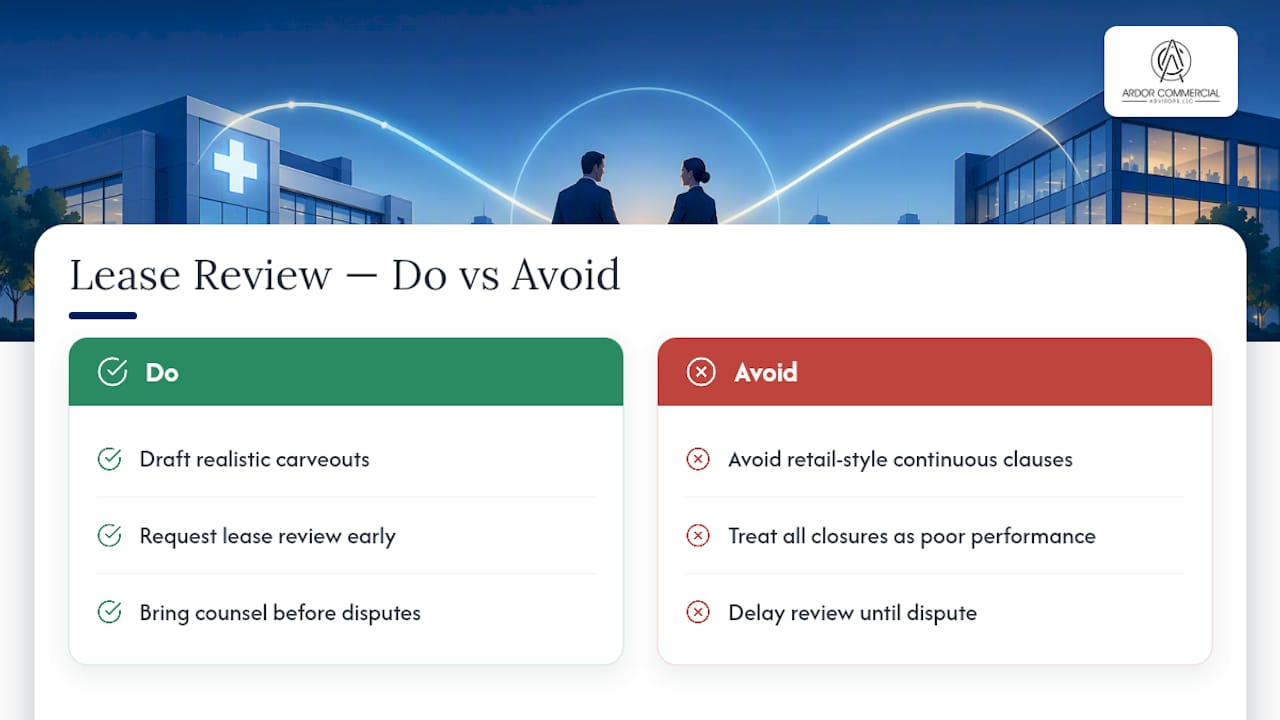
Office and medical leases rarely fit the retail-shaped continuous operation clause landlords default to using. A physician’s practice closes for CME days, staffing gaps, and credentialing delays that have nothing to do with poor business performance, yet a poorly drafted clause treats every closure the same way.
We work with medical and office tenants who need realistic carveouts written into the lease before those gaps become defaults. If your lease includes percentage rent structures, significant tenant improvement allowances, or vague comparable-operator language, that’s the moment to bring in counsel or request a lease review rather than after a dispute starts.
Balancing Landlord Protection With Tenant Reality
The clauses that hold up best in practice aren’t the harshest ones. They’re the clearest ones, with limited remedies and defined exceptions instead of an absolute covenant that invites litigation the moment a business hits a rough stretch.
Medical and office tenants deserve carveouts that reflect how those practices actually operate, not a retail template stretched to fit. When a lease gives ambiguous language the benefit of the doubt, it usually favors whichever side has better lawyers, not whichever side was actually right.
— Jim
Get Your Lease Reviewed Before You Sign or Renew
We work directly with office and medical tenants on issues such as reviewing operating covenants, negotiating carveouts for credentialing and staffing realities, and abstracting lease language to ensure nothing gets missed before signature. Unlike generic lease templates or a one-size-fits-all retail clause, our tenant representation work starts with your specific practice constraints, not a boilerplate assumption about how your business runs.
Whether you’re deciding between leasing and buying as a medical professional, weighing a multi-tenant building purchase, or just need a continuous operation clause reviewed before you sign, Ardor CRE’s services cover lease review, CAM reconciliation analysis, lease abstraction, and full landlord or tenant representation. Reach out to schedule a lease review before your next renewal deadline puts you in a weaker negotiating position.
Sources
- Continuous Operations Clause in a Commercial Lease | Eastman Smith
- Continuous Use sample clauses | LawInsider
- Continuous Operation Clause | USLegal Forms
FAQ
What Does “Continuous Operations” Mean in a Lease?
This differs from a basic hours-of-operation clause because it usually ties to ongoing performance benchmarks like comparable operator standards.
What Does SF/YR Mean on a Lease Rate Sheet?
This indicates the rent rate per square foot, per year, which is a common way commercial rates are quoted before additional charges like CAM or taxes. For example, multiplying this rate by the size of the space gives the annual base rent before extra costs.
What Are Some Red Flags in a Lease Agreement?
Vague continuous operation language without defined hours or exceptions, uncapped liquidated damages tied to recapture, and missing notice or cure periods are among the biggest red flags. A lease that lets the landlord include sales from a tenant’s other locations when calculating damages deserves particularly close scrutiny before signing.
Is a 6-Month Break Clause Normal?
A 6-month break clause is uncommon in commercial leases, which typically favor longer terms of three to ten years, especially when percentage rent or significant tenant improvements are involved. Short break clauses appear more often in flexible office or short-term retail arrangements rather than standard anchor or medical office leases.
Can a Landlord Force a Tenant to Stay Open?
Courts are generally reluctant to order a tenant back into daily operation because it would require ongoing judicial supervision of business decisions. Landlords typically rely instead on monetary damages, recapture rights, or liquidated damages rather than injunctive relief forcing reopening.