
Most commercial work in Charlotte needs a permit, and which office issues it depends on where the parcel sits. For a medical practice, office tenant or building owner, the safest time to find out is before you sign a lease or a purchase contract, because zoning, change of use and review time decide whether your space opens on the date you planned. We are a Charlotte-area commercial real estate brokerage, and this guide covers the permits, the agencies, the fees and the checks that matter before you commit to a property.
TL;DR
- Permits are required for new construction, alteration, repair, demolition and for electrical, mechanical and plumbing work in commercial buildings, according to Mecklenburg County Code Enforcement.
- Two tracks run side by side inside the city: City Land Development reviews the site, and the county issues the building permit. The county cannot release the building permit until the city’s holds are cleared.
- A change of use needs a certificate of occupancy, so check the zoning and the use matrix before you lease or buy.
- Medical build-outs typically take longer to permit than a standard office upfit. Build that into your lease commencement date.
Table of Contents
- Which commercial projects need a permit
- Who issues what: city, county and towns
- Check zoning and existing permits before you sign
- From application to certificate of occupancy
- What permits cost
- How long it takes
- Permit questions to settle in the lease or contract
- Get the permit questions answered before you commit
- FAQ
- Sources
Which commercial projects need a permit
The county’s Code Enforcement department states that permits are required for commercial work on any new construction, reconstruction, alteration, repair, relocation or demolition of a building. Installing, extending, altering or generally repairing electrical, mechanical or plumbing systems is covered too. Building, electrical, heating and air conditioning, and plumbing work each carry their own permit.
The city’s rule sits in Chapter 4 of the Unified Development Ordinance (UDO), the document that governs zoning and land use in Charlotte. Section 4.102 makes it illegal to start construction, reconstruction or demolition, make structural repairs, alterations or additions, or build a paved area over 20,000 square feet of impervious cover without a building permit. Section 4.101 adds that permitted uses need both a building permit and a certificate of occupancy (CO), and that a change in the use of a property requires a CO as well.
In plain terms:
- Moving a wall usually moves something else. Plumbing, ductwork, wiring and exits tend to follow, and each can trigger a trade permit.
- Like-for-like equipment swaps can be simpler. The county’s Trade Internet Permitting system offers instant online permits for commercial equipment changeouts that do not need plan review.
- Larger sites add environmental layers. Disturbing an acre or more requires an approved erosion and sedimentation control plan before land disturbance, and an NPDES construction permit from the state is part of that picture. Demolishing a structure built before 1985 requires an asbestos inspection by a licensed inspector first.
If you are buying land rather than a building, our guide to Charlotte land development covers the investor side of the same approvals.
Who issues what: city, county and towns
This is where most first-time applicants get confused. Charlotte-Mecklenburg Inspections handles building permits and inspections for the city and most county towns, but zoning and site review are not all in one place.
| Question | Where it goes |
|---|---|
| Zoning and UDO questions inside Charlotte | City of Charlotte Planning, Design & Development |
| Commercial site plans, drainage, tree review inside Charlotte | City Land Development, in the city’s Accela portal |
| Building, electrical, mechanical, plumbing permits and inspections | Mecklenburg County Code Enforcement, in its Accela portal |
| Zoning in Cornelius, Davidson, Huntersville, Matthews, Mint Hill, Pineville | The town’s own zoning code and staff |
A useful way to picture it: a site inside Charlotte answers to city land development reviewers for stormwater, buffers and transportation, then to county reviewers for the building itself. A site in unincorporated county skips the city’s stormwater and zoning layer but still meets county erosion control and floodplain rules.
The two tracks can run in parallel, but they meet at release. County Code Enforcement cannot issue the building permit until City Land Development approves and releases its holds. Projects that treat the city review as an afterthought are the ones that stall at the last step. File both early.
In the six towns, the county building permit is the same, but the town’s zoning code controls. In Huntersville, for example, the record can sit in a zoning deferral for roughly two to five working days while the town reviews. A mailing address does not always match the permitting jurisdiction, and annexation lines shift, so confirm the parcel’s jurisdiction on the county’s POLARIS GIS map before you plan around any timeline.
Check zoning and existing permits before you sign
The cheapest permit problem is the one you find during due diligence. Four checks take under an hour:
- Confirm the zoning. Charlotte’s GIS viewer, Charlotte Explorer, shows a parcel’s full zoning. Note whether it is a current UDO district or a legacy conditional zoning.
- Read the use matrix. Article 15 of the UDO marks each use as permitted by right, permitted with prescribed conditions, conditional or not allowed in each district. A use permitted by right still has to meet dimensional standards and pull the required permits. A use can be allowed in one sub-district and conditional in another.
- Watch for old labels. Charlotte adopted the UDO in 2022 and it took effect June 1, 2023. Older documents that cite B-1 or I-2 refer to the prior ordinance, where B-1 became CG and I-2 became ML-2.
- Pull the permit history. The county’s permit search shows building, electrical, mechanical and plumbing permits issued to a property within the last six years. Open permits or work with no permit on record are worth knowing about before closing.
Our commercial zoning guide walks through CG and CR districts and the UDO rules that most often change a project’s scope. For tenants, this check belongs next to the lease review: a use clause means little if the zoning does not allow the use.
From application to certificate of occupancy
Most commercial projects require plan review. Mecklenburg County’s commercial plan review page describes several tools worth knowing:
- On-Schedule and Express review, which let you control when the review happens, so you can plan construction and occupancy dates around it.
- A one-hour Preliminary Plan Review meeting with plans examiners before you submit, useful for settling code questions early.
- Revisions to Approved Plans for minor changes after approval.
- An electronic submittal system where architects and engineers upload drawings and track the project from estimate through plan review to permit.
On the city side, the Expedited Plan Review program covers eligible land development construction plans. Plans pass a three-business-day gateway before fees are assessed, then go into an initial 15-business-day review. Accepted projects get shorter later cycles. Projects in the extraterritorial jurisdiction, projects under NCDOT review and those with interchange or bridge requirements are excluded.
One more detail: North Carolina adopts new building code editions on its own schedule. Confirm which edition applies at the time you submit, because it can differ from the latest national model code.
The certificate of occupancy
The CO is issued after all final inspections pass across building, electrical, plumbing, mechanical and fire. The City of Charlotte’s preconstruction packet states that the city does not issue temporary COs, while Mecklenburg County does when conditions are met. The city can issue a Letter of Intent instead, a written agreement listing outstanding non-safety items the developer will finish within a set number of days. The commercial CO checklist in the city’s packet includes completed grading and drainage, approved detention as-builts, recorded easements and finished sidewalks, curbs and driveways.
The UDO also allows staff to withhold, suspend or revoke a permit or CO for ordinance noncompliance. A tenant who opens before the CO is in hand puts the whole lease at risk.
What permits cost
Costs split into two buckets: city planning and site review fees, and county building permit fees.
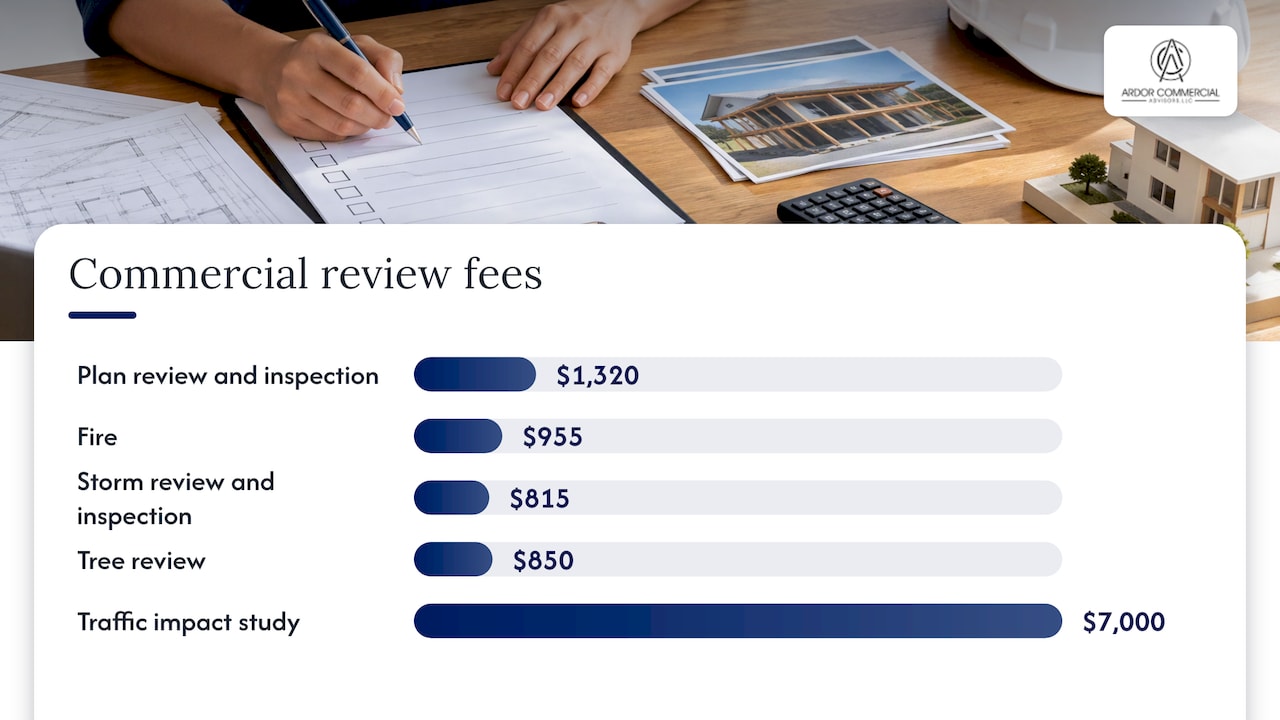
The city publishes a non-residential fee schedule each fiscal year. In the FY2026 schedule (projects passing gateway July 1, 2025 to June 30, 2026), commercial planning fees included $1,320 for plan review and inspection, $955 for fire, $815 for storm review and inspection and $850 for tree review. Commercial zoning review for work on existing buildings was $300 on-schedule, and a traffic impact study was $7,000. These figures are reset each July, so confirm the schedule for your submittal date.
On the county side, the fee ordinance defines the permit value as the higher of the owner’s figure or the county’s valuation calculation. It covers all project costs other than land, including labor, materials, and contractor and design fees. Complex projects may be permitted in increments such as foundation, steel, shell and core. Budget the permit fee off a realistic construction cost, not a low estimate.
One worked example for a tenant: a dental practice building out 3,000 square feet of second-generation space has a construction value that sets the county fee, plus trade permits, plus any city review fees if site work is involved. Ask the landlord’s contractor or your architect for the permit value, then check it against the county’s current fee table.
How long it takes
Timelines vary with completeness of the submittal, the number of correction cycles and the type of use. One local construction guide gives these typical ranges from complete submittal: 3 to 6 weeks for simple commercial permits, 4 to 8 weeks for office build-outs and 8 to 16 weeks for medical office. A change of occupancy can add several weeks, and a rezoning takes months. Treat these as planning ranges, not promises, and confirm against the county’s current review options.
Three practical rules follow:
- Permit time belongs in the lease. If the landlord is delivering the space or you are doing the work, the rent commencement date should reflect realistic permit and inspection time. Our leasing timeline for medical and office tenants shows where permitting fits in a three to six month process.
- Pay for completeness. Incomplete drawings generate correction cycles, and each cycle costs weeks.
- Use scheduling tools. On-Schedule and Express review exist so the project manager can protect the critical path. For help structuring that schedule, see this overview of keeping a commercial project on track.
Permit questions to settle in the lease or contract
Permits are a risk allocation question as much as a government one. Before you sign:
- Who applies and pays? Landlord work letters should say who pulls the permits, who pays the fees and who carries the risk of delay.
- Who owns the CO? A tenant improvement allowance does not help if the CO is not obtainable for your use.
- What happens if approval fails? Negotiate the remedy: extended free rent, a termination right or a delivery deadline. Our overview of rent concessions Charlotte tenants can win covers what is negotiable.
- What is the use clause? It should match the zoning and the use you will file for.
- What is in the cost stack? Taxes and operating costs also shape the budget. See Charlotte commercial property taxes for how bills are set.
Buyers and investors should add permit history, open violations and any pending change of use to the due diligence list, along with a lease abstract for each tenant in a multi-tenant building. Our lease abstract guide shows how to pull those terms.
Our perspective
A permit is rarely the reason a Charlotte deal fails. A missed permit assumption is. A tenant signs a lease with a commencement date, the zoning or the use turns out to need more approvals, and the date moves while rent obligations stay put.
We work across the Charlotte MSA on leasing, sales, tenant representation and landlord representation for office, medical, retail and industrial property. That is why we treat zoning, use and permit timing as part of the deal itself: they belong in the lease analysis, the valuation and the negotiation, not after closing.
If you are choosing between spaces, ask which one can be permitted for your use on your schedule. That question often decides which space is truly the better deal.
Jim
Get the permit questions answered before you commit
We represent tenants and landlords and advise owners and investors on commercial property across the Charlotte MSA, including lease review, valuation and the full leasing and sales process. If you are weighing a space or a building, start with our services or see how tenant representation works.
FAQ
Do I need a permit to build a shed in Charlotte, NC?
Often yes, but it depends on size, use and whether the lot is residential or commercial. Accessory structures on commercial property generally fall under the same rule that new construction needs a building permit. Contact Charlotte-Mecklenburg Inspections with the dimensions and parcel address before you build.
Does a change of use need a new certificate of occupancy?
Yes. The city’s UDO states that changes in the use of property require a certificate of occupancy. Converting retail space to a medical office is a typical example, and it may also bring new plan review and inspection requirements.
Which agency do I contact for a commercial building in a town like Huntersville or Matthews?
The building permit comes through Mecklenburg County, but the town’s own zoning code controls and the county routes the permit to the town for zoning review. The CO issues only when both county and town requirements are met.
How much does a commercial permit cost in Charlotte?
There is no single price. County fees scale with the total construction value, and the city charges separate planning and site review fees that it resets each fiscal year. Use the city’s current non-residential fee schedule and the county’s fee table for your project.
Sources
- Permitting | Code Enforcement, Mecklenburg County
- Commercial Plan Review | Code Enforcement
- Unified Development Ordinance, Chapter 4
- Expedited Plan Review, City of Charlotte
- City of Charlotte Preconstruction Packet
- City of Charlotte FY2026 Non-Residential Fee Schedule
- Mecklenburg County Fee Ordinance
- Charlotte UDO adoption ordinance
- Charlotte Commercial Building Permit Guide
- Charlotte Building Permit Guide
- Huntersville Building Permit Guide
- Mecklenburg County Zoning Ordinance: UDO Districts and Rules
- Commercial Project Management overview