
Most Charlotte restaurant space is quoted at roughly $15 to $65 per square foot per year on a triple net (NNN) basis. The range is wide because it depends on the neighborhood. Uptown and South End sit at the top, and University City and NoDa sit at the bottom. Base rent is also only part of the bill. Taxes, insurance and common area maintenance (CAM) are added on top, so the all-in number is often 30% to 50% higher than the quote.
This guide shows the ranges by neighborhood, turns a quoted rate into a monthly check, and covers the lease terms that move your real cost.
TL;DR
- Neighborhood ranges are wide: one local guide puts Uptown at $35 to $65/SF NNN and University City at $15 to $28/SF NNN.
- NNN charges can add 30% to 50% to base rent in restaurant leases, so compare quotes on total occupancy cost, not the headline rate.
- Second-generation space (a former restaurant with the hood, grease trap and plumbing in place) can cut build-out cost and time to open.
- Retail rent growth in Charlotte is forecast to be among the strongest in the country, so expect landlords to hold firm on rate and give ground on concessions instead.
- Negotiate CAM caps, exclusive use, free rent during build-out and TI before you negotiate the last 50 cents of base rate.
Table of Contents
- How restaurant rents are quoted in Charlotte
- Restaurant rent by Charlotte neighborhood
- Are Charlotte restaurant rents going up or down?
- What you pay beyond base rent
- Second-generation space versus a full build-out
- Lease terms to settle before you sign
- A quick budgeting example
- Perspective
- How we help restaurant tenants
- What to do next
- FAQ
- Sources
How restaurant rents are quoted in Charlotte
Commercial rent in Charlotte is almost always quoted as dollars per square foot per year, not per month. A 2,000 SF space at $40/SF is $80,000 a year, or about $6,667 a month, before any pass-through charges.
Two things trip up first-time restaurant tenants:
- Annual versus monthly. Some listings quote a monthly figure for small second-generation spaces and others quote an annual per-square-foot rate. Convert everything to the same basis before comparing. Retail rent quotes are only comparable once you confirm the annual per-square-foot basis and fold pass-throughs into total occupancy cost.
- NNN versus gross. In an NNN lease, the tenant typically pays base rent plus additional rent that can include operating expenses, real estate taxes, insurance and utilities. A gross or modified gross quote already includes some or all of those costs, so a higher gross rate can be cheaper than a lower NNN rate.
If you want the mechanics in detail, our triple net lease guide walks through what each party pays and where the surprises hide.
Restaurant rent by Charlotte neighborhood
These are published ranges for restaurant-suitable space, expressed as annual NNN base rent per square foot. They are a starting frame for budgeting, not a quote for a specific suite.
| Submarket | Annual rent per SF (NNN) |
|---|---|
| Uptown | $35 to $65 |
| South End | $30 to $55 |
| Ballantyne | $25 to $45 |
| Plaza Midwood | $22 to $40 |
| NoDa | $18 to $35 |
| University City | $15 to $28 |
Source for the ranges: We Build Charlotte NC’s restaurant opening guide, March 2026.
A few patterns explain the spread:
- Foot traffic and visibility drive the top of each range. A corner end-cap with patio space in South End costs more than an interior inline suite two blocks away.
- Condition drives the rest. A space with a working hood, grease interceptor and adequate electrical service commands more than a vanilla shell.
- Size matters in both directions. Smaller spaces often carry a higher rate per square foot but a lower total check. For a first location, total monthly occupancy cost often matters more than the rate.
If you are weighing a neighborhood against a different type of tenant space, our retail site selection playbook covers how to test a location before you commit, and our page on restaurant lease rates in Charlotte goes deeper on what to expect.
Are Charlotte restaurant rents going up or down?
The broad direction is up, and gently. Marcus & Millichap’s March 2026 retail outlook projects Charlotte retail vacancy falling 10 basis points to 3.5% in 2026, with rent growth reaching a market-leading 4.7% by year-end. The same report credits a strong labor market and steady population inflows, and notes that new retail construction has been constrained.
What that means for you as a tenant:
- Tight vacancy means fewer good restaurant boxes. Well-located second-generation spaces tend to lease quickly, so have your financials, concept and lease questions ready before you tour.
- Rate is stickier than concessions. When a landlord will not move on base rent, there is often room on free rent, tenant improvement allowance, escalation size and CAM caps. Our guide to Charlotte rent concessions lists what tenants can realistically ask for.
- Forecasts are not quotes. Citywide figures cover all retail. A specific restaurant space will price on its own condition, location and landlord.
What you pay beyond base rent
Base rent is the most predictable piece of occupancy cost. The rest is where budgets break.
NNN charges
According to Blue Cloud CPA, NNN charges add 30% to 50% to base rent in restaurant leases. Their example: a $30/SF base commonly becomes $42/SF all-in once property taxes, insurance and CAM are loaded on. For a 3,000 SF restaurant, that is $126,000 a year, or $10,500 a month, against $90,000 and $7,500 a month on base rent alone.
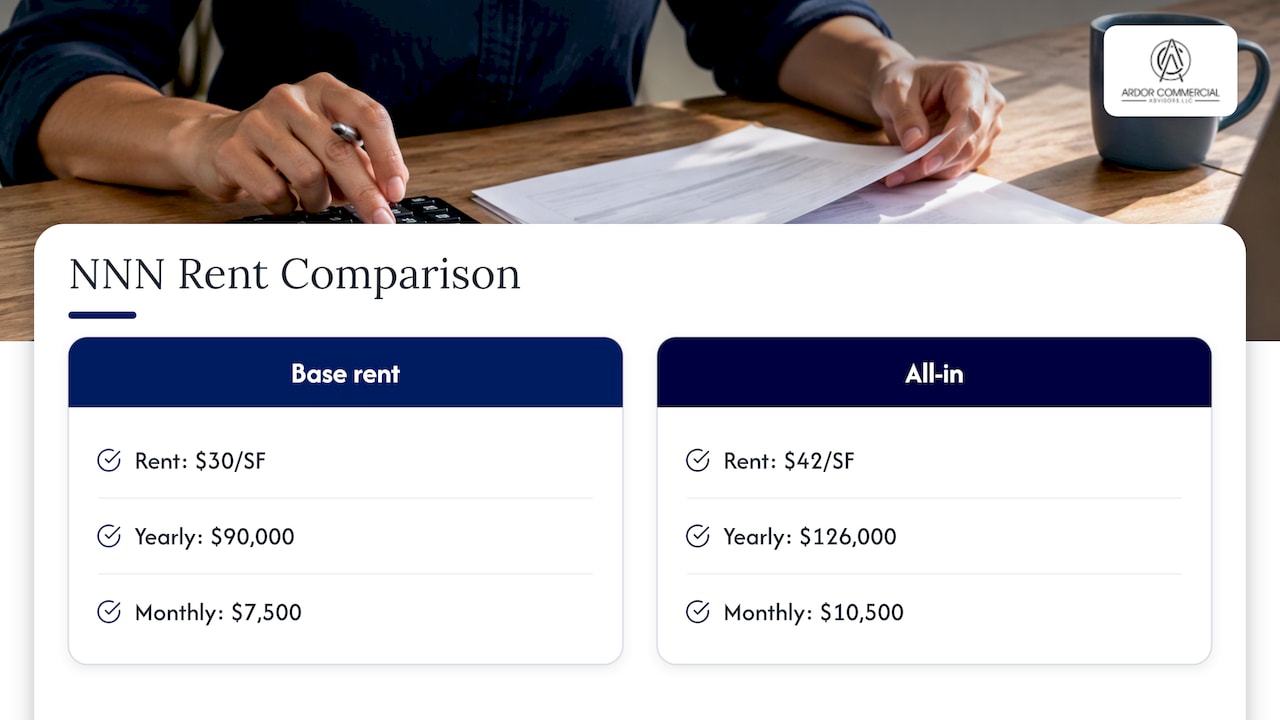
Run that math on every space you tour. A $38 quote with $14 of pass-throughs costs more than a $45 quote with $6.
CAM charges
CAM covers shared costs such as parking lot upkeep, lighting, trash, snow-free walkways in the rare freeze, and landscaping. One restaurant-focused finance writer notes CAM can run 15% to 30% of base rent. Ask for the prior two or three years of CAM reconciliations. For an idea of what grounds work can cost a property, see this commercial landscape maintenance cost guide, because those line items roll into your share.
The point of dispute is usually capital expenditures. Blue Cloud CPA’s CPA author says landlords have been known to push roof replacement, parking lot resurfacing or HVAC replacement into CAM, which inflates the charge in the year of the work. A well-negotiated lease caps annual CAM increases at 3% to 5% and excludes capital expenditures. Our pro rata share guide explains how to check that your share of the building is calculated correctly.
Escalations and percentage rent
Many leases build in annual escalations of 2% to 3% into the base rent schedule. Some retail leases also include percentage rent, which requires extra rent once sales pass a threshold. The same source gives an example of 6% of sales above $1.5 million a year. Model it against your best-case sales year, not only your average one.
Second-generation space versus a full build-out
A second-generation restaurant space is one that was previously a restaurant and still has much of the infrastructure. It often rents at a similar rate per square foot to comparable space, but it changes what you spend before opening day.
| Item | Second-generation space | Raw shell or non-restaurant space |
|---|---|---|
| Front-of-house work | Mostly cosmetic changes and new signage | Full design and construction |
| Time to open | Shorter | A new build-out can take nine to eighteen months |
| Upfit cost in Charlotte | Varies by condition | $150 to $350/SF with 12 to 20 week timelines |
| Missing infrastructure | Usually in place | Retrofitting electrical, gas, grease trap, hood and HVAC can add $50,000 to $200,000 |
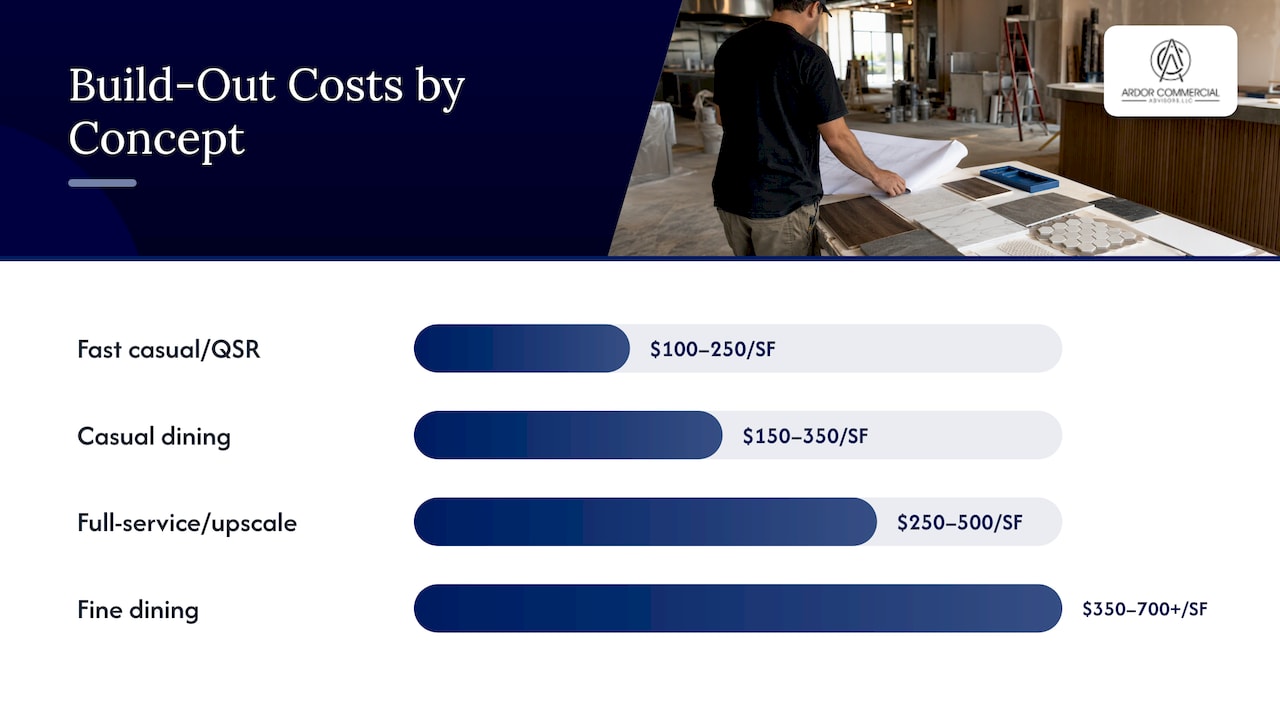
Build-out costs by concept, per the same Charlotte guide, run roughly $100 to $250/SF for fast casual and QSR, $150 to $350/SF for casual dining, $250 to $500/SF for full-service and upscale, and $350 to $700+/SF for fine dining.
Every month of construction is a month of rent on a dark space. That is why a slightly higher rate on a ready-to-cook second-generation suite can beat a cheaper rate on a shell. Ask who owns the hood, walk-in and grease interceptor, and whether they are included in the lease or need to be bought separately.
For shells and finished space alike, our shell versus vanilla box guide shows how to set build-out cost before rent starts, and our landlord work letter checklist covers what to pin down in writing.
Lease terms to settle before you sign
Rent per square foot gets the attention, but these terms decide whether the deal works.
- Use clause and exclusive use. Make sure the use clause covers your concept, including alcohol, outdoor seating and delivery. Ask for exclusivity for your cuisine type in the center.
- Free rent during build-out. Two to four months is a common request for restaurant tenants.
- TI allowance. Charlotte restaurant tenants can negotiate allowances that offset $20 to $50 per square foot of build-out cost.
- Term and renewals. Leases typically run 5 to 10 years with renewal options. Read how renewal rent is set; our guide to fair market rent renewal explains the mechanics.
- HVAC and grease trap responsibility. State in writing who repairs and replaces them.
- Percentage rent breakpoints. If the lease has them, push the breakpoint above projected revenue for the first 18 to 24 months.
- Personal guarantee. New restaurant concepts are often asked for one. Our guide to a corporate guarantee lease capped at 12 months’ rent shows an alternative structure to discuss.
A quick budgeting example
Suppose you tour a 2,400 SF second-generation space in Plaza Midwood. The landlord quotes $34/SF NNN, with estimated pass-throughs of $11/SF.
- Base rent: 2,400 x $34 = $81,600 a year, or $6,800 a month.
- Pass-throughs: 2,400 x $11 = $26,400 a year, or $2,200 a month.
- All-in occupancy: $108,000 a year, or $9,000 a month.
This is an illustration, not a market quote. The point is the habit: build the monthly all-in number first, then ask what your sales must be to carry it. Then add the escalation, so in year three you know the check will be larger.
Perspective
Restaurant operators usually come to us with a rate in mind and leave with a total occupancy number. That shift is the most valuable thing a broker does early on.
We tell tenants to compare spaces on the all-in monthly cost, the condition of the infrastructure and the strength of the concessions, in that order. Our approach is to review the lease line by line, run the CAM and pass-through numbers against the building, and negotiate with the whole package in view, not only the base rate.
In a market where retail space is tight, preparation wins. Have your concept, financials and priorities ready, and let an advisor who works Charlotte every day pressure-test the lease before you sign it.
Jim
How we help restaurant tenants
We are a Charlotte-area commercial real estate brokerage that handles leasing and tenant representation, lease review and CAM reconciliation analysis. If you are comparing spaces or holding a landlord’s draft lease, we can help you read it before you commit. See how tenant representation works, or have us look at your lease and CAM charges.
If you want to talk through a specific space, start on our services page.
What to do next
- Pick two or three target neighborhoods and set a total monthly occupancy ceiling, not a rate ceiling.
- Decide whether a second-generation space fits your concept, and what a full build-out would add in cost and months.
- Request CAM history, tax and insurance estimates and any existing equipment list for every space you tour.
- Have your lease reviewed before you sign a letter of intent. Our commercial leasing timeline shows how long each step typically takes.
FAQ
How much is rent usually for a restaurant in Charlotte?
Published ranges run from about $15/SF NNN in University City to $65/SF NNN in Uptown, per one Charlotte build-out guide. Add pass-throughs, which can raise the total by 30% to 50%. Specific suites price on location and condition.
Are rents going down in Charlotte?
Forecasts point the other way. Marcus & Millichap projects Charlotte retail vacancy at 3.5% and rent growth of 4.7% by the end of 2026. Concessions such as free rent and TI are where tenants usually find room.
Is second-generation restaurant space cheaper?
It usually costs less to open, because the hood, grease trap and plumbing are already there. Modern Restaurant Management reports that second-generation space only needs cosmetic changes to the front of house and signage. Confirm the equipment and infrastructure in the lease.
How long is a typical restaurant lease?
Restaurant leases in Charlotte typically run 5 to 10 years with renewal options. Negotiate the renewal rent method and any early termination rights before signing.
Sources
- Restaurant Opening Guide: Build-Out, Permits & Timeline in Charlotte, We Build Charlotte NC
- Commercial Upfit Charlotte NC, We Build Charlotte NC
- Restaurant Lease Negotiation: Triple Net, Percentage Rent, Blue Cloud CPA
- Occupancy Expenses, The Pragmatic CFO
- Triple Net Leases: 10 Opportunities for Commercial Tenants, Association of Corporate Counsel
- How to Calculate Rent Per Square Foot for Retail Space
- Second-Generation Restaurant Space Is the Hottest Real Estate Today, Modern Restaurant Management
- Commercial Landscape Maintenance Cost: A 2026 Budget Guide