
Medical office space in Charlotte is quoted in dollars per square foot per year, and a recent snapshot of listings put the average around $25.40 per square foot per year. That is only the base rent. A dental practice also pays for its share of building operating costs, a buildout that is far more expensive than for a standard office, and the lease terms that decide who owns the plumbing and the chairs’ infrastructure when you leave. This guide shows how to turn an asking rent into a real monthly occupancy cost for a Charlotte dental office.
TL;DR
- Asking rents are quoted per square foot per year. Divide by 12, then multiply by your square footage, to get the monthly base rent.
- Base rent is not your full cost. Under a triple-net (NNN) lease you also pay a share of CAM, taxes and insurance, plus your own utilities.
- Dental buildout is the largest variable. Charlotte contractor guides put it anywhere from about $150 to $500+ per square foot depending on the space and scope.
- The lease terms that protect you most are the tenant improvement allowance, rent start date, NNN caps and who owns improvements at the end.
- Start looking 12 to 18 months before you need to open or move.
Table of Contents
- How dental office rents are quoted in Charlotte
- What dental space costs to lease in Charlotte
- What you pay beyond base rent
- Buildout: the cost that decides the deal
- Lease terms to settle before you sign
- Building requirements that affect your rent
- A realistic timeline
- Lease or buy your dental space?
- Get help finding and leasing dental space
- FAQ
- Sources
How dental office rents are quoted in Charlotte
Listings show a rate such as $28.00 per square foot per year. It is an annual figure for each square foot you occupy, not a monthly price. A 2,400-square-foot suite at $28.00 works out to $67,200 a year, or $5,600 a month, before anything else.
Two details change what that number means:
- Rent structure. Full-service rents include most operating costs in the quoted rate. NNN rents do not: the rate is lower, and you pay operating costs separately. Office markets quote both, so a $35 full-service rate and a $26 NNN rate are not directly comparable.
- Rentable versus usable area. You pay on rentable square feet, which includes a share of common areas such as lobbies and corridors. A suite that feels like 2,200 square feet can be billed as 2,400.
For a sense of the wider office market, Charlotte office rents have been climbing at the top end. We track what tenants pay per square foot in our look at Charlotte office rents, and the same quoting conventions apply to medical space.
What dental space costs to lease in Charlotte
Medical office listings run lower on paper than top-tier downtown office space, which is why dentists often find the best value in suburban medical buildings. A recent marketplace snapshot of 13 Charlotte medical office listings showed asking rates from $25 to $27 per square foot per year, with a state average of $22.32 for comparison. Treat that as a floor reference, not a quote: listings are asking prices, they skew toward older suburban suites, and newer or better-located medical buildings ask more.
Here is how a monthly base rent looks at different asking rates and sizes. These are our arithmetic examples, not market quotes.
| Suite size | $25/SF/yr | $30/SF/yr | $35/SF/yr |
|---|---|---|---|
| 1,500 SF (2 to 3 operatories) | $3,125/mo | $3,750/mo | $4,375/mo |
| 2,400 SF (4 operatories) | $5,000/mo | $6,000/mo | $7,000/mo |
| 3,000 SF (4 to 6 operatories) | $6,250/mo | $7,500/mo | $8,750/mo |
A four-operatory dental office typically needs 2,000 to 3,000 square feet, so the middle rows are the realistic planning range for a general practice.
Rents by neighborhood
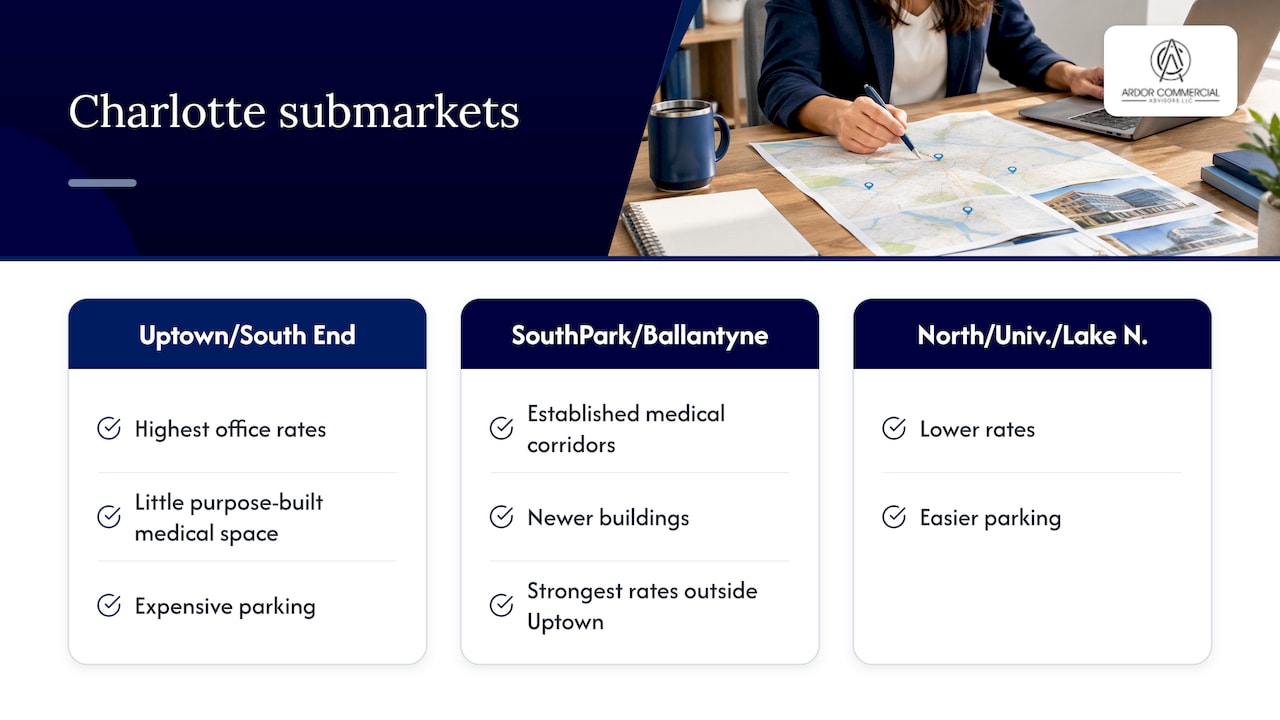
Charlotte rents vary by submarket, and a dental practice depends on patient access more than most tenants do. As a general pattern, Uptown and South End command the highest office rates but have little purpose-built medical space and expensive parking. SouthPark and Ballantyne are established medical corridors with newer buildings and the strongest asking rents outside Uptown. North Charlotte, University City and the Lake Norman area (Huntersville, Cornelius, Davidson) tend to offer lower rates and easier parking. Listings for the same year and building type can differ by several dollars per square foot between these areas, so compare buildings, not just ZIP codes.
What you pay beyond base rent
Most dental space is leased on a triple-net basis. Under an NNN lease, a dental tenant pays base rent, a pro-rata share of CAM charges, property insurance and property taxes, plus the tenant’s own utilities. Our guide to the triple net lease explains each piece.
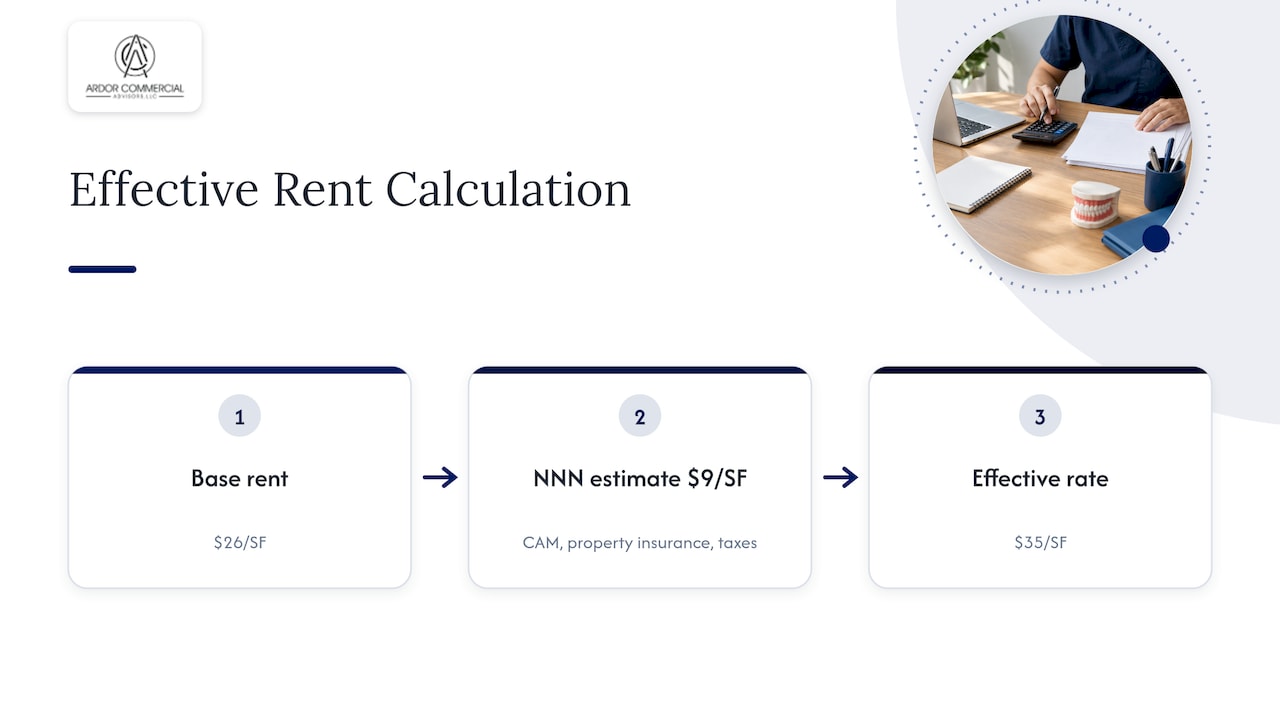
A practical way to budget: ask the landlord for the building’s current NNN estimate per square foot and the last two years of actual figures, then add it to the base rate. If the estimate is $9 per square foot and base rent is $26, your effective rate is $35. CAM statements are also reconciled after year end, so the bill can be higher or lower than the estimate. Reviewing a reconciliation is a specialty of ours, covered under lease review and CAM analysis.
Caps matter here. An experienced attorney should negotiate annual caps on NNN fees, which tend to be landlord-friendly. Ask which categories are capped, whether the cap is cumulative or compounding, and which costs are excluded from the cap (taxes and insurance usually are).
Buildout: the cost that decides the deal
A dental office needs plumbing at each chair, vacuum and compressed air, imaging infrastructure, sterilization and often nitrous. That is why the buildout dwarfs the rent in year one. Charlotte contractor guides give a wide range:
- $150 to $250 per square foot, with total costs of $300,000 to $875,000 for a four-operatory office, per one guide from February 2026.
- $225 to $300 per square foot for a standard dental office and $300 to $400 with an oral surgery suite, per a March 2026 guide from the same firm.
- $200 to $300 per square foot to renovate a clean second-generation medical suite, and $350 to $500+ for new construction, per a June 2026 guide.
The spread is wide because scope varies. A former dental or medical suite with plumbing already stubbed to the right places costs far less than a vanilla shell. This is the strongest argument for looking at second-generation dental space first.
Tenant improvement allowances
Landlords often contribute to buildout through a tenant improvement (TI) allowance. Charlotte retail TI allowances typically run $30 to $75 per square foot in suburban areas and can exceed $100 in premier locations. Those figures are for retail, so treat them as a reference point and ask your broker what medical landlords are offering in the specific building. A larger allowance usually comes with a longer term or a higher base rent, so compare the two together.
Lease terms to settle before you sign
A dental lease should state who pays for what in plain terms. A dental lease checklist recommends the document address dental plumbing, suction, compressor, electrical, IT, shielding, nitrous and sedation infrastructure, who approves plans, who pulls permits, who pays overruns, construction deadlines, whether rent starts before construction is finished, and who owns the improvements at the end. The same checklist advises resolving any “No” or “Not clear” item in writing before the lease is final.
In practice, these are the terms we focus on first:
- Rent commencement. Rent should start after construction is complete and you have received your certificate of occupancy, or after a defined number of days from delivery, not on signing.
- TI allowance and who manages construction. Confirm the dollar amount, the deadline to use it and how it is paid out.
- Term, renewals and rent bumps. Annual escalations compound. A 3% bump on $28 is about $0.84 in year two and more every year after.
- Exclusive use and assignment. If you sell your practice later, the buyer needs the right to take over the lease. See our guide on dental office lease terms that matter when you sell.
- Personal or corporate guarantee. Negotiate its size and a burn-off date. Our piece on a corporate guarantee lease capped at 12 months’ rent covers how.
- Restoration at lease end. Specialty infrastructure can be expensive to remove. Agree in advance what stays.
Building requirements that affect your rent
A cheaper suite can cost more if the building cannot support a dental use. Check these before you tour a second time:
- Plumbing and mechanical. Contractors list medical gas, specialized plumbing, HVAC upgrades and electrical capacity for imaging, sterilization and compressors as the main cost drivers. Ground-floor or slab-accessible space makes plumbing easier.
- X-ray areas. Dental offices need lead-lined walls or digital sensor infrastructure for X-ray areas and careful infection control between operatories.
- Code and parking. Medical facilities face stricter requirements than standard office space, including ADA compliance, fire suppression, plumbing fixture counts and parking ratios. Ask the landlord for the parking count and any restrictions.
- Hidden conditions in older buildings. Renovations can run into outdated wiring, asbestos or inadequate HVAC, and you have limited control over signage and parking in a leased building. Put signage rights in the lease.
- Permit timing. Permits in most North and South Carolina municipalities run 4 to 8 weeks, longer with special use permits or variances. Build that into your opening date.
A realistic timeline
Plan on starting 12 to 18 months before you need the space. The search, letter of intent, lease negotiation, design, permits and construction each take time, and rent should not start until you can see patients. Our medical office leasing timeline and the 3 to 6 month leasing process for medical and office tenants break down each stage.
Lease or buy your dental space?
Once your practice is stable, owning the building can look attractive, because your occupancy cost becomes a mortgage payment and the building builds equity. It takes a larger upfront commitment and a clear view of your growth plans. Run the numbers on your own square footage using our lease versus buy breakeven analysis, and if you are weighing a purchase, our commercial property valuation work models the income and value side.
Our perspective
Dentists usually ask us first what the rent is. The better question is what the suite will cost you per month once the buildout, the NNN charges and the escalations are in, and what you walk away with at the end of the term.
We believe the strongest lease outcomes come from three habits. Compare buildings on effective rent, not asking rent. Prioritize second-generation dental or medical space where the plumbing is already in the right place. And negotiate the rent start date and the improvement allowance alongside the rate, because they are worth as much as a lower rate.
Our advisors do tenant and landlord representation across the Charlotte MSA, so we see both sides of the table, and we review leases and CAM statements line by line. That is how we try to keep a practice’s occupancy cost predictable.
Jim
Get help finding and leasing dental space
We represent medical and dental tenants in the Charlotte MSA, from the initial search through lease negotiation and buildout timing. Our team can compare buildings on effective rent, review the lease and CAM terms, and advise on the allowance and rent start date. Learn more about tenant representation or see everything we do on our services page.
If you already have a lease in hand, our lease review service can flag the terms to renegotiate before you sign.
FAQ
How much does a dental office cost per month to rent in Charlotte?
Divide the annual rate by 12 and multiply by your size. At $25 to $35 per square foot per year, a 2,400-square-foot suite is roughly $5,000 to $7,000 a month in base rent, before NNN charges and utilities. The actual rate depends on the building, submarket and condition of the space.
What does NNN mean for a dentist?
It means you pay base rent plus your share of the building’s operating costs, property taxes and insurance, and your own utilities. Ask for the current NNN estimate and past actuals so you can calculate your effective rent. Ask your attorney or broker to negotiate caps on annual increases.
How much does it cost to build out a dental office in Charlotte?
Charlotte contractor guides published in 2026 give ranges from about $150 to $500+ per square foot, depending on whether the space is a second-generation medical suite or new construction and whether it includes specialty rooms. A landlord TI allowance can offset part of that. Get a contractor bid on the specific suite before you sign.
How early should I start looking for dental space?
Start 12 to 18 months before your target opening or move date. Permits alone commonly take 4 to 8 weeks, and design, lease negotiation and construction come on top of that.
Sources
- Charlotte medical office space for lease listings and averages
- Negotiating your dental office lease: Part 2
- Medical Office Setup Guide for Charlotte
- Commercial Construction Cost Guide: Charlotte NC 2026
- Should You Build or Lease a Dental Office in Charlotte NC?
- Healthcare Construction Checklist for Charlotte practice owners
- Dental Office Lease Checklist