
Medical office rents in Charlotte generally run from the low $20s to the low $40s per square foot per year, triple net (NNN), depending on submarket, building class and how much of the suite is already built out. Availability is near record lows, so the base rent matters less than how quickly you can find a suite and what the build-out will cost you. This guide breaks down the ranges, the extra costs on top of rent and the lease terms worth negotiating.
TL;DR
- Local guides put Charlotte medical rents at roughly $20 to $42 per square foot NNN, with the Midtown medical district at the top and University City at the bottom.
- Medical office availability in the Charlotte area is at a record low, so smaller practices face longer searches and less leverage.
- NNN means you pay taxes, insurance and common area maintenance (CAM) on top of base rent. Compare suites on all-in cost, not the headline number.
- Build-out is the other big cost. Allowance, work letter and timeline decide what a space really costs you.
- Start the search early. A typical medical lease takes months from search to opening.
Table of Contents
- What medical office space costs in Charlotte right now
- Rents by Charlotte submarket
- How medical rent is quoted, and what gets added
- What drives the rent for a specific suite
- Lease terms to check before you compare rents
- Tight supply: how to compete for a good suite
- Lease or buy: a quick framework
- Perspective
- Work with Ardorcre on your medical lease
- FAQ
- Sources
What medical office space costs in Charlotte right now
There is no single Charlotte rent. A suite near a hospital campus, a newer building in Ballantyne and a second-generation suite in University City can differ by $15 or more per square foot.
For context, CBRE’s Q2 2026 report puts the national average medical outpatient asking rent at a record $25.46 per square foot NNN, up 1.3% year over year, with vacancy falling to 9.8%. Cushman & Wakefield’s June 2026 report shows the top 50 markets averaging $26.64 per square foot, up 1.9%, with occupancy at 92.5% and new construction at just 2.2% of existing inventory.
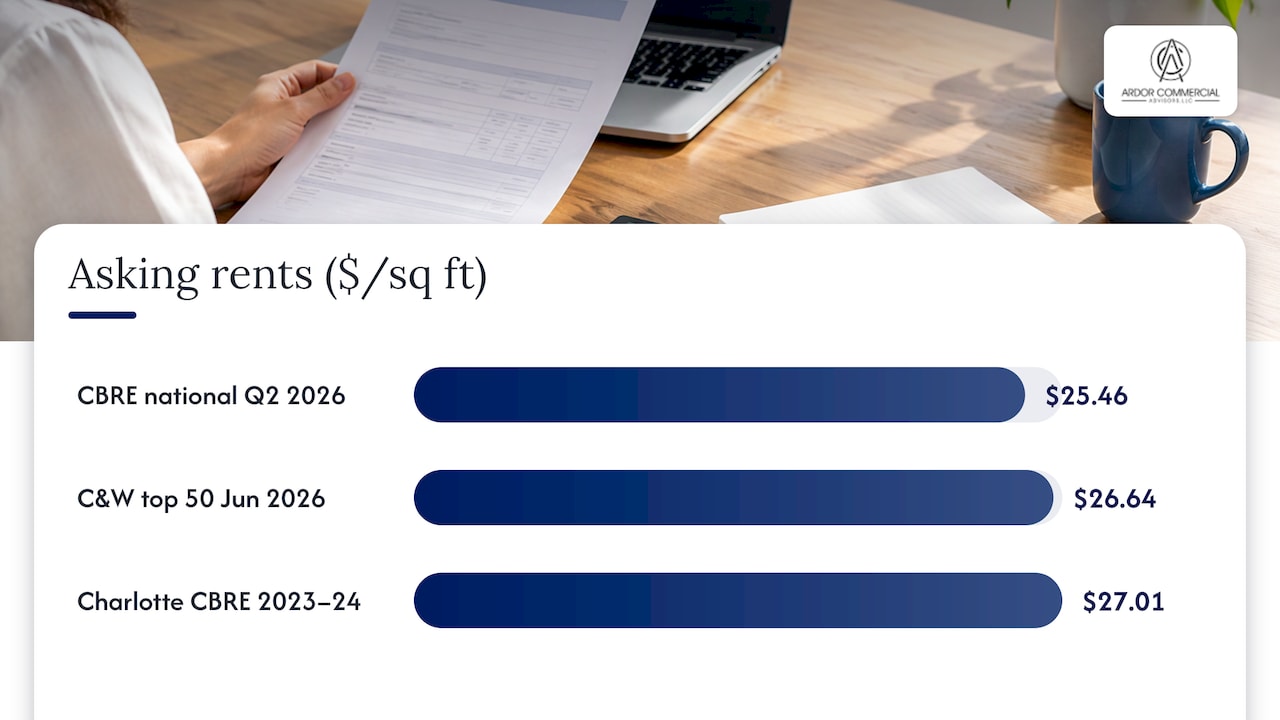
Charlotte sits at or above those averages. A CBRE healthcare outlook, covering Q3 2023 through Q2 2024, listed Charlotte’s average asking rent at $27.01 NNN with 5.1% vacancy. Occupancy has tightened since then. A PwC report from November 2025 put Charlotte’s medical office occupancy above 93%, a record.
Rents by Charlotte submarket
One local February 2026 guide gives these NNN ranges by area. Treat them as starting points for a conversation, not quotes for a particular suite.
| Submarket | Approximate rent (per sq ft per year, NNN) |
|---|---|
| Midtown Medical District (near Carolinas Medical Center) | $28 to $42 |
| SouthPark and South Charlotte corridor | $26 to $38 |
| Lake Norman and Union County | $22 to $32 |
| University City | $20 to $28 |
Three patterns show up in these numbers:
- Proximity to a hospital campus carries a premium. Referral patterns and parking convenience support higher rents near the major health systems.
- Growth suburbs offer more room to negotiate. Census estimates cited in June 2026 show Charlotte adding about 20,731 residents between July 2024 and July 2025, more than any other U.S. city, with much of the growth in Union County and the Lake Norman corridor. Practices are following patients there.
- Value areas still exist. University City and parts of the outer ring can fit a start-up practice budget, especially in second-generation space.
For how submarkets compare for buyers, sellers and refinancing owners, see our Charlotte submarket guide. If your practice is deciding between medical and general office space, our look at Charlotte office rents shows what office tenants pay.
How medical rent is quoted, and what gets added
Most medical listings quote rent per square foot per year. Multiply by the suite’s square footage and divide by 12 for the monthly base rent. A 3,000 square foot suite at $30 per square foot is $90,000 a year, or $7,500 a month, before anything else.
Under an NNN lease, you also pay your pro rata share of three things: property taxes, building insurance and CAM. CAM covers landscaping, parking lot upkeep, common area utilities, janitorial for shared spaces and management fees. Our triple net lease guide walks through how each line is billed.
A modified gross or full-service lease rolls some or all of those costs into one rent. The headline number looks higher, but the comparison is fair only when you convert both to the same basis. Ask every landlord for an estimate of operating expenses per square foot and compare totals.
Two items often catch practices off guard:
- Annual CAM reconciliation. Landlords bill estimates monthly, then true up after year end. Read the lease for audit rights, caps on controllable expenses and what counts as CAM. Our CAM charge and lease review service exists for exactly this.
- Medical-specific systems. Plumbing in every exam room, dedicated HVAC, after-hours access, and medical waste handling can affect operating costs and what the lease lets you do.
What drives the rent for a specific suite
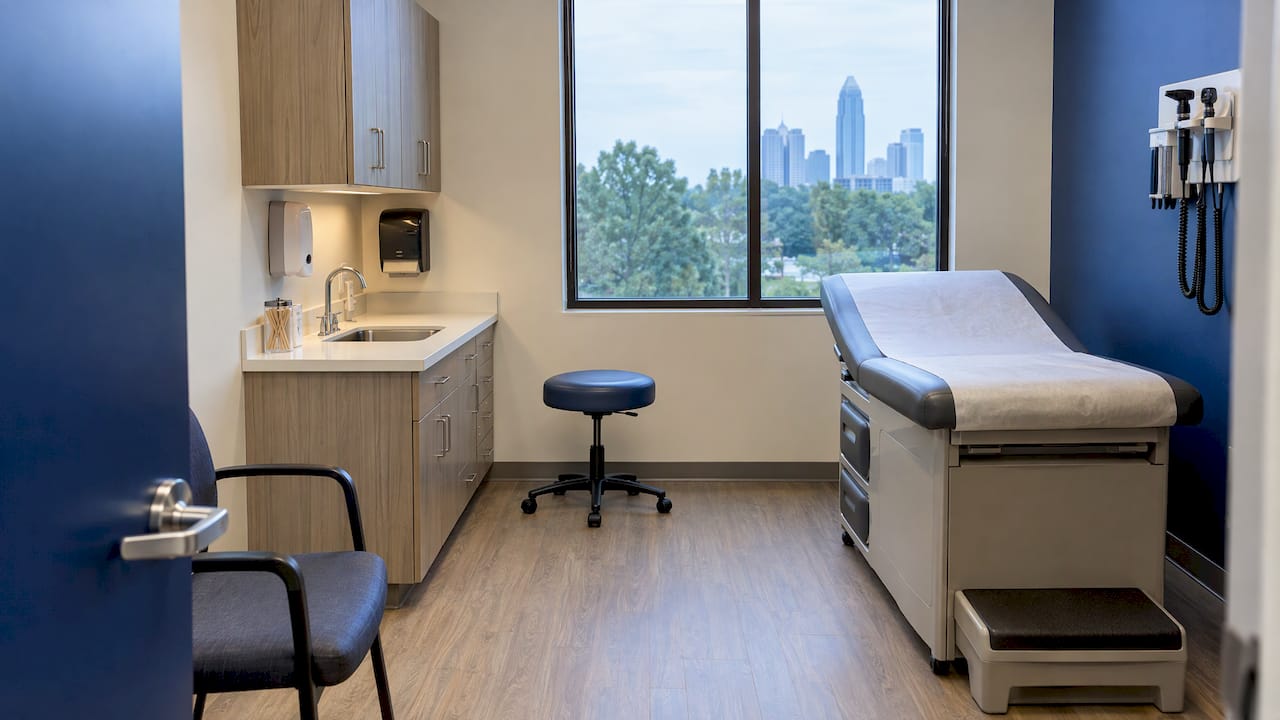
Condition and build-out. A suite already built for medical use, with plumbed exam rooms, reception and lab space, commands more than a vanilla shell. It also saves you money and time. JLL’s February 2026 work, reported by Bisnow, put outpatient fit-out cost at $412 per square foot, which is why existing medical space is so sought after.
Size. Small suites of 1,500 to 3,000 square feet are what independent practices want, and demand there is strong. Larger blocks come with more room to negotiate on allowances.
Competition for space. Local commentary cited by Hoodline says smaller practices face longer site searches, larger tenant improvement budgets and less negotiating power when bidding against health system tenants. Investor interest is also pushing prices up on move-in-ready medical buildings.
Landlord ownership. A building owned by an investor who values stable medical tenants may offer more flexibility on term and improvements than a building about to be sold. Our medical office demand analysis and cap rate guide explain how owners think about medical tenants, which helps you read the other side of the table.
Lease terms to check before you compare rents
Two suites at the same rent can cost very different amounts over a lease. Check these before choosing:
- Tenant improvement allowance. How many dollars per square foot will the landlord contribute, and is it paid as a lump sum, in draws, or amortized into your rent? Our landlord work letter checklist lists ten points to settle for medical and office build-outs.
- Term and renewal options. Medical build-outs pay back slowly. A longer term with fixed-rate or capped renewal options protects your investment in the space.
- Annual escalations. Fixed bumps are predictable. Check whether the percentage applies to base rent only.
- Free rent. Free rent during construction and the first months of operation helps cash flow while patient volume builds.
- Personal or corporate guarantee. New practices are often asked for a guarantee. Our guide on capping a corporate guarantee at 12 months’ rent shows a negotiating target.
- Exclusive use and assignment. Exclusives protect you from a competing practice next door. Assignment and sublease rights matter when you sell the practice or bring in a partner.
- Operating hours, parking and signage. Patient access and visibility drive revenue. Confirm parking ratio, after-hours HVAC and monument signage rights.
- Relocation and early termination. Understand the landlord’s right to move you and any option you have to leave early.
Tight supply: how to compete for a good suite
With vacancy this low, the best suites go fast. MMCG Invest’s July 2026 outlook describes Charlotte as having medical office occupancy above 95% and an empty construction pipeline, which suggests supply will not loosen quickly.
What helps:
- Start 9 to 12 months before you need the space. Our 3 to 6 month leasing timeline covers search to signing. Build-out and permitting come after.
- Have financials and a clear space program ready. Landlords favor tenants who can show a complete picture quickly.
- Watch for off-market and soon-to-be-vacant suites. Many good medical spaces are leased before they are publicly listed.
- Consider the landlord’s side of the tour. Landlords who prepare vacant suites, including lease-tour ready cleaning, tend to show better. Look past surface condition at the systems and layout that determine your build-out cost.
- Be open to second-generation space. An existing dental or medical suite can save a large share of that $412 per square foot fit-out.
Lease or buy: a quick framework
Every practice eventually asks whether it should buy. Leasing keeps capital free for equipment and staffing and carries less risk when you are still building patient volume. Owning can make sense once your patient base is stable, because rent payments turn into equity, and a multi-tenant building adds rental income from other tenants. Tight supply also makes an owned location hard to replace. The right answer depends on your cash, your growth plans and the financing you qualify for. A brokerage that does both leasing and sales can model both paths with you.
Perspective
Charlotte’s medical tenants usually come to us after they have seen a headline rent and assumed it is the cost of the space. It rarely is. The real number is base rent plus operating expenses plus the build-out dollars you carry, spread across the term.
Our approach is to treat the lease as a financial model. We review the CAM history, run the allowance and free-rent math, and compare the true cost per year of each option side by side. In a market this tight, a prepared tenant with a clear picture of what the space should cost is the one who gets the suite and the better terms.
We also advise on the owner side, so we know how landlords price medical space and where they have room to move. That is the advantage of using one team for leasing, sales and analysis.
Jim
Work with Ardorcre on your medical lease
We represent medical practitioners, dentists and orthodontists across the Charlotte MSA. That includes tenant representation, lease review and CAM analysis, and advice on whether buying makes sense for your practice.
If you are comparing suites, we can put the real all-in costs next to each other and help you negotiate the allowance, term and escalations. See our full list of commercial real estate services or contact us through ardorcre.com.
FAQ
What is the average medical office rent in Charlotte?
A reasonable working range is about $20 to $42 per square foot per year NNN, depending on the submarket. CBRE’s figures, covering the 12 months to Q2 2024, put the Charlotte average asking rent at $27.01 NNN. Current asking rents on specific suites can differ, so request quotes on the buildings you are considering.
Is medical office rent quoted monthly or yearly?
Most listings quote per square foot per year. Divide the annual total by 12 for a monthly figure. Add your share of taxes, insurance and CAM if the lease is NNN.
How much does it cost to build out a medical office?
JLL’s February 2026 guide, reported by Bisnow, puts medical outpatient fit-out at $412 per square foot. The landlord’s allowance can offset part of that. Existing medical space can reduce the cost considerably.
How long does it take to lease medical space in Charlotte?
Search, negotiation and lease signing commonly take several months, and build-out and permitting follow. With availability this tight, start well before your current lease or planned opening date.
Sources
- CBRE Q2 2026 U.S. MOB Market Report
- Cushman & Wakefield medical outpatient report, June 2026
- CBRE 2025 Healthcare Real Estate Outlook
- Bisnow: Charlotte healthcare real estate
- Hoodline: Charlotte medical office space
- Medical office setup guide for Charlotte
- MMCG Invest US Medical Office Outlook 2026
- Lease-tour ready cleaning for vacant spaces