
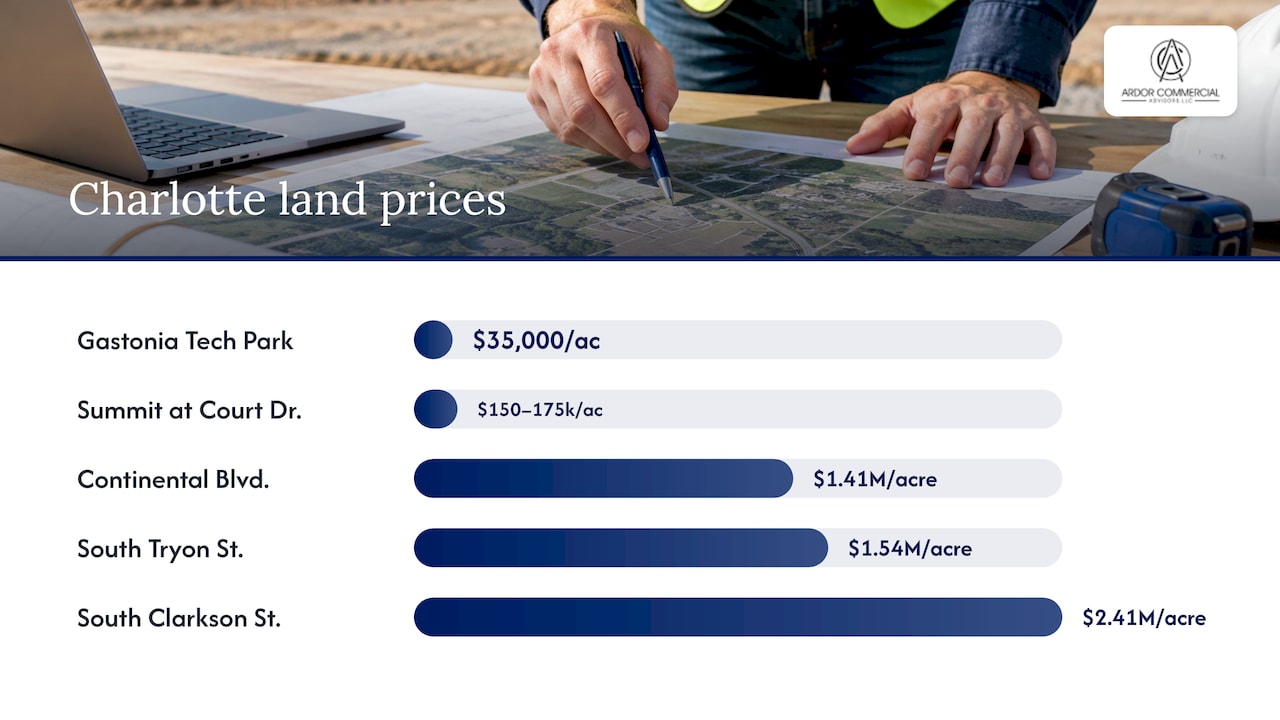
Charlotte commercial land has no single price. Recorded county sales in 2024 and 2025 work out to roughly $1.4 million to $2.4 million per acre for sizable in-city commercial and industrial sites. Graded industrial sites in neighboring Gaston County are listed at $35,000 per acre. Location, zoning, utilities and parcel size explain most of the gap between those numbers. This guide gives you the ranges, the sales behind them and a method for testing any asking price.
TL;DR
- Asking prices run from about $35,000 per acre for graded industrial land in Gaston County to $150,000 to $175,000 per acre for medical and office sites there. Inside Charlotte, large sites trade at seven figures per acre.
- Recent Mecklenburg County deeds show about $1.41 million per acre on a 68-acre industrial tract and about $2.41 million per acre on a 4.89-acre urban site.
- Zoning, utilities, road access and size move the price more than the address alone. Price per acre usually falls as acreage rises.
- Check any listing against recorded sales on the county’s parcel site, not against other asking prices.
- Price the full cost of getting the land ready to build, not just the purchase.
Table of Contents
- What commercial land costs in Charlotte and the metro
- Why the same acre can be priced ten times differently
- How to tell whether a Charlotte asking price is reasonable
- Costs beyond the price of the dirt
- Financing land and development
- Land for medical, office and industrial users
- Our perspective
- Work with an advisor on your land search
- FAQ
- Sources
What commercial land costs in Charlotte and the metro
Think in tiers instead of one average. Each tier is priced for a different future use.
| Area and type | Price signal | Source |
|---|---|---|
| Gaston County, graded industrial (Gastonia Technology Park) | $35,000 per acre | Gaston County Economic Development |
| Gaston County, medical and office (Summit at Court Drive) | $150,000 to $175,000 per acre | Gaston County Economic Development |
| Charlotte, 68.779 acres zoned ML-2 on Continental Boulevard | $97,000,000 (about $1.41 million per acre), May 2024 | Mecklenburg County record |
| Charlotte, 11.01 acres zoned B-1(CD) and B-1SCD on South Tryon Street | $16,950,000 (about $1.54 million per acre), December 2024 | Mecklenburg County record |
| Charlotte, 4.89 acres zoned RAC(CD) on South Clarkson Street | $11,800,000 (about $2.41 million per acre), February 2025 | Mecklenburg County record |
| Charlotte, 3.23 acres zoned MUDD-O on East 36th Street | $72,500,000, November 2024 | Mecklenburg County record |
The per-acre figures for the Mecklenburg sales are our own arithmetic: sale price divided by recorded acreage.
The last row is a reminder that a headline number can mislead. A site that sells for $72.5 million on 3.23 acres is priced for what can be built on it in the urban core, not for the dirt. Use it to understand the ceiling, not to estimate a typical parcel.
For a deeper read on per-acre pricing, see our own breakdown, Charlotte land prices and what an acre costs in 2026.
Why the same acre can be priced ten times differently
Four things do most of the work.
Location and submarket
Charlotte is a metro of many markets. Center City is in the middle of a transformation, with a $3.7 billion development pipeline that includes The Pearl, the North Tryon Tech Hub and the Iron District. Those projects depend on large assemblages of urban land, and they pull up pricing for neighboring parcels that could be assembled into something similar.
Out in Gaston, Cabarrus or Union counties, the same acre is priced for a different buyer and a different timeline. Our Charlotte submarket guide shows where to buy, sell or refinance by area.
Zoning and permitted use
Zoning decides what you may build, and what you may build decides what a buyer will pay. The recorded sales above carry designations such as B-1(CD), RAC(CD), MUDD-O and ML-2. The suffixes matter: conditional districts and optional provisions come with site plans and conditions that travel with the land. Always read the conditions attached to a parcel, not just the base district.
Medical and office users look for different things than industrial users. A dental or orthodontic practice wants visibility, parking and a building envelope that works for a medical build-out. An industrial user wants truck access and clear heights. Land that fits one use cleanly often commands more than land that could fit several uses poorly.
Utilities, road frontage and access
A parcel with water, sewer and power at the property line is a different asset from one that needs a line extension. Road frontage and curb cuts matter just as much, because a site that can’t get a driveway permit is hard to develop at any price. Gaston County’s graded, ready sites list at $35,000 per acre for industrial use, which reflects how much of the work is already done.
If you are comparing a lot that needs site work to one that does not, price the work. Clearing, grading and drainage can change the real cost per buildable acre, and a commercial land clearing contractor can give you a quote to put beside the asking price.
Parcel size
Price per acre generally falls as acreage rises, because fewer buyers can write a larger check and large parcels need more entitlement work. The reverse is also true: a small infill lot priced at a high per-acre number may still be a modest total check. Compare per-acre figures only between parcels of similar size, and compare totals to your budget.
How to tell whether a Charlotte asking price is reasonable
Asking price is a seller’s hope. A recorded sale is a fact. Use this sequence.
- Pull the recorded sales. Mecklenburg County’s Polaris 3G parcel records show deed references, sale prices, ownership and zoning. Search the parcels near your target and note the date, acreage and price.
- Convert to price per acre and per buildable acre. Subtract floodway, stream buffers, easements and steep slopes from the gross acreage before dividing.
- Match the zoning. Compare only sales with similar zoning or similar entitlement paths. A sale with an approved site plan is worth more than one that still needs rezoning.
- Adjust for utilities and access. Subtract the cost of bringing water, sewer, power and a driveway to the site if the comp already has them.
- Adjust for timing. A 2024 sale reflects 2024 rates and demand. Interest rates and construction costs move land values, so weigh recent sales more heavily.
- Run the numbers for your use. Work backward from the building: expected rent or sale value, minus construction and soft costs, minus profit, gives a residual land value. If the asking price is above that, the seller needs to move.
A valuation helps when the numbers are large or the use is unusual. Our commercial property valuation work includes DCF modeling for just that residual question.
Costs beyond the price of the dirt
The purchase price is rarely the full cost of land. Build a budget that also includes:
- Due diligence: survey, environmental review, geotechnical work and title.
- Entitlements: rezoning or site plan approval can take months and carry consultant and legal fees.
- Site work: clearing, grading, stormwater and utility extensions.
- Carry: taxes and interest while you wait for approvals.
- Impact and permit fees: these vary by jurisdiction, so confirm them with the city or county where the parcel sits.
For a fuller look at the development side, read our Charlotte land development guide for investors.
Financing land and development
Lenders treat raw land differently from income-producing buildings. Land has no income to support debt service, so expect lower leverage and larger equity requirements than on a stabilized building. Once there is a building and a lease, the structure changes, and debt service coverage becomes the key measure. Our guide to DSCR for commercial real estate walks through loan sizing.
Private capital advisors can also arrange options such as bridge and construction financing for acquisition and development phases. Compare terms from more than one lender, and ask each how they treat entitlement risk and how long they will fund before construction starts.
If you are selling other real estate to buy land, a 1031 exchange may defer the tax. Talk to a CPA and a qualified intermediary before you list, since the timeline rules are strict.
Investors can also look at the 17 Charlotte opportunity zones, which include medical, industrial and office sites.
Land for medical, office and industrial users
The use case shapes what you should pay.
Medical and office. Practices tend to buy land when they want to own a purpose-built building, often with room to lease extra space to other tenants. Gaston County lists medical and office sites at Summit at Court Drive at $150,000 to $175,000 per acre, which is a useful reference point for suburban pricing outside Mecklenburg. For demand signals, see our look at Charlotte medical office demand and the Charlotte office market analysis.
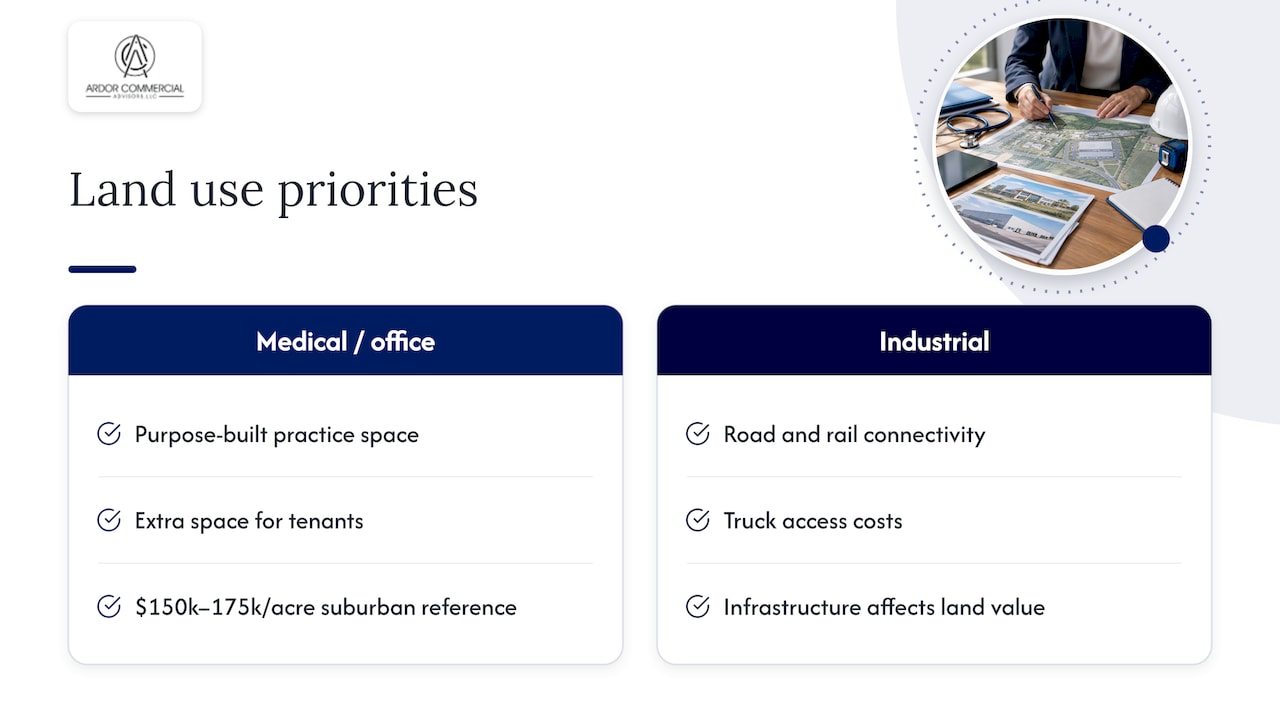
Industrial. Buyers watch road and rail connectivity and the cost of getting trucks in and out. A regional study of logistics sites by NCDOT evaluated air, rail and highway connectivity and the improvements those sites needed, which shows how much infrastructure drives where industrial land is worth more. Before you buy industrial land to build for tenants, check what warehouse tenants pay: our warehouse lease rates in Charlotte page gives the income side of the math.
Our perspective
Most land buyers start with the asking price and work forward. We start with the building and work backward. What will this site support, who will lease or buy it, and what does the market pay for that product? That residual number is your ceiling.
We also see people underestimate how much price depends on zoning conditions, utility capacity and access. Two parcels of the same size on the same road can differ by a wide margin because one has entitlements and services and the other has promises.
Our advisors work on both sides of the table, representing buyers, sellers, landlords and tenants in the Charlotte MSA. We put recorded sales, lease comparables and a valuation model next to every land decision, so you can see how a price holds up before you commit.
Jim
Work with an advisor on your land search
If you are buying or selling commercial land in the Charlotte MSA, we can help you test the price against recorded sales and the building you plan to put on it. We handle land sales, valuation, and tenant and landlord representation, so the land decision connects to the lease or sale that follows.
See our land sales and services or start at Ardorcre.com to talk with an advisor.
FAQ
How much does commercial land cost per acre in Charlotte?
It depends on location, zoning and size. Recent recorded Mecklenburg County sales of larger sites work out to about $1.4 million to $2.4 million per acre, while Gaston County lists graded industrial land at $35,000 per acre. Small urban parcels and those with approved entitlements can price higher.
Where can I find actual sale prices for Charlotte land?
Mecklenburg County’s Polaris 3G parcel records list deed references, sale prices, ownership and zoning for each parcel. Search the area around your target site and compare recent sales with similar zoning and size.
Why is land cheaper outside Mecklenburg County?
Surrounding counties have less demand pressure, fewer approvals needed in some cases and longer distances to Center City employment. For example, Gaston County lists industrial sites at $35,000 per acre and medical and office sites at $150,000 to $175,000 per acre, well below the in-city sales above.
Does a bigger parcel cost less per acre?
Usually yes. Fewer buyers can afford a large tract and large sites need more entitlement and infrastructure work, so the per-acre price tends to fall as acreage rises. Compare per-acre figures only among parcels of similar size.
Sources
- Business Parks, Gaston County Economic Development
- Mecklenburg County Polaris 3G record, South Tryon Street
- Mecklenburg County Polaris 3G record, Continental Boulevard
- Mecklenburg County Polaris 3G record, South Clarkson Street
- Mecklenburg County Polaris 3G record, East 36th Street
- Charlotte Center City Partners, State of the Center City 2025
- NCDOT, Charlotte Region logistics study