
Office lease concessions are the incentives a landlord gives to win or keep a tenant: free rent, a tenant improvement allowance (TIA), landlord-built work, and a handful of smaller terms. Almost all of them are negotiable, and almost all of them are won or lost at the letter of intent (LOI), before a lawyer drafts a single page of lease. This guide covers what each concession is, how to compare them, and where tenants in the Charlotte area leave money on the table.
TL;DR
- The main office concessions are free rent (abatement), a TI allowance, landlord work, and caps on fees tied to the build-out. Smaller items such as parking, signage and early access matter too.
- Negotiate them in the LOI. Once the lease is drafted, you have far less leverage.
- Compare offers on net effective rent and total occupancy cost, not on headline rent or a single big number.
- Landlord construction management fees on TIA-funded work are a common hidden cost. Ask for them to be capped or waived.
- Concessions trade against each other and against term length. A longer term usually buys more.
Table of Contents
- What counts as a concession
- The concessions worth asking for
- How to compare two offers
- Start at the LOI, not the lease
- Plan for move-in costs outside the lease
- Our perspective: concessions are a price, not a gift
- Get the lease read before you sign
- Common mistakes
- FAQ
- Sources
What counts as a concession
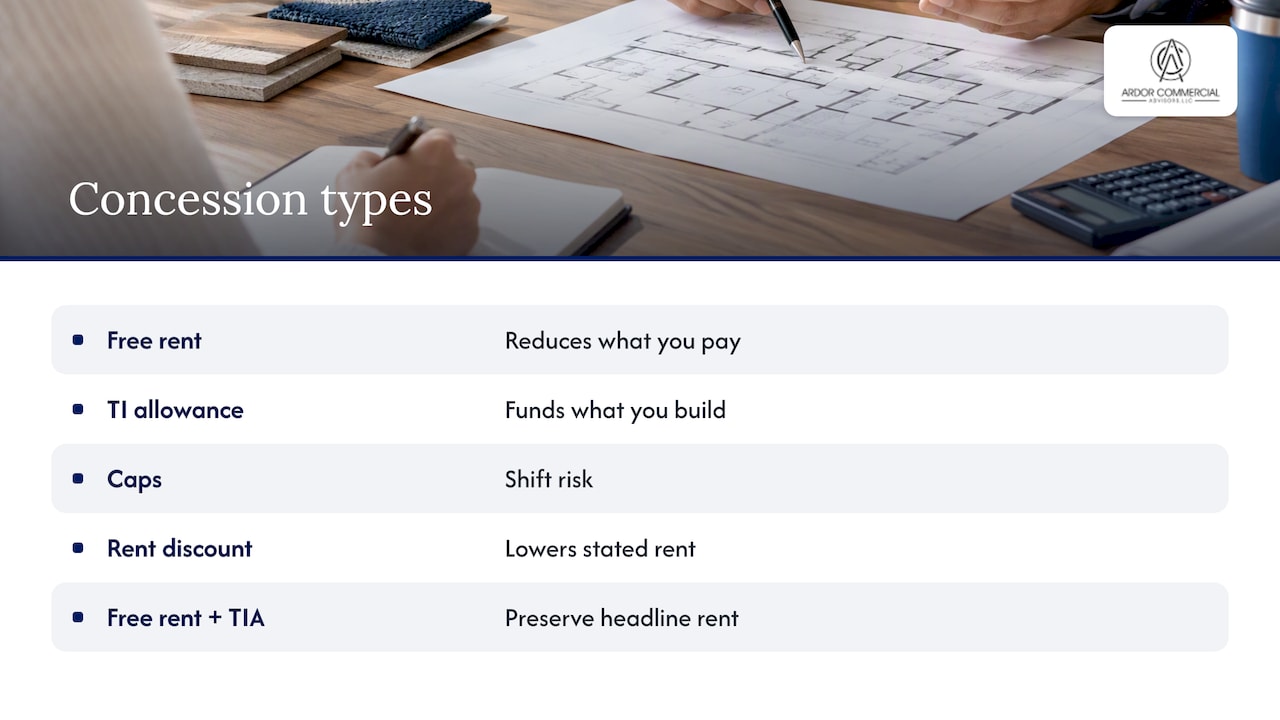
A concession is any compromise a landlord makes to its standard lease terms. Some reduce what you pay (free rent). Some fund what you build (a TI allowance). Some shift risk (a cap on guarantees or on charges). Landlords like some of these better than others, because a rent discount lowers the stated rent on paper, while free rent and allowances leave the headline number intact and protect the building’s value to a lender or buyer.
That is the reason you see “asking rent” and “effective rent” diverge. The headline figure may look steady while the deal underneath it moves. Data tools such as CoStar’s Rent Benchmark draw on anonymized, signed leases to show starting rents and net effective rents, which is the comparison that matters.
The concessions worth asking for
Free rent (rent abatement)
Free rent is a period at the start of the term when you pay no base rent, or a reduced rate. It is usually expressed in months, and it is most valuable when you are paying for a move, a build-out, or a ramp-up in headcount or patients.
Three details decide its real value:
- Is it base rent only? Many leases abate base rent but still charge operating expenses, taxes and insurance. On a net lease, those charges can be large. See our triple net lease guide for how that works.
- When does it start? Free rent that runs while your space is still under construction is worth much less than free rent that begins when you open.
- What happens if you default? Some leases make the abated rent repayable on default. Read that clause.
We cover the mechanics in more depth in our piece on rent abatement.
Tenant improvement allowance (TIA)
A TIA is money the landlord contributes toward customizing the space. As Nolo’s guide to tenant improvement allowances explains, you and the landlord have to settle who designs the work, who is responsible for completing it, and who pays. The allowance is usually quoted per rentable square foot.
Lease language matters as much as the number. A sample lease filed with the SEC shows how a TIA can be written as a fixed dollar sum with conditions on how it is applied. Look for:
- the deadline to use the allowance, after which unused funds may be forfeited
- what qualifies (hard costs only, or design, permits, cabling and furniture too)
- how and when funds are paid out (against invoices, on completion, or as a rent credit)
- whether any unused portion can offset rent
A bigger allowance with a short use-by date can be worth less than a modest one with flexible terms. Our TIA playbook walks through how build-out gaps appear and how to close them.
Landlord work and the work letter
Instead of a cash allowance, a landlord may build the space itself. That makes your cost certain, but only if the work letter says exactly what will be delivered. The question of what condition the space arrives in matters here: bare shell, second-generation space, or a finished “vanilla box.” Our comparison of shell versus vanilla box shows how that choice changes your costs before rent starts, and our 10-point landlord work letter checklist gives you the items to confirm in writing.
Caps on construction management fees
Practitioners point to one costly mistake again and again: failing to cap the fees a landlord charges to oversee TIA-funded improvements. Guidance for in-house counsel notes that the LOI should pin down the work letter, TIA and construction management fees before moving to a lease, so the final document reflects the agreed business terms. Asking for a low percentage, or zero, is a standard request. Left open, the fee can quietly eat part of the allowance you thought you had.
Smaller concessions that add up
- Parking: free or discounted spaces for the first term, or a guaranteed ratio.
- Early access: time to install cabling and furniture before rent begins.
- Signage: building or monument signage rights.
- Renewal and expansion options: a right to renew at a set formula, or to take adjacent space.
- Guarantee limits: for newer or smaller companies, a cap on the personal or corporate guarantee. We explain how to cap a corporate guarantee at 12 months’ rent.
- Early termination rights: a negotiated exit and its cost. See our guide to exiting a commercial lease early.
How to compare two offers
Headline rent is the least useful number in an office proposal. Build a simple side-by-side over the full term and look at total cash out of pocket.
| Item | Building A | Building B |
|---|---|---|
| Base rent per sq ft | Higher | Lower |
| Free rent | More months | Fewer months |
| TI allowance | Larger | Smaller |
| Fee on allowance work | Uncapped | Capped |
| Operating expense exposure | Net, uncapped | Net, with a cap on controllable items |
| Term | 10 years | 5 years |
That table is a template, not market data. Fill it with real figures from your proposals, then calculate:
- Net effective rent: total rent over the term, minus free rent and the allowance, divided by the number of months.
- Your out-of-pocket build-out: total project cost minus the allowance, minus any fee leakage.
- Cost at exit: what it costs if you outgrow the space or need to leave early.
A longer term often unlocks bigger concessions, but it also locks you in. If your headcount, patient volume or footprint is uncertain, a smaller concession package on a shorter term can be the better deal.
Start at the LOI, not the lease
The letter of intent is the first critical step in the leasing process and should not be skipped in a rush to relocate. It is short, it is usually non-binding on most terms, and it is where the landlord is still competing for you. By the time a lease draft arrives, the landlord’s counsel is working from the LOI, and anything you did not raise is hard to add.
A practical sequence:
- Define your needs (square footage, timing, build-out scope, budget).
- Tour several buildings and request proposals from each, so landlords know they are competing.
- For larger or complex projects, consider a request for proposals. A North Carolina commercial leasing CLE paper notes that a broker may suggest an RFP on a significant project rather than simply reviewing what landlords offer.
- Negotiate the LOI: rent, free rent, TIA, work letter, fee caps, term, options.
- Have counsel review the lease against the LOI line by line.
Timing matters. A realistic commercial leasing timeline for medical and office tenants runs several months, and medical users should read our advice on starting 12 to 18 months early on medical office leasing.
Plan for move-in costs outside the lease
Not every build-out cost is covered by an allowance. Cleaning, punch-list work and final prep before you open come out of your own budget unless you negotiate otherwise. When you price the project, include a line for post-construction cleanup, and for a sense of what that service covers, look at how one provider describes commercial office cleaning and post-construction cleaning in its Florida markets. In Charlotte, get local quotes, but use the same scope checklist.
Our perspective: concessions are a price, not a gift
We see office and medical tenants treat concessions as favors, and that is where deals go wrong. A concession is a price the landlord pays to fill space on terms that suit the landlord’s lender, its pro forma and its next refinance. Once you see it that way, the questions get sharper. What does this landlord need? A longer term? A credit-worthy guarantor? A fast opening?
Here is what we tell Charlotte-area tenants and owners:
- Run the numbers on a net effective basis, and show the landlord you are doing it.
- Medical tenants carry more build-out risk. Plumbing, imaging, shielding and specialized equipment make the allowance gap larger, so spend time on the work letter.
- Landlords benefit from concessions that keep tenants. For owners, a well-priced renewal package usually beats months of vacancy, which is why we model NPV-based tenant retention and a 120-day renewal strategy.
- Get an advisor on your side early, before you tour. Representing only one party in a deal is the cleanest way to protect that party’s interests.
— Jim
Get the lease read before you sign
If you have a proposal in hand, we can help you make sense of it. Our team does tenant representation, lease review and CAM reconciliation analysis, and works with landlords on structuring offers across office, medical, retail and industrial space in the Charlotte MSA. See everything we offer on our services page.
Common mistakes
- Accepting free rent that starts before you can occupy. Tie it to your commencement date or opening.
- Ignoring operating expenses during free rent. Ask whether they are abated too.
- Leaving the fee on TIA-funded work uncapped.
- Forgetting the use-by date on the allowance.
- Skipping the renewal formula. A fixed or capped renewal protects you from a reset at market after you have invested in the space.
- Negotiating after the draft arrives.
FAQ
Can a lease agreement be modified after signing?
Yes, but only by a written amendment that both parties sign. The landlord has no duty to agree, so your leverage is far lower than at the LOI stage. If you need changes, raise them before signing, and have an attorney draft any amendment.
What are some examples of tenant improvements?
Common examples include new walls and doors, flooring, ceilings, lighting, paint, data cabling, and restroom or kitchenette work. In medical space, they often include plumbing for exam rooms, cabinetry and equipment-related electrical. What the allowance actually covers depends on the lease wording.
What are concessions in a commercial rent context?
They are terms a landlord adds or relaxes to win a tenant, such as free rent, a TI allowance, landlord-built work, parking or lower fees. Each one lowers the tenant’s real cost or risk compared with the standard lease.
Are office lease concessions negotiable in Charlotte?
Generally yes. What you can get depends on the building, the term, your credit and how many alternatives you have. Getting competing proposals and negotiating in the LOI gives you the best chance.
Sources
- The Letter of Intent (Association of Corporate Counsel)
- A Guide to the Tenant Improvement Allowance (Nolo)
- Sample lease with a tenant improvement allowance (SEC filing)
- North Carolina commercial leasing CLE materials
- CoStar Rent Benchmark