
Net effective rent is the landlord’s true per-period economic income after concessions, and it is the figure that belongs in your underwriting, not the face rent printed on a lease abstract. Free months, tenant improvement allowances, and step rents can push the asking rent well above what a landlord actually collects. Skipping this adjustment overstates net operating income and can lead to a mispriced acquisition or an undersized loan.
TL;DR:
- Concessions like free months and tenant improvements significantly lower the true net effective rent, which impacts valuation and loan sizing.
- Simple formulas for calculating NER are useful for quick estimates, but discounted cash flow methods provide more accuracy for large or unevenly timed concessions.
- Properly amortizing concessions and modeling escalations or pass-through expenses are essential to understanding the lease’s true income potential.
- Using face rent instead of NER can lead to overstated income figures, risking mispriced acquisitions and oversized loans.
- Regularly contrasting the arithmetic and discounted NER helps ensure your underwriting reflects real income flow and economic reality.
Table of Contents
- What net effective rent is and why it matters
- How to calculate net effective rent with a simple formula
- Why institutional underwriting uses annuitized lease value instead
- Treating common lease concessions correctly
- How effective rent drives valuation, underwriting, and negotiation
- Two worked examples: arithmetic and discounted NER
- Building effective rent into your workflow
- A practitioner’s view on effective rent in medical and office deals
- How we can help you apply effective rent analysis
- FAQ
- Sources
What net effective rent is and why it matters
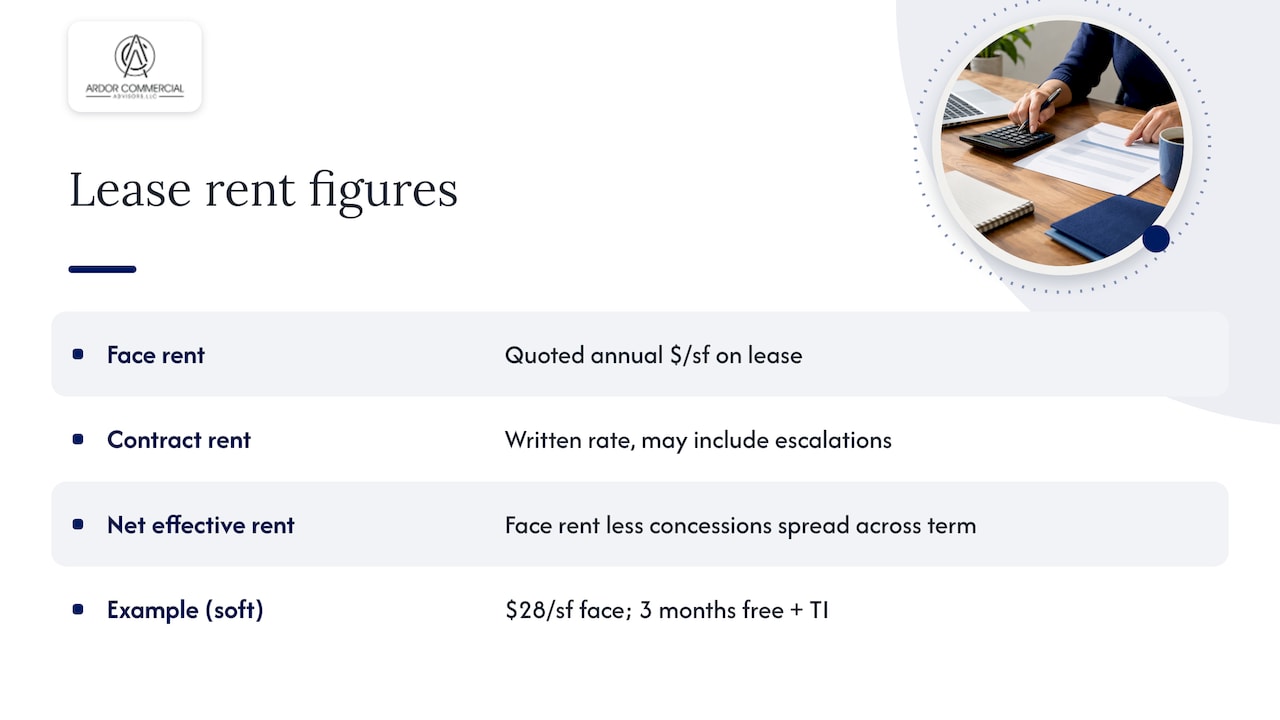
A lease carries at least three rent figures, and conflating them causes most valuation errors. Face rent, or nominal rent, is the quoted rate on the lease document, typically shown as an annual rate per square foot. Contract rent is the rate actually written into the binding lease terms, which may already include scheduled escalations. Net effective rent (NER) strips out the value of concessions, free months, TI dollars, and other giveaways, to show what the landlord nets per period over the full term.
The gap between face rent and NER widens in soft leasing markets. A landlord fighting for tenants in a market with rising vacancy might advertise a face rent of $28 per square foot while quietly offering three months free and a generous TI package. The headline number looks strong, but the net effective rent tells a different story once those giveaways are spread across the term.
This distinction matters most when comparing leases across a rent roll or building a comp set for an appraisal. Two tenants paying the same face rent can have very different effective economics once concessions are factored in, and an appraiser who treats face rent as the real rent will misstate the asset’s income. Appraisal Institute training on this topic exists specifically because face rent, used uncritically, produces misleading valuations whenever concessions are common.
How to calculate net effective rent with a simple formula
For a quick underwriting pass or a first look at a rent comp, a simplified arithmetic formula gets you close enough to make a go or no-go decision. The WallStreetPrep version of this formula is the industry standard shortcut:
NER = (Total rent paid over the lease term − Total abatements) ÷ Total lease periods
Before running the math, collect these inputs from the lease or offering memo:
- The face rent schedule, including any contractual escalations by year.
- The number of free months and when they fall in the term.
- The dollar value of any TI allowance, if it reduces rent rather than getting capitalized separately.
- Tenant-paid expenses versus landlord-paid expenses, since this affects comparability.
- The total lease term in months or years.
Say a multi-year office lease runs at a given face rent with some free months in the first year. The total rent paid over the lease term minus the value of free months, divided by the total number of periods, gives the net effective rent, which is lower than the face rent annualized.
This method works well for quick screening and for leases with modest, front-loaded concessions. Its limitation is that it ignores the time value of money, treating a dollar of free rent in month one the same as a dollar in month 59.
Why institutional underwriting uses annuitized lease value instead
The arithmetic average above is fine for a first pass, but it breaks down whenever concessions are large or unevenly timed. Institutional-grade analysis treats effective rent as an annuitized lease value (ALV), discounting the lease’s cash flows and converting the result to a level, equivalent per-period payment, according to methodological guidance used in CRE discounted cash flow modeling. This avoids the distortion that a straight average creates when a large TI check goes out in month one but rent payments only start accruing months later.
The approach works like this:
- Build the full cash flow stream, including rent, abatements, and TI outlays, by period.
- Discount each period’s net cash flow to present value using an appropriate rate.
- Solve for the level annuity payment that produces the same present value over the same term, which becomes your discounted NER.
Choosing the discount rate requires judgment. Many analysts use the property’s target yield or a rate close to the cost of capital, and they should be consistent about whether rent is modeled in arrears or in advance, since that timing convention shifts the present value slightly. A landlord’s discount rate and a tenant’s discount rate can reasonably differ, since each party is weighing the cash flows against its own cost of capital.
Pro Tip: Run both the simple average and the discounted ALV side by side. When they land within a percentage point or two of each other, the simple method was good enough. When they diverge sharply, trust the discounted number for underwriting.
Reach for the DCF version whenever the lease term exceeds three years or the TI package is large relative to annual rent. Short terms with small, evenly spread concessions rarely justify the extra modeling effort.
Treating common lease concessions correctly
Each concession type pulls on NER differently, and lumping them together produces a number nobody can defend. Net effective rent calculations commonly need to account for several distinct categories:
- Free rent periods: amortize the lost months across the full term rather than expensing them only in the year they occur.
- TI allowances: treat the dollars as either a capitalized landlord outlay recovered through rent, or as a direct rent reduction, but pick one convention and apply it consistently. Our tenant improvement allowance guide walks through how landlords and tenants typically structure this.
- Step rents and escalations: model the full schedule, then convert it to a level-equivalent rent rather than averaging the stated rates.
- Expense pass-throughs and percentage rent: adjust for whether the tenant or landlord carries operating costs, since a gross lease and a triple net lease at the same face rent are not equivalent.
- Non-cash incentives: moving allowances, parking concessions, and reimbursement caps all reduce effective income and belong in the model even when they feel minor individually.
How effective rent drives valuation, underwriting, and negotiation
Once NER replaces face rent, first-year net operating income typically drops, and that change flows directly into direct capitalization and DCF valuation. A building priced off face rent can look like it clears an acquisition hurdle that it would miss once concessions are properly amortized.
Lenders feel this too. Debt service coverage ratio calculations and loan sizing depend on stabilized NOI, so a lender using face rent can oversize a loan relative to what the property’s real cash flow supports. A property with heavy near-term concessions may need a temporary debt service reserve or an interest-only period until NER catches up to stabilized income.
Appraisers address this gap by adjusting capitalization rates upward for leases with significant concessions, or by applying leasehold-specific valuation methods that separate the concession burden from the underlying real estate value. A few red flags deserve extra scrutiny:
- TI allowances well above market norms for the space type and condition.
- Free rent periods longer than what comparable, completed leases show.
- Incentives back-loaded late in the term, which can mask a weaker near-term cash flow.
Two worked examples: arithmetic and discounted NER
Consider a multi-year office lease with free months and a tenant improvement allowance treated as a rent credit spread evenly across the term.
- Arithmetic method: Total rent over 60 months is $160 per square foot. Subtract two free months ($5.33) and the amortized TI credit ($40), leaving $114.67 over 60 months, or $22.93 per square foot annualized.
- Discounted method: Build the monthly cash flow stream, including the upfront TI outlay and the free months, discount at a 7% rate, and solve for the level annuity payment. Because the TI hits early, the discounted NER lands below the arithmetic figure, since that upfront cash cost carries more weight in present-value terms.
- Interpretation: The discounted number is the more conservative input for underwriting precisely because it respects when the landlord’s cash goes out the door, not just how much.
For lease-up strategy and TI negotiation specific to medical and office space, our lease-up strategy resource covers how these concessions get structured in practice.
Building effective rent into your workflow
A consistent process keeps NER comparable across a rent roll or comp set. Prioritize just-leased, signed comparables over pending or asking rents, since asking rents only indicate a ceiling. Normalize each lease, compute NER, feed the result into NOI and DCF, then run sensitivity on the discount rate and concession assumptions.
- Collect face rent, concessions, and term length for every comparable before normalizing anything.
- Keep a dedicated model tab for concession assumptions, separate from the NOI build, so reviewers can audit each input.
- Document your discount rate and timing convention directly in the appraisal or underwriting file.
It flags marginal deals faster than scanning a full pro forma.* Our lease abstraction guide covers how to extract these inputs cleanly from signed leases.
A practitioner’s view on effective rent in medical and office deals
Effective rent analysis stops being theoretical the moment a medical tenant asks for six months of free rent tied to buildout delays, or an office landlord offers a CPI-indexed escalation to win a renewal. Leasing and valuation work often reveals that the lease with the highest face rent is rarely the one that performs best once abatement, TI, and escalation structure get modeled properly.
Rent abatement recovery, lease-up protection clauses, and CPI-based rent adjustments all change the effective number in ways a quick skim of the lease summary will miss.
— Jim
How we can help you apply effective rent analysis
Commercial property valuation and DCF modeling built around the same annuitized approach covered above can help ensure your pro forma reflects real economics rather than headline rent. Services to clean up underlying lease data include:

- Commercial property valuation and DCF modeling for acquisition or refinance decisions.
- Lease review and CAM reconciliation analysis to catch pass-through errors before they distort NER.
- Lease abstraction to pull clean, structured data out of signed leases and amendments.
- Tenant improvement strategy guidance for landlords negotiating buildout packages.
If you want a second set of eyes on a rent roll or a lease you are underwriting, reach out through our services page to start a conversation.
FAQ
How do you calculate effective rent?
Subtract the dollar value of concessions, such as free months and TI allowances treated as rent credits, from the total rent paid over the lease term, then divide by the number of periods. The WallStreetPrep formula is (Total rent paid over the lease term − Total abatements) ÷ Total lease periods, and institutional underwriting often refines this further with a discounted cash flow approach.
What is the 2% rule for rentals?
It is not a commercial real estate standard and does not account for concessions, lease structure, or effective rent adjustments that matter in office, medical, or industrial underwriting.
What is the 7% rule for rental property?
For commercial assets, investors rely on calculated metrics like capitalization rate, DSCR, and discounted net effective rent rather than a fixed percentage rule of thumb.
What is the 30% rule for rent?
It applies to personal finance decisions, not to commercial lease underwriting, where effective rent and NOI drive valuation instead of a tenant’s income ratio.
Sources
- Net effective rent | Formula + Calculator
- Methodological foundations: DCF, effective rent, and underwriting in CRE
- Net effective rent