
Cold storage demand remains structurally strong, anchored by population growth and e-grocery adoption, but the sector just posted its first negative net absorption since 2007 as new deliveries outpaced occupier move-ins. For investors, that split means underwriting conservatively, favoring modern temperature-controlled assets, and treating legacy inventory with caution.
TL;DR:
- New large-scale cold storage deliveries have outpaced occupancy growth, leading to the sector’s first negative net absorption since 2007.
- The average new building size is nearly 300,000 square feet, while recent leases average only 125,000 square feet, creating a size mismatch.
- Vacancy increased to the high single digits in early 2026, mainly due to supply timing issues rather than waning demand.
- Modern, energy-efficient buildings attract tenants at a rent premium, while legacy assets face higher re-leasing risks and wider discounts.
- Demand remains structurally supported by population growth and e-grocery expansion, but investors should focus on local data and asset quality.
Table of Contents
- 1. What cold storage means and the metrics investors must track
- 2. Market size and capacity: headline figures and state concentration
- 3. Primary demand drivers: demographics, e-grocery, pharma, and trade
- 4. Supply pipeline and development dynamics: deliveries, retrofits, and the size mismatch
- 5. Vacancy, net absorption, and the flight-to-quality effect
- 6. Investment performance and transaction market considerations
- 7. Near-term forecasts and scenario planning for demand
- 8. Investor implications and financing: DSCR, leasing, and repositioning decisions
- 9. A practitioner’s read on this cycle
- How ArdorCRE helps you evaluate cold-storage-adjacent opportunities
- FAQ
- Sources
1. What cold storage means and the metrics investors must track
Cold storage splits into two temperature bands: coolers, which hold product above freezing for produce, dairy, and floral goods, and freezers, which run below freezing for meat, frozen foods, and pharmaceuticals. Facilities also split by ownership model. Public (third-party logistics) warehouses store goods for multiple clients under short-term contracts, while private facilities are operator-run and dedicated to a single company’s supply chain, often attached to a grocery distribution center or food processing plant.
Capacity numbers matter more than square footage in this asset class, and two figures get confused constantly: gross capacity versus usable capacity. Gross cubic feet is the total refrigerated volume a facility can physically hold. Usable capacity strips out racking, aisles, dock space, and mechanical rooms, leaving the volume actually available for product. The gap between the two is substantial, which means a facility’s headline size can overstate what a tenant can actually store.
Lease size benchmarks also matter for underwriting. The average cold storage lease signed in recent years runs around 125,000 square feet, according to Newmark’s market data reported by Food Logistics, while facilities currently under construction average nearly three hundred thousand square feet. That gap, covered in more detail later, is a direct cause of the lease-up slowdown investors are seeing today.
Key terms to keep straight:
- Cooler vs. freezer: above-freezing storage for perishables versus below-freezing storage for frozen goods and pharma.
- Public vs. private: multi-client third-party logistics space versus single-operator, owner-occupied facilities.
- Gross vs. usable capacity: total refrigerated volume versus the portion actually available for product after racking and circulation space.
- Lease size vs. building size: the average signed lease is far smaller than the average new building, a mismatch that shapes vacancy today.
2. Market size and capacity: headline figures and state concentration
The United States held nearly 4 billion cubic feet of gross refrigerated warehouse capacity as of October 1, 2025, according to the USDA’s refrigerated warehouse capacity survey. Usable capacity came in at about eighty-two percent of the gross figure, spread across several hundred refrigerated warehouses nationwide. Public warehouses accounted for roughly sixty-two percent of the total gross capacity, underscoring how much of the industry’s footprint sits in multi-client third-party logistics space rather than single-operator facilities.
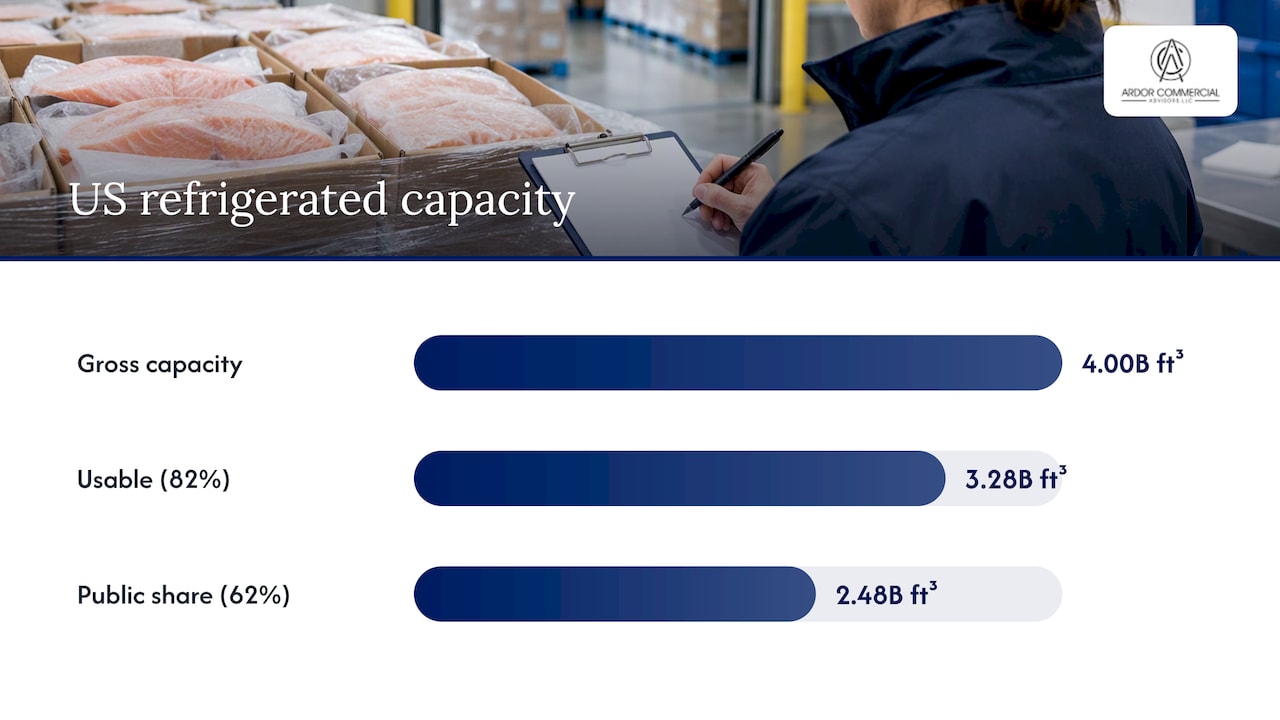
Public warehouses hold roughly 62% of total U.S. refrigerated capacity, according to the USDA survey, meaning most cold storage exposure in the market runs through third-party logistics operators rather than owner-occupied supply chains.
Capacity is not evenly distributed. The same USDA survey ranks the top five states by gross capacity:
- California: 400 million cubic feet
- Georgia: 304 million cubic feet
- Washington: 301 million cubic feet
- Wisconsin: 297 million cubic feet
- Texas: 254 million cubic feet
Those five states alone account for a sizable share of national capacity, which tells investors two things. First, scale in this sector concentrates around major agricultural production zones, port access, and population centers rather than spreading evenly across the country. Second, that concentration creates regional risk: an oversupply cycle in one of these states can move the national vacancy average more than a comparable swing in a smaller cold storage market would. Portfolio diversification across these concentration points, rather than within a single state, is one of the more overlooked risk controls in this asset class.
3. Primary demand drivers: demographics, e-grocery, pharma, and trade
The structural case for cold storage rests on forces that don’t reverse quickly. Population growth and the way metro areas have grown out rather than up is the baseline driver: more people eating more food, concentrated in dense metros and fast-growing regions, requires more cold-chain capacity to move perishables from farm to store to table. Industry analysts cited in a Nareit podcast featuring CBRE commentary point to Los Angeles, Seattle, Chicago, and the Northeast corridor as established demand centers, with Sunbelt metros like Atlanta, Dallas, and South Florida showing some of the fastest incremental growth.
E-grocery is the trend doing the heavy lifting on the margin. Online grocery sales rose about 21.5% year over year in July 2026, while in-store grocery sales contracted roughly 2.6% over the same period, according to Newmark’s data summarized by Food Logistics. That shift matters structurally, not just in volume. A ship-to-home order touches more cold-chain nodes than a shopper picking items off a store shelf, since it typically moves through a distribution center, sometimes a micro-fulfillment node, and then a last-mile cold pack, each step adding refrigerated handling requirements that in-store retail never needed.
Pharmaceutical and life-sciences logistics add a smaller but growing demand layer, particularly for facilities that can meet strict temperature-excursion and compliance standards, which makes exploring the best vaxsac.com alternatives an important consideration for specialized cold-chain equipment needs. Vaccine and biologic distribution requires tighter tolerances than most food-grade cold storage, which is pushing some operators toward specialized retrofits rather than general-purpose freezer space.
Seasonality and trade flows round out the picture. Harvest cycles, holiday demand spikes, and import or export timing all create short-term swings in utilization that layer on top of the long-term growth trend, and they’re a major reason utilization rates can look tight in one quarter and loose in the next without the underlying structural story changing.
- Population and metro density drive the long-term baseline need for cold-chain capacity near where people live.
- E-grocery growth intensifies cold-chain touchpoints per order relative to in-store shopping.
- Pharma and life-sciences logistics add a specialized, compliance-driven demand layer.
- Seasonality and trade timing create short-term utilization swings independent of the structural trend.
Pro Tip: When evaluating a cold storage asset, check whether its tenant mix leans toward e-grocery fulfillment or traditional food distribution: the two segments have different lease duration and expansion patterns.
4. Supply pipeline and development dynamics: deliveries, retrofits, and the size mismatch
The current softness in cold storage demand traces directly to a supply timing problem, not a demand collapse. In the first half of 2026, the sector recorded roughly 56 million cubic feet of negative net absorption against about 41 million cubic feet of new deliveries, according to Newmark’s data reported by Food Logistics, the first negative absorption reading the sector has posted since 2007.
The root cause is a size mismatch. Developers built large speculative facilities averaging nearly 300,000 square feet, betting on future demand growth, while actual signed leases over recent years have averaged closer to 125,000 square feet. That gap means a single large building often needs two, three, or more tenants to fully lease up, which takes considerably longer than leasing a building sized to match typical tenant demand. The result is lease-up periods stretching well beyond what developers originally underwrote.
That mismatch is pushing some owners toward retrofits instead of ground-up development. Converting existing dry warehouse or light industrial space into refrigerated capacity costs less upfront than new construction and can be sized to match actual tenant demand rather than a speculative bet on future growth. Retrofit projects also move faster through permitting and construction, since the building shell already exists, though they carry their own constraints around ceiling height, floor loading, and electrical capacity for the mechanical systems cold storage requires.
- Deliveries outpaced absorption in 1H 2026, producing the sector’s first negative net absorption since 2007.
- New construction has skewed large, averaging nearly 300,000 square feet versus a roughly 125,000 square foot average lease.
- Retrofits are gaining favor as a lower-cost, faster-to-market alternative to speculative ground-up development.
5. Vacancy, net absorption, and the flight-to-quality effect
Cold storage vacancy climbed to the high single digits in the first half of 2026, according to Newmark data reported by Food Logistics, driven almost entirely by the supply and lease-up timing issues described above rather than a genuine falloff in occupier interest.
That vacancy is not evenly distributed by building vintage. Facilities delivered since 2020 and those built in the 2006 to 2019 window show meaningfully different occupancy patterns, with the newest, most efficient buildings generally holding tighter vacancy even as the overall market average rises.
This is the flight-to-quality effect in practice. Occupiers evaluating new leases increasingly prefer modern, energy-efficient facilities with current racking configurations and updated refrigeration systems, even at a rent premium, over legacy space that may need capital investment to meet today’s operating standards. That preference is compressing rent spreads between class A and older product, widening the concession packages landlords of legacy buildings need to offer, and making cap rates on older cold storage assets more sensitive to re-leasing risk than they were a few years ago. For investors, the practical read is that headline vacancy understates how tight the market is for genuinely modern product and understates the risk sitting in older inventory.
6. Investment performance and transaction market considerations
Elevated vacancy in legacy inventory and extended lease-up timelines on new large-format buildings have made cold storage transactions more selective than they were during the sector’s fastest growth years. Buyers are concentrating capital on assets with clean occupancy histories and modern specifications, while legacy properties and buildings still working through initial lease-up are seeing wider pricing discounts and longer time on market before a deal closes.
That selectivity shows up most clearly in how due diligence has shifted. Buyers are no longer treating refrigeration infrastructure as a given; they’re pricing it as a line item with real variability in cost and risk.
- Temperature-control systems: age, redundancy, and remaining useful life of refrigeration equipment directly affect both operating cost and capital expenditure forecasts.
- Energy costs: refrigerated facilities run some of the highest utility loads in industrial real estate, and utility rate exposure varies significantly by region and utility provider.
- Labor availability: cold storage operations require specialized refrigeration technicians and warehouse staff willing to work in cold environments, and local labor supply affects operating cost assumptions.
- Compliance standards: food safety and, where applicable, pharmaceutical handling requirements affect what tenant types a building can serve and what retrofit costs might be needed to serve them.
Investors underwriting an acquisition in this environment should lean on current commercial property valuation and DCF modeling to stress-test lease-up assumptions rather than relying on pre-2026 absorption trends, which no longer reflect current market timing.
7. Near-term forecasts and scenario planning for demand
The sector’s near-term path depends heavily on how quickly the current wave of large speculative deliveries gets absorbed, and investors should model at least three scenarios rather than anchor on one forecast.
- Base case: vacancy stabilizes gradually over the next several quarters as e-grocery growth continues absorbing large-format space, with legacy inventory lagging behind modern product throughout the adjustment period.
- Downside case: e-grocery growth slows from its current pace, lease-up on large speculative buildings drags out further, and vacancy climbs above current levels, concentrated disproportionately in legacy assets and oversized new construction. Watch quarterly e-grocery sales growth rates and large-lease signing velocity as early warning signs.
- Upside case: online grocery adoption accelerates further, or a major retailer or 3PL commits to a multi-building expansion that absorbs a meaningful share of the current oversupply in large-format space, pulling vacancy down faster than the base case assumes and tightening rent spreads between legacy and modern product.
None of these scenarios challenge the structural demand case built on population growth and shifting retail habits. They differ mainly in how fast the current supply overhang clears, which is the variable that matters most for timing an acquisition, a disposition, or a refinancing decision in this cycle.
8. Investor implications and financing: DSCR, leasing, and repositioning decisions
Rising vacancy and longer lease-up timelines change how lenders size loans on cold storage and adjacent industrial assets. Debt service coverage ratio underwriting gets more conservative when a building’s income is unproven or concentrated in a single tenant still in a lease-up period, which lowers the loan amount a lender will support relative to a fully stabilized asset. Our DSCR loan sizing guide walks through how lenders adjust these assumptions for assets carrying lease-up or rollover risk.
That same vacancy-driven caution is forcing a real decision for owners holding CMBS loans coming due: sell into a more selective buyer pool now, or refinance at today’s higher conservative DSCR assumptions and carry the asset through stabilization. Neither answer is universal, but the choice should be driven by how close the asset is to full, durable occupancy, not by loan maturity timing alone.
- Selling vs. refinancing: compare the discount a buyer would price into a lease-up asset against the lower proceeds a conservative DSCR refinance would generate.
- Medical occupiers weighing lease vs. buy: factor in how much operational stability your practice needs, current medical office cap rates, and whether ownership ties up capital better deployed elsewhere, a decision our Charlotte medical office market coverage walks through with real transaction examples.
- Multi-tenant building ownership: a multi-tenant asset diversifies rollover risk across several leases instead of concentrating it in one tenant’s renewal decision.
- Retrofit vs. ground-up for industrial owners: retrofitting existing shell space generally costs less and moves faster than new construction, though ceiling height and power capacity limits should be checked before committing capital.
Pro Tip: Before refinancing a cold-storage or industrial asset with upcoming lease rollover, run DSCR under both the in-place rent and a conservative renewal-rate scenario: lenders increasingly underwrite to the weaker of the two.
9. A practitioner’s read on this cycle
What stands out this cycle isn’t the vacancy headline, it’s where that vacancy sits. Legacy buildings are absorbing nearly all the pain while modern, well-located product keeps leasing at a premium, and that split is where the opportunity is for buyers patient enough to look past the national average. We apply the same local transaction discipline to cold storage and industrial decisions that we use across Charlotte’s office and medical markets: pull current lease comps, underwrite to a conservative DSCR, and treat any lease-up assumption as unproven until the signed leases say otherwise.
— Jim
How ArdorCRE helps you evaluate cold-storage-adjacent opportunities
Cold storage demand is structurally sound, but telling a modern, well-leased asset apart from a legacy building carrying hidden lease-up risk takes current local data, not a national headline vacancy rate. Commercial real estate advisors work across the Charlotte MSA on industrial, office, and medical real estate, pairing acquisitions and dispositions work with practical underwriting: DSCR and loan-sizing analysis, lease review and CAM reconciliation, and landlord or tenant representation for owners and occupiers weighing a lease-versus-buy decision. Whether you’re deciding to sell or refinance a loan coming due, repositioning an industrial building, or sizing up a multi-tenant acquisition, an engagement starts with the same local comps and cash-flow modeling we use on every deal. Visit our services page to request a consultation on your next acquisition, disposition, or financing decision.
FAQ
Is cold storage in demand?
Yes, structurally. Population growth and the shift toward e-grocery, which saw sales rise about 21.5% year over year in July 2026 according to Newmark data, continue to drive long-term occupier need even as near-term vacancy has risen.
Is there a shortage of cold storage?
No, the market is not short on capacity right now. The sector actually posted negative net absorption in the first half of 2026 because new deliveries, averaging nearly three hundred thousand square feet per building, have outpaced the average lease size of around one hundred twenty-five thousand square feet, per Newmark’s figures, leaving some large buildings in extended lease-up.
Are cold storage facilities profitable?
Profitability depends heavily on vintage and tenant mix: modern, well-located facilities with efficient refrigeration systems tend to hold tighter occupancy and stronger rents than legacy buildings, which account for about 68% of current vacant space according to Newmark data. Energy costs and labor availability are the two biggest variables investors should underwrite carefully before assuming a stabilized return.
What are the key trends in the cold storage industry right now?
The dominant trends are flight to quality, with occupiers favoring modern buildings even at a rent premium, and a supply-driven vacancy increase as large speculative buildings work through lease-up. E-grocery growth continues to intensify cold-chain demand per order, while retrofitting existing warehouse space is gaining ground as a faster, lower-cost alternative to new ground-up development.
How does climate affect cold storage demand?
Seasonal harvest cycles, holiday demand spikes, and regional climate patterns create short-term swings in cold storage utilization that sit on top of the longer-term growth trend driven by population and e-grocery adoption. These fluctuations affect quarterly occupancy more than they affect the structural, multi-year demand case for the sector.
Sources
- Capacity of Refrigerated Warehouses 2025 Summary 02/09/2026
- Cold Storage Market Faces First Negative Absorption Since 2007 | Food Logistics
- Cold Storage Industry Demand Driven by Population Growth, Changing Retail Habits | Nareit