
The best lease renewal strategy runs on a repeatable 120-to-30-day timeline, not last-minute phone calls. Start outreach 120 days before expiration, present a clear menu of rent and term options priced from fresh market comps, and track the process with templates and KPIs so every renewal season improves on the last one.
TL;DR:
- Starting renewal outreach 120 days before lease expiration allows ample negotiation time and helps avoid last-minute vacancies.
- Pricing should be based on local market comparables, with a typical annual increase of 2 to 5 percent, unless turnover costs surpass potential rent gains.
- Presenting tenants with a menu of renewal options, including different terms and pricing, increases the likelihood of signed agreements.
- Using KPIs like renewal rate, decision days, and turn costs helps optimize renewal performance and justify concessions.
- Coordinating property management and leasing teams, along with early relationship-building, reduces renewal failures caused by miscommunication or lack of proactive engagement.
Table of Contents
- What Is the Best Lease Renewal Timeline?
- How Do You Set the Renewal Rate?
- How Should You Structure Renewal Offers?
- What Negotiation Tactics Actually Work?
- How Do You Track Renewal Performance With KPIs?
- When Should You Use Blend-and-Extend for Commercial Tenants?
- What Legal and Notice Requirements Should You Check First?
- How Do You Reduce Tenant Turnover Risk During Renewal?
- How Do You Build Relationships Before Renewal Season Starts?
- How Do You Measure the Financial Impact of a Renewal Strategy?
- How Do You Coordinate Property Management and Leasing Teams?
- What Are the Most Common Lease Renewal Mistakes?
- A Broker’s View on What Actually Moves Renewal Numbers
- How Ardorcre Helps You Execute a Renewal Strategy That Works
- Sources
- FAQ
What Is the Best Lease Renewal Timeline?
A renewal process that starts 120 days before lease expiration cuts down on last-minute vacancies and gives both sides room to negotiate instead of panicking, according to Buildium’s property management research. Waiting until 30 days out, which is what a lot of owners still do, leaves almost no leverage for either party.
The workflow breaks into four checkpoints:
- 120 days out: Run an internal condition assessment, resolve any open maintenance requests, and segment tenants by payment history and lease compliance. Calculate your walk-away number now, before emotions or vacancy anxiety creep in.
- 90 days out: Send the formal renewal menu with a response deadline, backed by current market comps and at least two term options.
- 60 days out: This is your decision point. No response means it’s time to start backup marketing quietly, without burning the relationship.
- 30 days out: Finalize signatures, or if the tenant is leaving, execute the move-out plan and confirm all required notices are documented.
How Do You Set the Renewal Rate?
Pricing a renewal by gut feeling is how owners lose good tenants over a few hundred dollars a month. Pull 5 to 10 local comparables and classify the current rent as below, at, or above market before you propose a number.
- A 2 to 5 percent annual increase is a workable baseline in most stable markets, a range echoed across PropsManager’s landlord playbook and rent trend data from Apartments.
- When turnover cost (marketing, downtime, cleaning, leasing commissions) exceeds the extra rent you’d gain from an aggressive increase, a flat renewal or a phased increase almost always wins financially.
- Document a minimum acceptable increase, your walk-away number, before you sit down to negotiate. Never invent it mid-conversation.
- For below-market units with a strong tenant, a slightly larger jump toward market rate can still make sense if the tenant has nowhere comparable to go.
Statistic to know: Apartment rents typically move 2 to 5 percent year over year in most markets, per aggregated data cited by RentCafe. Anything well above that range invites shopping, anything well below it leaves money on the table.
How Should You Structure Renewal Offers?
A single take-it-or-leave-it renewal notice is the fastest way to trigger a “no.” Presenting renewals as a menu of choices reduces decision friction and increases signed renewals compared to a single offer, based on findings from RentCafe.
A workable three-option menu looks like this:
- 6-month renewal: Priced at a premium, since it costs you flexibility and administrative overhead sooner.
- 12-month renewal: Your baseline offer, priced at standard market rate.
- 24-month renewal: A modest discount in exchange for locking in stability and skipping a full renewal cycle.
Pair small, efficient concessions, like an autopay discount, a minor tenant improvement, or rent abatement spread across the term, with a term commitment rather than giving them away for free. Avoid automatically re-granting the original move-in concessions; that trains tenants to expect a discount every cycle regardless of market conditions.
Pro Tip: Never lead with your biggest concession. Offer the smallest incentive that still moves the tenant toward the longer term, and hold something back in case negotiation requires it.
What Negotiation Tactics Actually Work?
Open with genuine appreciation for the tenancy, then bring data, not emotion, to the table. Comparables and turnover math do more convincing than a firm tone ever will.
Useful trades to offer:
- A longer term in exchange for a smaller increase.
- A prepayment discount for tenants with the cash flow to take it.
- A repair credit in place of a rent reduction, which often costs you less than it feels like it saves the tenant.
When a tenant objects, respond with specifics instead of getting defensive:
- If they cite a cheaper unit elsewhere, ask for the address and terms, then compare unit condition and included amenities honestly.
- If they threaten to leave, run the turnover math out loud: lost rent during vacancy, marketing costs, and leasing commission almost always outweighs a modest increase.
- If they ask for time, set a firm deadline and confirm it in writing.
Every agreed change belongs in a signed written addendum, never a verbal handshake. Starting these conversations 90 to 120 days out preserves negotiating leverage that landlords who wait until 30 days have usually already lost, according to ReadYourLease’s renewal guide.
How Do You Track Renewal Performance With KPIs?
Renewals stop being a fire drill once you automate the repetitive parts and measure the results. Set automated alerts at 120, 90, 60, and 30 days, run everything through a resident portal, and use e-signature for the final documents. Automating follow-ups this way increases signed renewals while freeing staff time for the negotiations that actually need a human, per Buildium’s data.
Four templates make this repeatable:
- A renewal calendar tied to lease expiration dates.
- A standardized renewal menu document.
- A short mid-lease satisfaction check, sent around 180 days before expiration.
- An offer tracker logging every tenant’s status and response deadline.
| KPI | What it tells you |
|---|---|
| Renewal rate | Whether pricing and outreach are working portfolio-wide |
| Days to decision | How much friction is in your process |
| Turn cost | The real dollar cost of every non-renewal |
For medical and office assets, NPV-based tenant retention reasoning matters more than almost anywhere else in commercial real estate. A medical tenant’s fit-out costs and patient disruption from relocating are so high that a modest concession, valued against the avoided downtime, often pencils out clearly in the owner’s favor.
When Should You Use Blend-and-Extend for Commercial Tenants?
A blend-and-extend swap resets the tenant’s effective rent by averaging the remaining contracted rent with a new market rate, in exchange for extending the lease term, as explained in LegalClarity’s breakdown of the mechanic. It’s a tool for keeping a credit tenant in place without giving them a full rent reset, and without you eating a vacancy.
This works best when:
- The tenant has strong credit and a track record, but current rent sits noticeably above where new leases are signing.
- You can amortize tenant improvement dollars or abated rent across a longer new term, keeping the concession’s per-year cost low.
- The lease has meaningful term remaining, giving you real rent-weighting leverage instead of negotiating from a weak position.
Longer commercial extensions paired with amortized TI frequently secure tenants who would otherwise have walked, a pattern documented in coverage of blend-and-extend structures. Put the new terms in a formal lease amendment, confirm the effective date, and check whether an existing subordination, non-disturbance, and attornment agreement needs updating alongside it. Skipping the paperwork is how a verbally agreed blend-and-extend turns into a dispute eighteen months later.
What Legal and Notice Requirements Should You Check First?
Every renewal strategy has to sit inside your state’s and your lease’s actual notice requirements, and those vary more than most owners assume. Some states require 30, 60, or even 90 days of written notice before a lease automatically renews or converts to month-to-month; others require none unless the lease itself specifies a window. Check your specific lease document and your state’s landlord-tenant statute before assuming a standard timeline applies.
Commercial leases are often stricter, and less forgiving, than residential ones. Many commercial agreements include an automatic renewal clause that triggers unless the landlord or tenant sends written notice by a specific date, sometimes 180 days out for larger anchor or medical tenants. Miss that window and you can be locked into another full term at the old rate, or lose the right to renew at all if the tenant elects not to.
Documentation matters as much as timing. Keep a written record of every notice sent, including the delivery method, since certified mail or a receipted email often carries more weight in a dispute than a phone call ever will. A lease abstract that captures renewal option dates, notice periods, and rent escalation language in one place removes the guesswork that causes missed deadlines in the first place.
Before finalizing any renewal, confirm:
- The exact notice period specified in the lease, not just what’s typical in your market.
- Whether the lease requires notice by certified mail, email, or another specific method.
- Any automatic renewal or automatic termination language that could override your intended timeline.
- State-specific rules on rent increase notice, which sometimes differ from the renewal notice period itself.
How Do You Reduce Tenant Turnover Risk During Renewal?
Turnover risk rarely shows up out of nowhere. It builds quietly over months, through unresolved maintenance requests, a rent increase that lands without warning, or a tenant who’s quietly been shopping comparable space for weeks before your renewal notice even goes out.
The single biggest lever is timing. A tenant who hears from you only when the renewal notice arrives has had zero chance to raise concerns beforehand, and silence often gets read as indifference. Mid-lease satisfaction checks, short surveys sent around the 180-day mark, surface small issues while they’re still fixable and prevent a tenant from quietly deciding to leave without ever telling you why, a pattern Buildium’s research confirms shows up often in silent non-renewals.
Segmenting tenants by quality also reduces risk in a different way. Your best tenants, the ones who pay on time and maintain the space, deserve a faster, friendlier renewal process and more room to negotiate. Marginal tenants deserve a firmer number and less flexibility. Treating every renewal identically wastes goodwill on tenants you’d be fine losing and under-invests in the ones you can’t afford to lose.
Watch for early warning signs specifically: a sudden drop in communication responsiveness, questions about early termination clauses, or requests for a shorter lease term than usual. Any of these should trigger a direct conversation well before the 90-day renewal menu goes out, not after.
For commercial and medical tenants, turnover risk carries a much steeper financial tail. Re-tenanting a build-out-heavy medical suite can take months longer than a standard office space, and that gap alone often justifies a modest concession that would look excessive in a residential context.
How Do You Build Relationships Before Renewal Season Starts?
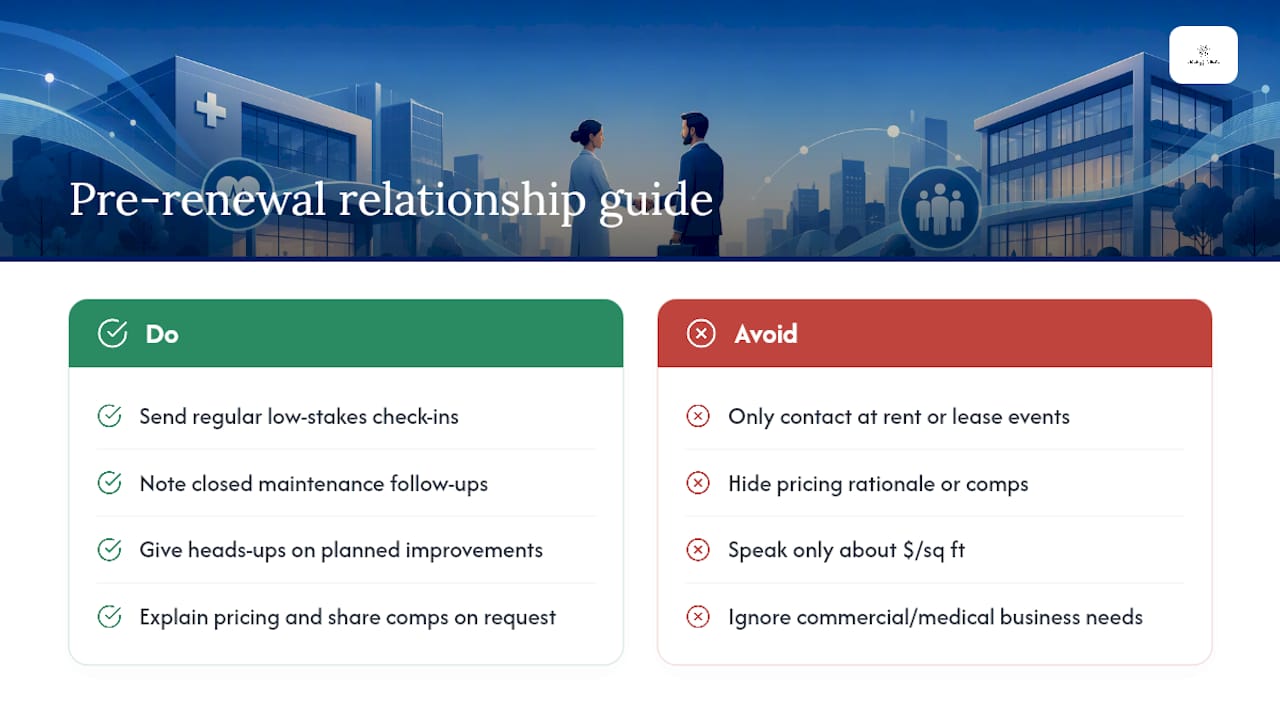
Renewal negotiations go smoother when the relationship wasn’t built entirely inside a 90-day window. Owners and managers who only communicate during rent collection and lease events are negotiating with a tenant who has no reason to feel loyal when a cheaper option appears.
Regular, low-stakes contact does the heavy lifting here. A quick check-in after a maintenance request is closed, a heads-up about a planned property improvement, or a brief note acknowledging an on-time payment streak all cost almost nothing and build the kind of goodwill that makes a rent conversation feel less adversarial later.
Transparency about pricing helps too. Tenants who understand that increases are tied to market comps and operating costs, rather than an arbitrary decision, are far less likely to treat a renewal notice as a personal insult. Share the comps if a tenant asks; hiding the reasoning behind a number almost always makes negotiations harder, not easier.
For commercial and medical tenants specifically, relationship building often means understanding their business, not just their lease. A medical practice weighing a renewal against a purchase decision is thinking about patient volume projections, equipment amortization, and staffing, not just square footage cost. Resources like a lease versus buy comparison help frame that conversation honestly, and a landlord who can speak to those pressures earns more trust than one who only talks about rent per square foot.
Small property improvements matter here too. Upgrades tenants actually notice, like window improvements that support comfort and energy costs, can double as both a retention tool and a renewal-negotiation chip, giving you something concrete to offer besides a rent discount.
How Do You Measure the Financial Impact of a Renewal Strategy?
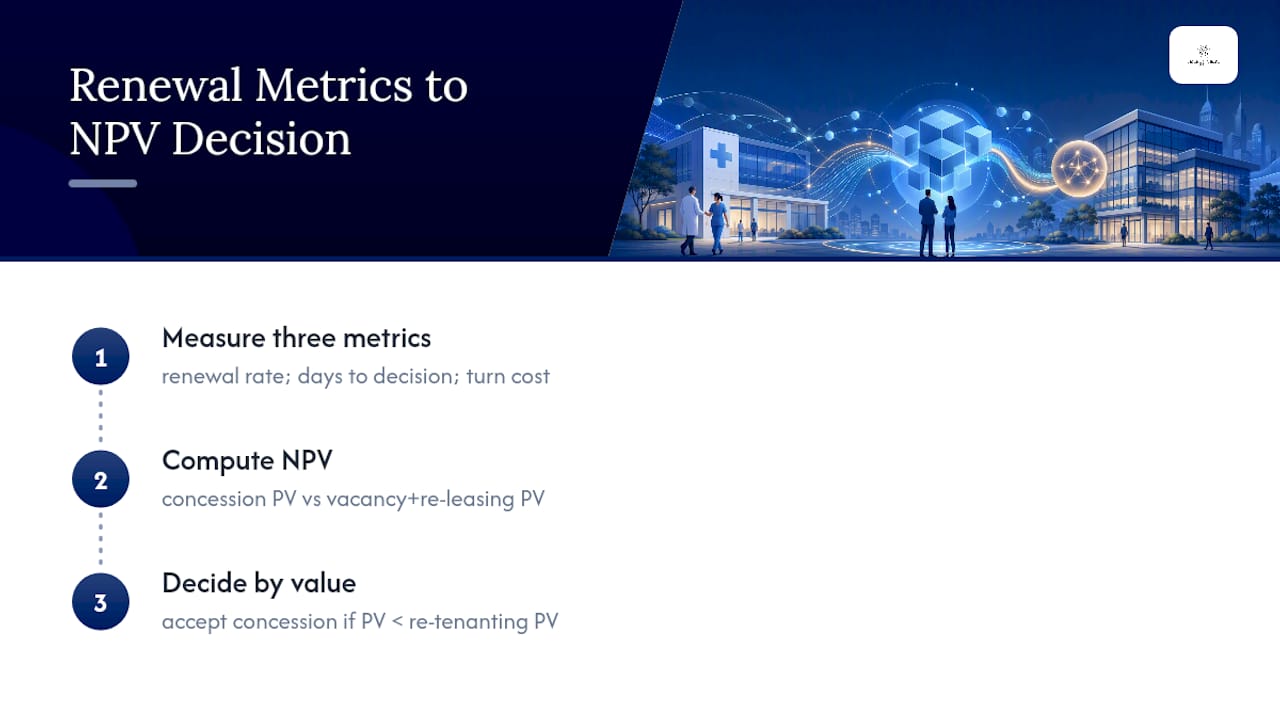
A renewal strategy that isn’t measured is just a hunch with better paperwork. Three numbers tell you almost everything: renewal rate, days to decision, and turn cost, tracked and reviewed quarterly rather than left in a spreadsheet nobody opens, a practice Buildium and PropsManager both recommend.
Renewal rate tells you whether your pricing and outreach are working across the portfolio, not just for one unit. A dropping renewal rate usually means one of two things: rents have drifted too far above market, or the outreach process itself has gotten sloppy. Days to decision measures friction directly. If tenants routinely wait until the deadline to respond, your menu probably isn’t clear enough or the deadline isn’t being enforced.
Turn cost is the number that actually justifies concessions. Calculate it honestly: lost rent during vacancy, marketing spend, cleaning and repair costs, and leasing commission. Once that number is on paper, a modest renewal concession almost always looks cheap by comparison. This is where NPV-based reasoning earns its keep, particularly for medical and office assets where turn costs run high and re-tenanting timelines stretch long. Weighing the present value of a concession against the present value of an extended vacancy and re-leasing cost turns a subjective negotiation into a defensible financial decision.
Owners weighing bigger capital decisions, like whether to sell or refinance a stabilized asset through a CMBS loan or DSCR-based financing, should factor renewal performance directly into that analysis. A property with a strong renewal rate and low turn cost supports a stronger valuation and better refinancing terms than one bleeding tenants every cycle.
How Do You Coordinate Property Management and Leasing Teams?
Renewals fail more often from poor handoffs than from bad pricing. If your leasing team is quoting market rents that your property manager doesn’t know about, or your property manager is promising concessions that finance never approved, tenants notice the inconsistency immediately.
A shared renewal calendar, the same one used for the 120-to-30-day workflow, should be visible to both teams, not siloed in one department’s system. When property management flags a maintenance issue or a tenant complaint, that information needs to reach whoever is handling the renewal conversation before the 90-day menu goes out, not after a tenant has already decided to leave.
Clear ownership matters too. Decide upfront who owns the walk-away number, who’s authorized to approve concessions beyond the standard menu, and who signs off on the final addendum. Ambiguity here is how a tenant ends up negotiating with two different people who give two different answers.
For multi-tenant buildings, especially medical office and mixed-use office assets, this coordination becomes more complex simply because there are more moving pieces. The advantages of owning a multi-tenant building include diversified rent roll and staggered lease expirations, but that same structure demands tighter internal communication so one tenant’s renewal negotiation doesn’t get lost in the noise of five others happening simultaneously.
What Are the Most Common Lease Renewal Mistakes?
The most expensive mistake is waiting too long to start. Owners who begin renewal conversations at the 30-day mark have already lost most of their negotiating leverage, and the tenant knows it. A rushed renewal often means overpaying in concessions just to avoid a vacancy that better timing would have prevented entirely.
A close second: pricing off gut feeling instead of comps. Guessing at a rent increase, rather than running actual local comparables, either leaves money on the table or pushes a good tenant toward the exit over a number that was never grounded in the market to begin with.
Other recurring pitfalls include:
- Sending a single take-it-or-leave-it offer instead of a menu, which invites a flat “no” rather than a negotiation.
- Automatically re-offering original move-in concessions every cycle, training tenants to expect a discount regardless of market conditions.
- Failing to check lease-specific and state-specific notice requirements, which can void a rent increase or extend a lease on the old terms by accident.
- Treating every tenant identically instead of segmenting by payment history and lease compliance.
- Leaving negotiated terms verbal instead of documenting them in a signed addendum.
Most of these mistakes share a root cause: treating renewal as a single event instead of an ongoing process that starts months before the lease actually expires.
A Broker’s View on What Actually Moves Renewal Numbers
Years spent on both sides of the table, representing landlords and tenants, teaches you that the numbers people fight hardest over in a renewal are rarely the ones that matter most. One medical office tenant, weighing a modest increase against relocating an entire practice, stayed once the owner ran the retention math out loud: the present value of a small rent concession was a fraction of what re-tenanting that suite would have cost, fit-out and downtime included.
That’s the piece most owners skip. They negotiate rent per square foot when they should be negotiating against their own turn cost. Get that math right, start early, and the rest of the renewal conversation gets a lot less contentious.
— Jim
How Ardorcre Helps You Execute a Renewal Strategy That Works
Running a renewal playbook well takes more than a template. It takes market comps that hold up under a tenant’s scrutiny, a lease abstract that catches notice deadlines before they’re missed, and someone who’s negotiated the concession-versus-turn-cost math enough times to know where the real leverage sits.
Ardorcre works the Charlotte MSA across office, medical, retail, and industrial assets, handling both landlord and tenant representation so renewal negotiations don’t lean lopsided toward whichever side has better advice. That includes lease review and CAM reconciliation analysis, lease abstraction to keep every notice date and escalation clause documented, and commercial property valuation and DCF modeling when a renewal decision is tangled up with a bigger question about selling, refinancing, or holding.
Expertise in complex commercial renewals, medical office tenant improvement planning, and multi-tenant building strategy is particularly valuable. If your next renewal season is approaching and you want the comps, the timeline, and the negotiation handled by someone who does this daily, start with Ardorcre’s services page and get a conversation started before your next 120-day window opens.
Sources
- Lease Renewal Strategies Every Property Manager Needs | Buildium
- Lease renewal timeline for renters: What to expect | RentCafe
- How to Handle Lease Renewals and Negotiations: A Landlord’s Complete Playbook (2026) | PropsManager
- How a Blend and Extend Swap Modifies a Lease – LegalClarity
FAQ
How Do You Negotiate a Lower Rent Renewal?
Bring specific market comps to the conversation and offer a trade, like a longer lease term, in exchange for a smaller increase. Landlords are far more likely to negotiate down when you can point to comparable units at a lower rate rather than simply asking.
What Should You Avoid Saying to a Landlord During Renewal?
Avoid vague threats to leave without backing them up with specifics, since that usually reads as a bluff and weakens your position. Also avoid demanding a number before you’ve reviewed what the lease actually says about notice periods and renewal terms.
What Are the Pros and Cons of Renewing a Lease?
Renewing avoids moving costs, downtime, and the uncertainty of finding new space, and it preserves a working relationship with a landlord who already knows your payment history. The main downside is a locked-in rent increase and reduced flexibility if your space needs are likely to change soon.
What Are the Best Tactics for Negotiating a Lease Renewal?
Start the conversation 90 to 120 days before expiration to preserve leverage, since waiting until 30 days out usually means the leverage is already gone. Present multiple term and rent options rather than a single offer, and put every agreed change into a signed written addendum.
Does Ardorcre Help With Lease Renewal Negotiations?
Yes. Ardorcre provides landlord and tenant representation, lease review, and lease abstraction services across the Charlotte MSA to support renewal negotiations for office, medical, retail, and industrial properties. Current service details and pricing are available on Ardorcre’s services page.