
Most small and medium businesses come out ahead leasing office space, especially with occupancy horizons under seven years or uncertain headcount growth. Buying wins for businesses staying 7 to 10+ years with stable cash flow, particularly medical practices with heavy tenant improvements. Run a 10-year total cost of ownership comparison before committing either way.
TL;DR:
- Leasing remains more cost-effective for businesses with occupancy horizons under seven years or uncertain growth, especially when lease concessions are factored into effective rent.
- Buying is more suitable for stable, long-term tenants like medical practices with predictable cash flow and a plan to stay for more than seven years, considering initial and ongoing costs.
- Running a detailed 10-year total cost comparison, including appreciation, capital reserves, and financing risks, is essential before deciding to lease or buy.
- Market conditions, such as distressed assets and generous leasing terms, currently favor tenants, but higher interest rates extend the breakeven point for ownership.
- Proper exit planning, understanding lease renewal options, and assessing refinancing or sale risks are crucial for both leasing and ownership decisions.
Table of Contents
- Lease vs. Buy Office: What Leasing Really Costs
- Lease vs. Buy Office: What Ownership Actually Costs
- How to Run a 10-Year Lease vs. Buy Comparison
- Lease or Buy: A Decision Checklist Before You Sign Anything
- ArdorCRE’s Perspective on Medical and Multi-Tenant Ownership
- How Market Conditions Are Shaping the Lease vs. Buy Decision
- Tax Differences Between Leasing and Owning Office Space
- Matching Space Flexibility to Your Growth Plans
- Planning Your Exit Before You Ever Sign
- Why the Standard Lease vs. Buy Formula Undersells Risk
- How ArdorCRE Helps You Decide and Close the Deal
- Sources
- FAQ
Lease vs. Buy Office: What Leasing Really Costs
Leasing costs more than the number on the rent roll suggests, and less than owners assume once you factor in what you’re not paying for. The two dominant lease structures, full-service (gross) and NNN (triple net), split obligations differently. Full-service bundles taxes, insurance, and common-area maintenance into one rent number. NNN pushes those costs onto the tenant separately, which usually produces a lower base rent that looks deceptively cheap until the operating expense reconciliation lands in your inbox.
The real leverage in a lease negotiation isn’t the rate. It’s the concessions.
- Tenant improvement (TI) allowances, often $30 to $80 per square foot depending on build-out complexity
- Free rent periods, commonly one to three months on a five-year term
- Graduated escalations instead of flat 3% annual bumps, which soften early-year cash flow
To compare offers honestly, convert every concession into effective rent: total cash outflow over the term, divided by square footage, divided by months. A lease with a higher face rate but six months free and a full TI package can easily beat a “cheaper” lease with none of it.
Leasing also preserves capital for the business itself, which matters more for a company growing 20% a year than for one that’s been flat for a decade. The tradeoff is exposure to landlord risk: buildings in financial distress, deferred maintenance, or ownership churn can disrupt operations in ways an owner-occupant never has to worry about.
Lease vs. Buy Office: What Ownership Actually Costs
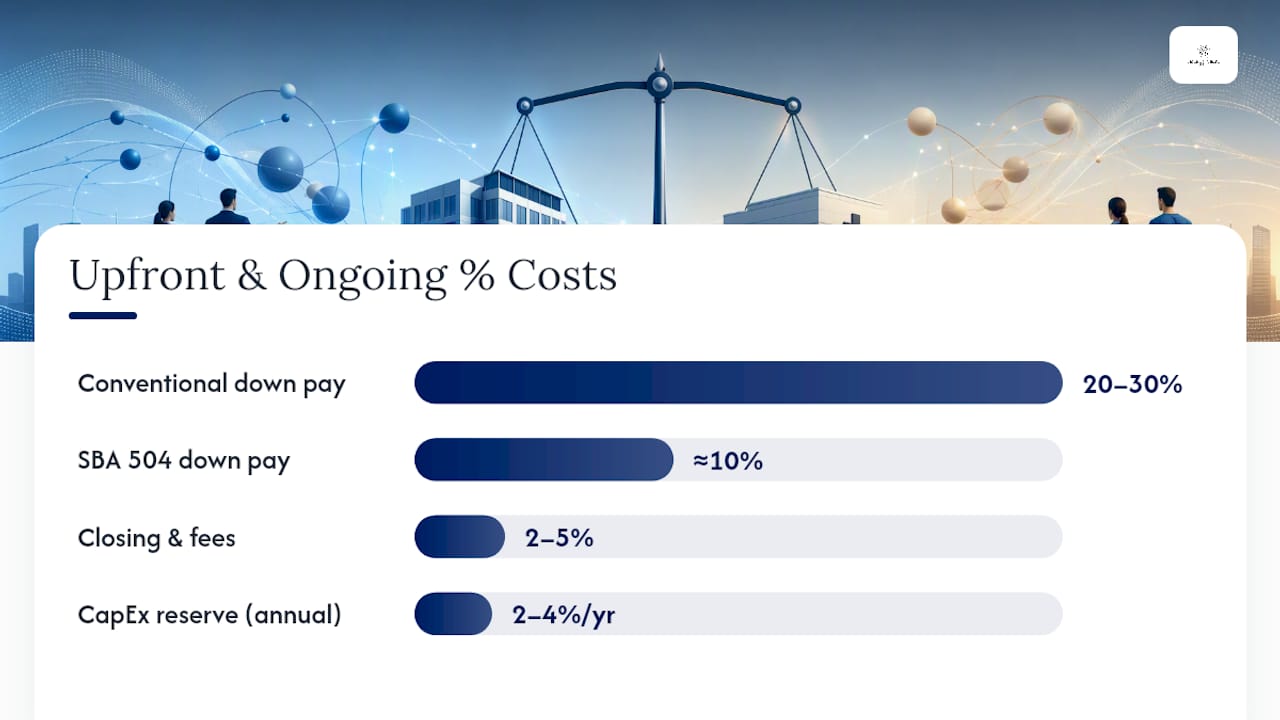
Buying flips the risk profile. You trade landlord uncertainty for direct responsibility, and the upfront capital requirement is the first wall most SMBs hit. Conventional commercial mortgages typically require 20% to 30% down. The SBA 504 program changes that math for owner-occupants, allowing down payments as low as 10% in many cases, which is often the single factor that makes ownership viable for a practice or firm that would otherwise stay a renter indefinitely.
Closing costs, appraisal, environmental reports, and loan fees add another 2% to 5% on top. Then the ongoing bill starts:
- Debt service on the mortgage
- Property taxes and building insurance
- Routine maintenance and building systems upkeep
- A capital expenditure reserve, generally 2% to 4% of property value annually, for roof, HVAC, and parking lot replacement cycles
Ownership isn’t a real estate decision so much as a second business line. Tax treatment offsets some of that: depreciation and mortgage interest are deductible, which lowers the after-tax cost of ownership below the sticker price of debt service and taxes combined. Commercial landlords face ongoing management responsibilities that extend well past the mortgage payment, and owners of multi-tenant buildings should expect to budget for either self-management or a third-party property manager.
The payoff on the other side is equity. Every principal payment builds ownership value, and a well-located building often appreciates over a 10-year hold. Owners who buy more space than they need can lease the surplus to another tenant, turning excess square footage into income that offsets their own occupancy cost.
How to Run a 10-Year Lease vs. Buy Comparison
A 10-year total cost of ownership model is the standard way to compare leasing against buying, and the breakeven point typically lands between 5 and 10 years depending on appreciation assumptions, cost of capital, and how generous the lease concessions are.
Build the model with these steps:
- List every lease-side cost: base rent, escalations, operating expenses (if NNN), and any TI you’re financing yourself.
- List every buy-side cost: down payment, closing costs, debt service, property tax, insurance, maintenance, and capex reserve.
- Apply a discount rate to both cash flow streams so a dollar spent in year one and a dollar spent in year nine aren’t treated as equal.
- Calculate the opportunity cost of the down payment. Money tied up in a building isn’t earning a return elsewhere in the business.
- Estimate a terminal value for the buy scenario. Even a conservative appreciation assumption changes the outcome meaningfully over a decade.
- Compare cumulative net cost, lease versus buy, year by year, and mark where the lines cross.
Pro Tip: Run the model three times: flat market, 2% annual appreciation, and a mild downturn. If buying only wins in the optimistic scenario, that’s your answer. Ownership decisions shouldn’t depend on the best case actually happening.
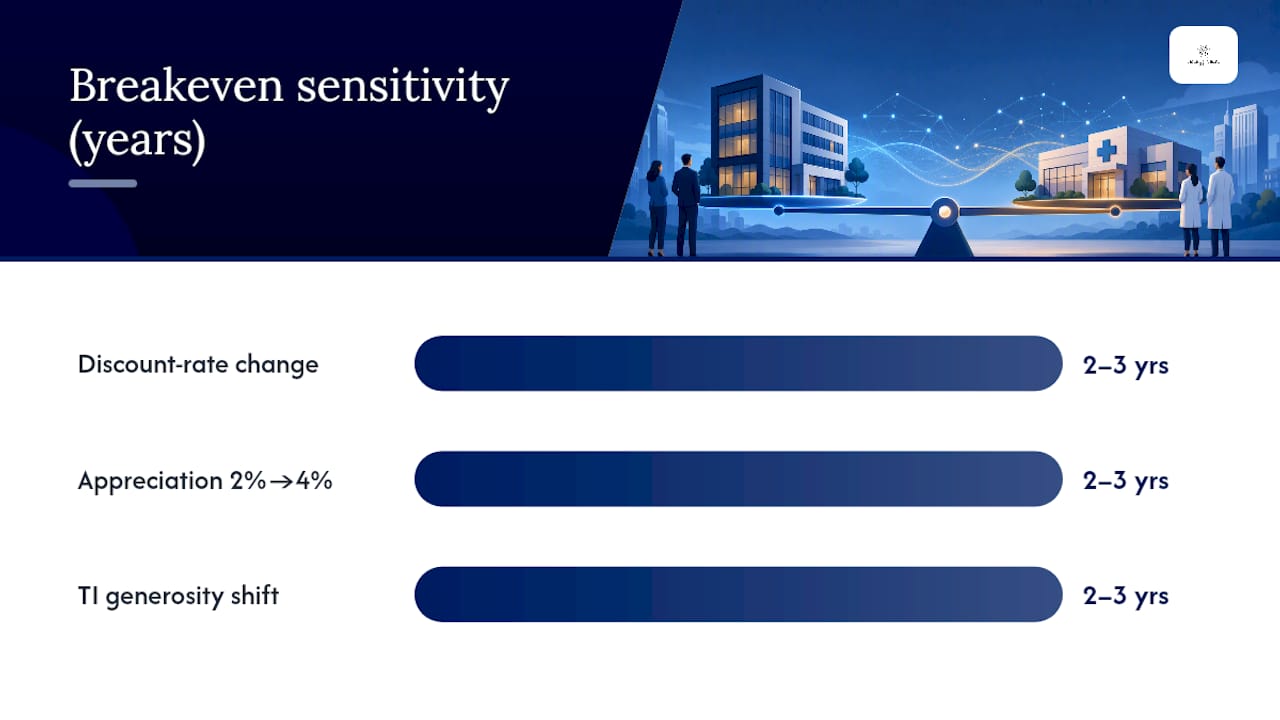
Sensitivity matters more than the base case. A half-point change in your discount rate, or a shift from 2% to 4% annual appreciation, can move the breakeven year by two or three years in either direction. TI generosity does the same thing on the lease side. Several free online calculators let you stress-test these variables, but the inputs that deserve the most scrutiny are your actual occupancy horizon and your realistic cost of capital, not the rent quote itself.
Lease or Buy: A Decision Checklist Before You Sign Anything
Before you sign a lease renewal or a purchase agreement, score your situation against five factors and bring specific questions to the people who’ll actually finance or negotiate the deal.
- Occupancy horizon. Under 5 years, lease. Over 7 to 10 years with confidence, buying starts to make sense.
- Capital opportunity cost. If deploying that down payment elsewhere in the business would generate a higher return, leasing usually wins on paper.
- Business volatility. Volatile headcount or revenue argues for lease flexibility over ownership’s fixed costs.
- Asset specialization. Medical space with heavy MEP and TI investment favors ownership more than generic office space does.
- Local market fundamentals. Soft rents and heavy concessions favor tenants; tight supply favors buyers who can lock in occupancy cost.
Ask landlords about TI responsibility, renewal option pricing, and assignment or sublease rights before you sign. Ask lenders about loan term versus amortization period, balloon exposure, DSCR requirements, and prepayment penalties. A lender quoting a 10-year amortization on a 5-year term is telling you a balloon payment is coming, whether they say it plainly or not.
Red flags favoring lease: thin credit, uncertain headcount, or a lender pushing aggressive refinancing risk. Red flags favoring buy: stable multi-year cash flow and space needs specialized enough that moving would be genuinely costly.
ArdorCRE’s Perspective on Medical and Multi-Tenant Ownership
Medical practices are the clearest case for ownership, and also the group most likely to underestimate the timeline. Specialized MEP systems, imaging equipment infrastructure, and permitting mean medical TI and buildout planning should start 12 to 18 months before occupancy, not three months. Practices certain to stay put for a decade often come out ahead owning, once that lead time is respected.
Multi-tenant ownership is underused by SMB owners who buy more space than they need. Leasing out the surplus can offset a meaningful share of your own occupancy cost, though it comes with landlord responsibilities you may not have planned for.
The mistakes we see repeatedly:
- Capex reserves set too low, leaving no cushion when the roof or HVAC fails in year six
- Underestimating refinance risk on a loan structured with a balloon payment
- Buying through the operating company directly instead of a separate ownership entity, which mixes real estate and operating liability
Our property versus asset management guide covers how owners of five or more buildings structure oversight without it becoming a second full-time job.
How Market Conditions Are Shaping the Lease vs. Buy Decision
The 2026 market rewards patience and capital discipline more than any single formula does. Distressed commercial assets, roughly $126 billion worth as of late 2025 and early 2026, are trading at prices that create real acquisition opportunities, but only for buyers with the equity and operating stability to close on them. That opportunity doesn’t extend to every SMB weighing a purchase.
Soft fundamentals in several office submarkets have pushed landlords toward more generous concessions, longer free-rent periods, and heavier TI packages to keep occupancy up. That environment favors tenants disproportionately. A creditworthy business negotiating a renewal right now often has more leverage than at any point in the past several years.
The catch on the buy side is financing cost. Interest rates well above the pre-2022 era mean debt service on a purchase eats a larger share of the total cost than it did when 10-year TCO comparisons were built around cheaper capital. That doesn’t kill the case for ownership, but it does mean the breakeven year has generally moved later, not earlier, compared to older rules of thumb. Anyone modeling a purchase today needs current rate assumptions, not the assumptions from five years ago. Well-capitalized buyers with a 7 to 10 year hold and disciplined reserves are positioned to benefit from a distressed and selective market; buyers stretching to close on thin margins are taking on risk the market data doesn’t currently reward.
Tax Differences Between Leasing and Owning Office Space
Lease payments are fully deductible as a business operating expense in the year you pay them. That simplicity is part of leasing’s appeal. There’s no depreciation schedule to track, no asset basis to manage, and no distinction between land and building value to worry about at tax time.
Ownership’s tax treatment is more complex and, for many owners, more favorable over time. Commercial buildings depreciate over 39 years under standard straight-line schedules, and that depreciation deduction reduces taxable income every year regardless of whether the property is appreciating in market value. Mortgage interest is deductible as well, which means the after-tax cost of debt service is meaningfully lower than the sticker rate on the loan.
A common structure among practices and professional firms is to hold the property in a separate real estate LLC that leases the space back to the operating company. The operating business deducts its rent payment normally, while the ownership entity captures depreciation and interest deductions and builds equity separately. This keeps operating liabilities away from the real estate asset, which matters if the business ever faces litigation or financial stress.
Depreciation recapture is the tradeoff to plan for. When you eventually sell, the IRS taxes previously claimed depreciation at a separate rate rather than at capital gains rates. That doesn’t make ownership a worse deal, but it does mean the terminal-value assumption in your TCO model should account for it rather than assuming a clean capital gain on exit.
Matching Space Flexibility to Your Growth Plans
Space flexibility is where leasing has no real substitute for a business that can’t confidently forecast headcount three years out. A lease lets you negotiate expansion rights, right-size at renewal, or relocate entirely when the term ends. Ownership locks you into a fixed footprint until you can find a tenant for the extra space.
The businesses that regret buying almost always share one trait: they underestimated how much their space needs would change. A ten-person team that signs for a 5,000 square foot building because “we’ll grow into it” often finds itself either cramped in year three or stuck carrying excess square footage they can’t easily convert into cash.
Growth-stage companies with unpredictable hiring curves should weight heavily toward leasing, and negotiate expansion options or first-right-of-refusal clauses on adjacent space rather than buying ahead of actual need. Stable, mature businesses with flat or slow-growing headcount, particularly established medical practices with predictable patient volume, face much less of this risk, since the building’s footprint and the business’s needs tend to stay aligned for years.
The middle case, moderate but steady growth, is where the multi-tenant ownership approach earns its place. Buying a building larger than current needs and leasing the surplus to another tenant gives you room to expand into your own space later without the disruption of a move, while the interim lease income offsets your carrying cost.
Planning Your Exit Before You Ever Sign
Every lease vs. buy decision needs an exit plan built in from day one, not figured out under pressure five years later.
On the lease side, exit options depend entirely on what you negotiated up front. Subleasing lets you recover part of your cost if your space needs shrink, but most leases require landlord consent and cap how much of the space you can sublease. Lease transfer, or assignment, shifts your remaining obligation to a new tenant entirely, which is cleaner but harder to arrange without landlord cooperation. Terminating early, without either option, usually means paying a termination fee or remaining liable for rent through the end of the term. Review what early termination actually costs before you sign, not after you need out.
On the ownership side, exit means selling the asset or refinancing it, and this is where CMBS loan structures introduce real risk. Loans built around a balloon payment or set for refinancing at term can force a large capital injection or a discounted sale if property values or your business’s cash flow have weakened by the time the loan matures. That risk is exactly why current DSCR calculations matter before refinancing, not just at origination. An owner who bought at the top of a cycle and needs to refinance during a downturn can face a materially worse deal than the one they signed originally, sometimes forcing a sale into a soft market rather than on their own timeline.
Why the Standard Lease vs. Buy Formula Undersells Risk
Most lease vs. buy guides treat the decision as a spreadsheet problem: plug in rent, plug in mortgage terms, see which number is smaller over 10 years. That’s useful, but it undersells the two variables that actually break most SMB real estate decisions: refinancing risk and occupancy uncertainty.
The conventional advice says “buy if you’re staying long term.” That’s directionally right but incomplete. A business staying 10 years but financing through a loan structure with balloon exposure can still get hurt badly if it has to refinance during a downturn. The horizon question and the financing-structure question are separate risks, and treating them as one is where a lot of owners get surprised.
What the data actually supports is more selective: 2026’s distressed-asset opportunities and generous lease concessions both reward buyers and tenants who model multiple scenarios rather than a single forecast, and who take DSCR and refinance timing as seriously as the purchase price itself. Medical practices with long horizons and predictable cash flow have the strongest case for ownership right now. Everyone else should run the TCO model with real interest-rate assumptions before assuming buying is the mature choice. It isn’t automatically. It’s the choice that fits a specific financial profile, and confirming you actually have that profile should come before signing anything.
— Jim
How ArdorCRE Helps You Decide and Close the Deal
Running a 10-year TCO model on your own is doable. Getting the DSCR math, the SBA loan sizing, and the lease terms right on the first pass, without a broker’s blind spots working against you, is harder. Commercial real estate brokers can handle office and medical-office transactions, tenant representation and landlord representation, plus acquisition advisory for owner-occupants weighing a purchase.
Our services include lease abstraction to catch the clauses that quietly cost tenants money, loan sizing and DSCR analysis for buyers structuring financing, and full representation whether you’re negotiating a renewal or bidding on a building. Before you reach out, pull together your current lease, two to three years of P&L, a rough headcount growth plan, and a budget range. That’s enough for us to start modeling your actual numbers instead of generic assumptions.
Start with our DSCR and loan sizing guide to see how lenders will evaluate your deal before you’re sitting across the table from one.
FAQ
Why Do Companies Lease Instead of Buy?
Leasing preserves capital for operations, offers flexibility to scale space up or down, and avoids the maintenance, tax, and capex responsibilities that come with ownership, which is why fast-growing or uncertain-horizon businesses usually lease.
Why Would a Company Lease Instead of Buy Its Office?
A company leases when its occupancy horizon is under roughly seven years, its headcount or space needs are hard to predict, or it can earn a better return deploying capital into the business than into a down payment on real estate.
How Long Should a Business Plan to Stay Before Buying Office Space?
Most rules of thumb put the breakeven between 5 and 10 years, so businesses confident they’ll occupy a space for 7 to 10 years or longer generally have the stronger financial case for buying.