
Medical office demand in Charlotte is exceptionally strong right now, and availability is sitting at record lows. The Azalea Building’s $59.5 million sale and back-to-back health system expansions confirm it. Investors should prioritize stabilized or hospital-affiliated assets, lock financing terms before they move again, and stay cautious on ground-up speculative builds until construction costs settle.
TL;DR:
- Medical office vacancy in Charlotte is extremely low, with tenants competing for space in established corridors, and leasing velocity remains strong despite limited new supply.
- The surge in demand is driven by population growth in suburban areas and hospital systems expanding outpatient services into these regions, with construction costs rising and limiting speculative projects.
- The recent sale of the Azalea Building for around $59.5 million shows institutional interest in stabilized, hospital-anchored properties commanding premium prices, especially in affluent submarkets.
- Yields on stabilized medical office buildings are tightening, making detailed tenant credit analysis, lease risk assessment, and prelease verification essential before investing.
- Most new projects are preleased or anchored by hospital systems, so unanchored speculative construction is rare due to high costs and completion risks in the current environment.
Table of Contents
- Medical Office Demand Charlotte: The Current Data Snapshot
- Why Is Medical Office Demand So High In Charlotte?
- What The Azalea Building Sale Tells Investors
- How Should Investors Adjust Their Underwriting?
- Should A Medical Practice Lease Or Buy Office Space?
- Financing And 1031 Timing For Charlotte Medical Office Deals
- Your 3 To 12 Month Action Plan For Charlotte Medical Office
- How Does Charlotte Compare To Other Southeast Medical Office Markets?
- Does Telemedicine Reduce The Need For Medical Office Space?
- Are Regulatory Changes Affecting Charlotte’s Medical Office Market?
- A Local Read On Where Charlotte’s Medical Office Market Is Headed
- Get Ahead Of Charlotte’s Medical Office Market With Ardor CRE
- Sources
- FAQ
Medical Office Demand Charlotte: The Current Data Snapshot
Occupancy across Charlotte’s medical office buildings has climbed to levels rarely seen in this market, and the trend lines up with what’s happening nationally in healthcare real estate. Bisnow’s reporting on the Charlotte market documents occupancy running above historical norms in late 2025, mirrored by similarly tight conditions across the broader U.S. healthcare real estate sector into mid-2026. CoStar’s coverage puts a finer point on it: medical office space in Charlotte has tightened to levels the market hasn’t dealt with before, driven by population growth stacked on top of hospital system expansion.
A few numbers and trends worth underwriting around:
- Vacancy is compressed enough that tenants are competing for remaining blocks in established medical corridors, not just premium buildings.
- Leasing velocity has stayed strong even as new supply lags demand, a signal that absorption is outpacing deliveries.
- The delivery pipeline skews heavily toward preleased, hospital-backed projects rather than speculative construction, which keeps new supply from flooding the market and undercutting rents.
That last point matters most for anyone modeling rent growth. When developers won’t break ground without a hospital system or anchor tenant already signed, the supply response to demand becomes slow and deliberate instead of speculative and risky.
Why Is Medical Office Demand So High In Charlotte?
Three forces are converging at once, and none of them are temporary. Charlotte added roughly 20,731 residents between mid-2024 and mid-2025, with much of that growth concentrating in suburban corridors like Union County and the Lake Norman area. Every one of those new residents eventually needs a primary care visit, an imaging appointment, or a specialist referral.
At the same time, Atrium Health and Novant Health keep pushing outpatient campuses deeper into the suburbs, chasing patients where they now live rather than waiting for them to drive downtown. That outpatient shift is structural, not cyclical. Hospitals have spent the last decade moving lower-acuity care out of expensive inpatient settings and into ambulatory buildings, and specialties like dermatology and imaging are following that migration into leased or owned space.
Layer construction cost inflation on top of that demand story and you get today’s supply constraint:
- Population growth in Union County and Lake Norman is pulling primary care and urgent care into new suburban nodes.
- Outpatient campus strategies from Atrium Health and Novant Health are absorbing large blocks of new and existing space.
- Rising construction costs are making speculative medical office development harder to pencil, so most new projects only break ground once anchor tenants sign.
Pro Tip: When you see a developer breaking ground without a signed anchor tenant, ask why. In this cost environment, unanchored speculative medical office construction is the exception, not the rule.
What The Azalea Building Sale Tells Investors
SouthPark just delivered the clearest proof point of investor appetite in this cycle. The Azalea Building, a 151,993 square foot outpatient property with Novant Health occupying roughly 75% of the space, sold to Anchor Health Properties for approximately $59.5 million. That’s an institutional buyer paying a premium for stabilized cash flow anchored by a credit health system tenant.
SouthPark works as a medical corridor for reasons beyond convenience. The submarket sits along Morrison and Fairview near some of the most affluent demographics in the Charlotte MSA, which draws elective and cosmetic specialties willing to pay for visibility and foot traffic.
For investors evaluating similar deals, the Azalea sale points to a few takeaways:
- Hospital-anchored buildings with 70% or higher single-tenant credit exposure command premium pricing from institutional buyers.
- Tenant concentration cuts both ways: it de-risks near-term cash flow but raises the stakes on lease renewal and rollover risk.
- Active asset management around lease renewal timing becomes more important as single-tenant concentration rises.
How Should Investors Adjust Their Underwriting?
Tight supply and heavy investor demand are compressing yields on move-in-ready medical office buildings, especially anything with hospital system credit in the rent roll. National data backs this up: CBRE tracked a 35% year-over-year jump in MOB investment volume to $12.6 billion in 2025, with the Southeast pulling in a leading share of that capital in the fourth quarter. That capital has to land somewhere, and Charlotte’s fundamentals make it a natural target.
Before you underwrite the next deal, run through this checklist:
- Verify tenant credit quality, especially for any hospital system or specialty group anchoring more than half the rent roll.
- Map lease expiration and rollover risk against your hold period, not just the current in-place rent.
- Stress-test tenant improvement exposure. Buildout costs for medical suites run well above standard office TI, and that gap is the first thing that gets missed in a rushed model.
- Confirm prelease status on any development deal. An unanchored building in this cost environment carries real completion risk.
Pro Tip: Pull a full lease abstract before you finalize pricing on any medical office acquisition. TI reimbursement clauses and renewal options buried in older leases routinely change the real cash-on-cash return.
Favor hospital-anchored or diversified tenant mixes over single-specialty buildings when you have the choice. A dermatology-anchored building performs well until that one practice relocates, and then you’re re-leasing medical-grade space that doesn’t convert easily to standard office use.
Should A Medical Practice Lease Or Buy Office Space?
The right answer depends on capital position and growth timeline, not just which option sounds more stable. Leasing makes sense for a physician group still building patient volume, testing a new location, or unsure whether it needs 4,000 square feet or 8,000 in three years. It preserves capital for equipment and staffing instead of tying it up in a building.
Ownership makes more sense once patient volume is predictable and the practice plans to stay put for a decade or longer. Buying converts rent payments into equity, and in a market this tight, owning your space also protects against the rent spikes that tenants are increasingly facing at renewal.
A few practical numbers to plan around:
- Move-in-ready, fully built medical suites carry a real premium over shell space, since tenant improvement costs for exam rooms, plumbing, and specialty equipment run well above standard office buildouts.
- Starting the leasing or buying process 12 to 18 months ahead of your target occupancy date is standard in this market, not overly cautious, given how tight supply has become.
- Physician buyers frequently use SBA 504 or 7(a) financing for practice-owned real estate, and those approval timelines need to be mapped against your site selection window from day one.
Pro Tip: If you’re a physician group weighing a purchase, start the SBA conversation before you fall in love with a specific building. Financing timelines, not site availability, are usually what derail medical office purchases.
Financing And 1031 Timing For Charlotte Medical Office Deals
Capital stacks for Charlotte medical office deals split fairly cleanly by size. Smaller physician-owner acquisitions typically run through SBA 504 or 7(a) programs, while larger institutional assets rely on conventional bank debt, agency financing, or bridge loans depending on stabilization status.
The sell-versus-refinance decision on existing CMBS debt comes down to debt service coverage ratio sensitivity. Use this DSCR loan sizing guide to check whether your loan sizing has grown, and if maturing CMBS debt no longer matches current cap rates, refinancing at today’s rates may cost more in debt service than a sale and 1031 exchange into a lower-leverage deal would.
Key points for anyone timing a 1031 in this market:
- The 45-day identification window and 180-day closing deadline don’t bend for a hot market, so start replacement property searches before you close on the sale.
- Ardor CRE’s 1031 exchange timeline helps investors sequence identification and closing around Charlotte’s compressed inventory.
- Given how few stabilized MOBs trade hands in a given quarter, lining up a qualified intermediary and a shortlist of replacement candidates before you list is worth the extra planning time.
Your 3 To 12 Month Action Plan For Charlotte Medical Office
Treat the next few quarters as a window to position, not a window to wait out. Here’s the priority order:
- Track preleased deliveries quarterly. New supply concentrated in hospital-backed projects tells you where rent growth will slow first and where it won’t.
- Lock financing terms now rather than betting on rate improvement, given how compressed cap rates already are on stabilized assets.
- Stress-test acquisition models against both rent growth assumptions and tenant improvement cost inflation before you commit to pricing.
- Reserve speculative development for sites with a signed anchor tenant or hospital system commitment. Unanchored spec builds carry too much completion risk in this cost environment.
- Engage an advisory team early on any disposition, acquisition sourcing, or 1031 planning, since the identification window closes faster than most investors expect in a tight market.
How Does Charlotte Compare To Other Southeast Medical Office Markets?
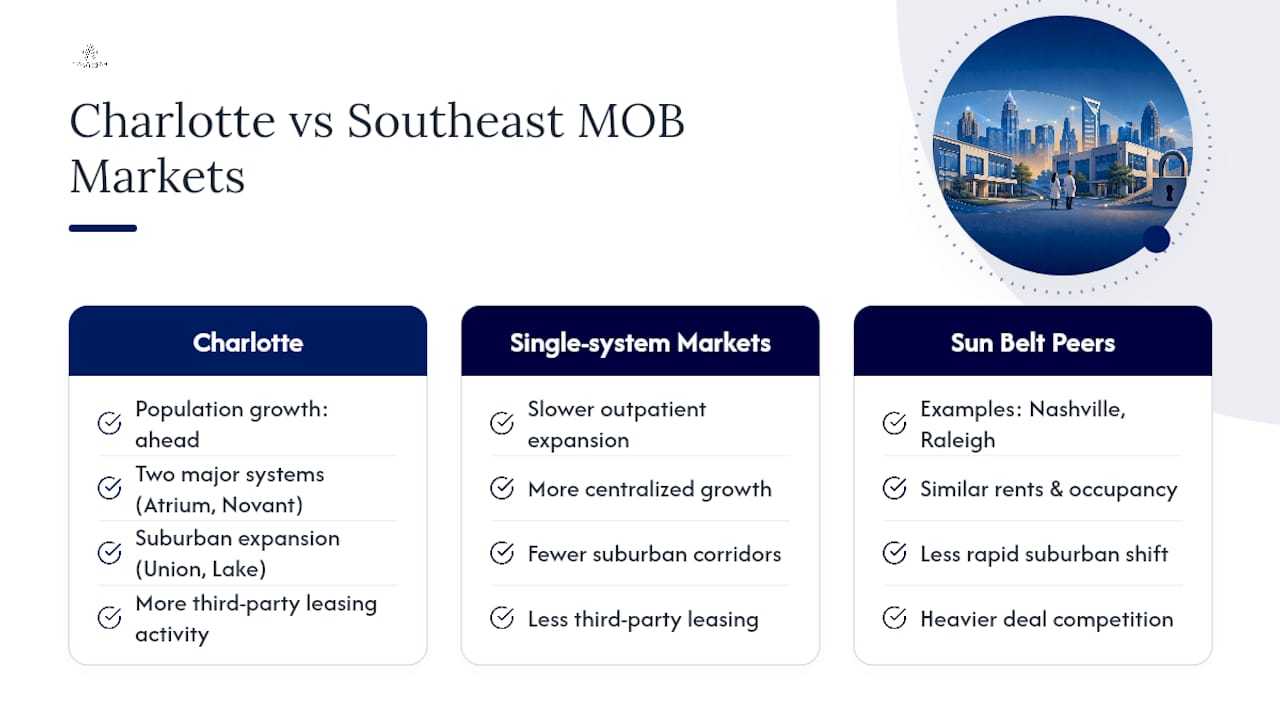
Charlotte isn’t an outlier in the Southeast, it’s near the front of a regional trend. The Southeast broadly captured a leading share of the $12.6 billion in national MOB investment volume that CBRE tracked in 2025, and Charlotte’s population growth rate puts it ahead of most peer metros in that region.
What sets Charlotte apart is the combination of two systems, Atrium Health and Novant Health, both aggressively building outpatient infrastructure in overlapping suburban corridors. Markets with a single dominant health system tend to see slower, more centralized outpatient expansion. Charlotte’s two-system competition creates more building activity and more leasing opportunity for third-party landlords, since neither system wants to cede a growing suburb to the other.
Compared to peer Sun Belt markets like Nashville or Raleigh-Durham, Charlotte’s medical office fundamentals look similarly tight, but its suburban growth pattern, especially around Union County and Lake Norman, is pushing demand further from the urban core faster than in some comparable metros. That matters for site selection: the corridors worth watching over the next several years are increasingly the suburbs, not just SouthPark or uptown.
For investors benchmarking Charlotte against other Southeast metros, the takeaway is straightforward. Charlotte offers similar rent growth and occupancy tightness to its regional peers, with less competition for deal flow than more heavily picked-over markets, at least for now.
Does Telemedicine Reduce The Need For Medical Office Space?
Telemedicine hasn’t reduced demand for physical medical office space in Charlotte, and the occupancy data backs that up directly. What’s changed is the type of space certain services need. Routine follow-ups and mental health consults have moved partly to virtual visits, easing pressure on some primary care square footage.
But procedures, imaging, infusion, and specialty diagnostics all require in-person space, and those service lines are exactly where outpatient demand keeps growing. Health systems have leaned into this by using telemedicine as a triage layer that routes patients toward the right physical location, whether that’s a satellite primary care clinic or a specialty building, rather than eliminating the need for that location entirely.

The practical effect on real estate is a shift in space configuration more than a shrinking footprint. Practices are asking for smaller exam room counts paired with more procedure and imaging square footage, and that’s changing how buildouts get designed even as total demand for outpatient buildings keeps climbing. Partner platforms built for medical office operations, like Callspace’s answering service for dental and medical practices, are increasingly part of how practices handle the call volume that virtual triage generates without adding staff. On the imaging side, demand for overflow capacity is real too. Outsourced radiology read services are one response to volume that outpaces in-house staffing, another sign that outpatient service lines are growing faster than the workforce supporting them, which keeps pressure on physical space.
Are Regulatory Changes Affecting Charlotte’s Medical Office Market?
Certificate of need rules in North Carolina still shape where major equipment and facility investments can go, and that indirectly steers where health systems locate new outpatient buildings. Since large equipment purchases and new facility bed counts require state approval, health systems often build outpatient campuses around approved locations rather than starting from scratch elsewhere, which reinforces demand in existing medical corridors instead of spreading it evenly across the metro.
Local zoning and permitting timelines in Mecklenburg and surrounding counties also affect how quickly new medical office supply can respond to demand. Combined with construction cost pressure already limiting speculative development, permitting delays add another reason new supply lags population growth rather than keeping pace with it.
No major federal reimbursement change has fundamentally altered the outpatient shift underway in Charlotte, but investors should watch site-neutral payment policy discussions in Washington. Any move toward equalizing reimbursement between hospital-owned and independent outpatient settings would likely accelerate the trend toward smaller, off-campus medical office buildings, since it would reduce the financial incentive for health systems to route procedures through higher-cost hospital-affiliated locations.
A Local Read On Where Charlotte’s Medical Office Market Is Headed
The data in this article backs a simple read: Charlotte’s medical office fundamentals are as tight as I’ve tracked them, and the Azalea sale confirms institutional buyers agree. Ardor CRE’s own transaction and leasing conversations across the Charlotte MSA line up with what CoStar and Bisnow are reporting publicly.
Three areas deserve the most attention right now. Acquisitions of stabilized or hospital-affiliated medical office buildings, tenant representation for physician groups navigating buildout timelines, and 1031 exchange timing for owners looking to trade into this market before pricing tightens further.
— Jim
Get Ahead Of Charlotte’s Medical Office Market With Ardor CRE
Commercial real estate advisors working the Charlotte MSA across medical, office, retail, and industrial properties develop a read on medical office demand from live deal flow, not just published reports. Compensation on transactions may be structured deal by deal rather than through a fixed standard commission, discussing terms upfront based on the scope of work instead of applying a flat industry default.
If you’re evaluating a medical office acquisition, a physician practice lease, or a sale that might trigger a 1031 exchange, come prepared with your target property type, deal size, and timeline. That’s what lets our team move fast in a market where stabilized inventory doesn’t sit long. Whether you’re weighing leasing versus buying your next practice location or need help sequencing a 1031 timeline against a sale, reach out to Ardor CRE and start that conversation before your next lease renewal or acquisition deadline forces the decision for you.
Sources
- SouthPark medical office nets $59.5M as Charlotte health hub heats up — Hoodline
- Charlotte healthcare real estate scene adapts to updated patient needs — Bisnow
- Medical office space tighter than ever in Charlotte — CoStar
FAQ
Is Medical Office Demand In Charlotte Actually Strong Right Now?
Yes. Occupancy is running at record highs and availability is exceptionally tight, driven by population growth and hospital system expansion, according to both CoStar and Bisnow reporting.
Who Is The Biggest Employer Driving Medical Office Demand In Charlotte?
Atrium Health and Novant Health are the two dominant health systems driving outpatient expansion across Charlotte, and their competing suburban buildout strategies are a major factor behind the metro’s tight medical office fundamentals.
What Jobs Are In High Demand In The Charlotte Healthcare Sector?
Outpatient specialties tied to the shift away from inpatient care, including imaging technicians, specialty physicians in dermatology and ophthalmology, and ambulatory care staff, are seeing the strongest hiring demand as health systems expand suburban campuses.
Should I Buy Or Lease Medical Office Space As A Physician In Charlotte?
Lease if you need flexibility or are still building patient volume; buy if your practice has predictable volume and plans to stay in one location for a decade or more, since ownership converts rent into equity in a market where space is only getting tighter.
How Does Ardor CRE Help With 1031 Exchanges On Medical Office Sales?
Ardor CRE manages 1031 exchange timelines for Charlotte investors, helping sequence the 45-day identification window and 180-day closing deadline against available replacement properties in a tight inventory market.