
A recourse loan lets your lender chase your personal assets, bank accounts, and wages if the collateral doesn’t cover the debt after default. A nonrecourse loan caps the lender’s recovery at the collateral itself, no matter how large the shortfall. That single distinction determines whether a bad deal costs you a building or costs you everything else you own too.
TL;DR:
- Nonrecourse loans limit lender recovery to the collateral, preventing lenders from pursuing personal assets or other property after default.
- Borrowers of nonrecourse loans face tighter debt service ratios and lower loan-to-value ratios, often around 65% or less, to offset the higher risk for lenders.
- Most residential and SBA loans are recourse by default, giving lenders the ability to pursue deficiency judgments and assets beyond the collateral.
- State laws can enforce anti-deficiency protections for residential mortgages but rarely restrict commercial or nonrecourse agreements, so legal review is essential.
- Bad-boy carve-outs can turn a nonrecourse loan into a recourse one if misconduct occurs, requiring careful legal examination before signing.
Table of Contents
- Recourse vs Nonrecourse Loan: A Quick Comparison
- What Is a Recourse Loan, and How Does a Lender Collect?
- What Is a Nonrecourse Loan, and Where Does Lender Recovery Stop?
- How Do Lenders Price and Underwrite Each Loan Type?
- Which States Limit Deficiency Judgments After Default?
- What Are Bad-Boy Carve-Outs, and When Do They Trigger?
- What Happens on Default: Examples and Tax Consequences
- How Do You Decide Which Loan Structure to Accept?
- How advisors can help office and medical owners on loan structure
- Which Way Do Most Owners Actually Lean?
- Need Help Structuring Your Next Loan?
- Sources
- FAQ
Recourse vs Nonrecourse Loan: A Quick Comparison
Before you sign anything, know exactly what each structure allows a lender to do after a default.
- Liability: Recourse exposes personal and business assets beyond the collateral; nonrecourse limits recovery to the pledged property.
- Remedies: Recourse lenders can pursue deficiency judgments, garnishment, and asset levies; nonrecourse lenders generally can only foreclose.
- Pricing: Recourse loans typically carry lower interest rates because lenders take on less risk.
- Common uses: Nonrecourse financing dominates stabilized commercial real estate and structured finance; recourse is standard for most residential mortgages, business lines of credit, and SBA loans.
The tradeoff in one line: IRS guidance treats these as fundamentally different debt instruments, and that difference shows up directly in your rate sheet, not just your risk exposure.
What Is a Recourse Loan, and How Does a Lender Collect?
A recourse loan gives the lender a legal path to your assets beyond whatever collateral secured the note. If your building sells for less than the outstanding balance after foreclosure, the lender doesn’t just absorb the loss. It can sue for the difference.
That process usually unfolds in a few stages:
- The lender forecloses and sells the collateral, often at auction.
- If the sale proceeds fall short, the lender calculates a deficiency balance.
- The lender files for a deficiency judgment in court.
- Once granted, the lender can pursue wage garnishment, bank levies, or liens on other property you own.
Courts decide whether a note is recourse by reading the actual contract language. The Legal Information Institute notes that a clause permitting “suit at law for recovery of any and all amounts” is about as clear a recourse signal as a document can carry. Most conventional business loans, SBA loans, and residential mortgages outside a handful of anti-deficiency states fall into this category by default.
What Is a Nonrecourse Loan, and Where Does Lender Recovery Stop?
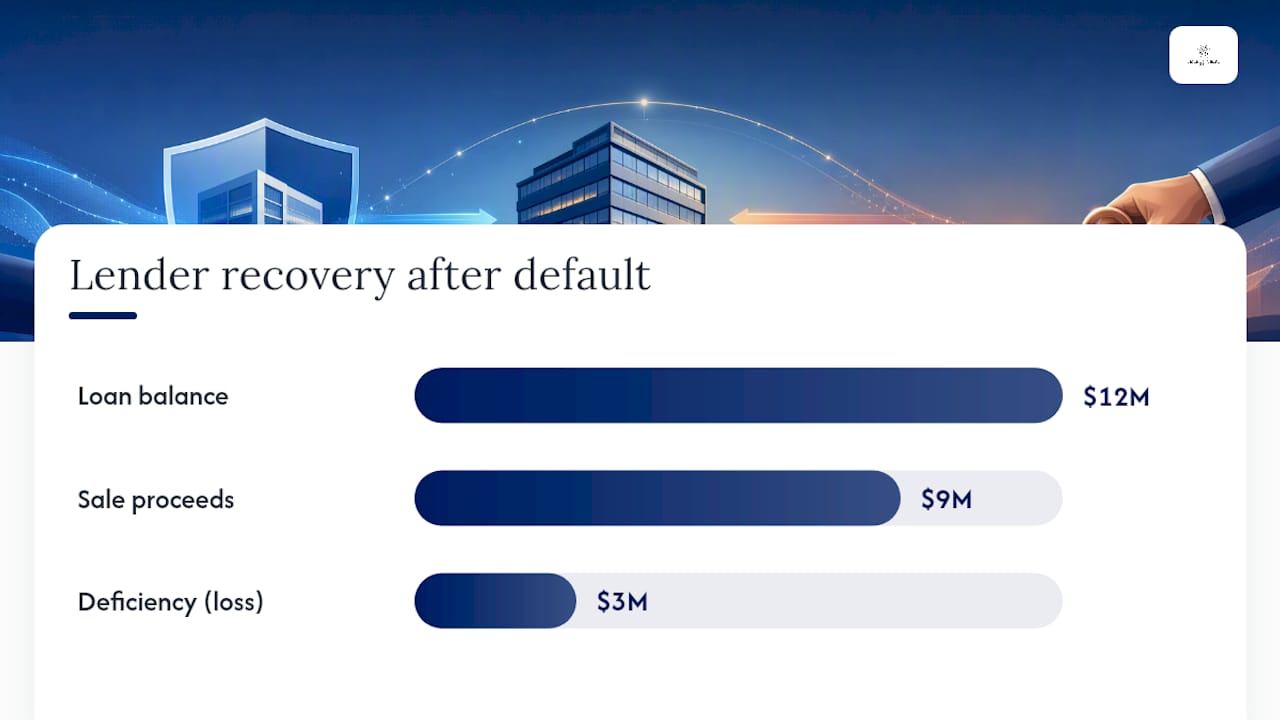
A nonrecourse loan restricts the lender to the collateral, full stop. If a $12 million office property sells for $9 million after default, the lender eats the $3 million gap. It cannot come after your other holdings, your operating accounts, or your personal net worth.
Lenders don’t offer that protection cheaply. Because nonrecourse loans concentrate all the risk on one asset, they demand:
- Lower loan-to-value ratios, often 65% or less
- Stronger debt service coverage ratios
- Stricter reserve and covenant requirements
- Detailed underwriting of tenant quality and lease terms
This structure shows up most often in stabilized commercial real estate and structured finance deals, where the asset itself generates predictable income. It also appears in an unexpected place: many Home Equity Conversion Mortgages, the federally insured reverse mortgage program, are structured as nonrecourse notes so a borrower’s estate never owes more than the home’s value.
Pro Tip: Nonrecourse protection sounds absolute, but it never is. Read the carve-out section before you assume you’re fully shielded.
How Do Lenders Price and Underwrite Each Loan Type?
Interest rate and personal liability move in opposite directions, and understanding that tradeoff is the whole point of this comparison.
Recourse loans generally carry the lower rate because the lender has more ways to get repaid if things go wrong. Nonrecourse loans carry a rate premium, sometimes 25 to 75 basis points higher on comparable commercial deals, because the lender’s only recourse (no pun intended) is the property itself.
- Recourse borrowers usually qualify with lower DSCR minimums and higher leverage.
- Nonrecourse borrowers face tighter DSCR thresholds and lower maximum LTV.
- Weaker credit or thin operating history often steers borrowers toward recourse debt by default, since lenders won’t extend nonrecourse terms without a stabilized income stream.
- Some lenders offer partial or “springing” recourse, where the loan starts nonrecourse but converts if certain covenants are breached.
Which States Limit Deficiency Judgments After Default?
State law can override or narrow what your contract says a lender can pursue. Anti-deficiency statutes restrict or eliminate a lender’s ability to chase a deficiency judgment after certain foreclosures, mostly on residential property.
- States commonly cited for anti-deficiency protections on purchase-money residential mortgages include California, Arizona, and North Carolina, though the scope and exceptions vary by transaction type and loan structure.
- These protections typically apply to purchase-money loans on owner-occupied homes, not commercial refinances or investment property debt.
- Nonrecourse mortgage rules vary significantly by state, and a loan that looks nonrecourse under state statute can still be fully recourse if the contract language says otherwise.
Never assume your state’s reputation for borrower protection applies to your specific deal. Confirm current statutory language with a real estate attorney licensed in your state before you sign, because these rules shift and carry exceptions that swallow the general rule.
What Are Bad-Boy Carve-Outs, and When Do They Trigger?
Bad-boy carve-outs convert a nonrecourse loan into a recourse loan the moment the borrower does something the lender considers misconduct. They exist because lenders want a backstop against fraud, not against ordinary business failure.
Common triggers include:
- Fraud or intentional misrepresentation on loan applications or financial statements
- Unauthorized transfers of the property or a change in ownership structure
- Filing bankruptcy in bad faith or to delay foreclosure
- Waste, environmental violations, or misapplication of insurance and condemnation proceeds
Carve-outs are standard in nearly every nonrecourse deal, but their scope varies widely. Legal analysis from firms specializing in this area warns that nonrecourse protection is powerful but never absolute, and due diligence on carve-out language matters as much as the headline rate. Have counsel narrow vague terms like “material misrepresentation” before you sign.
What Happens on Default: Examples and Tax Consequences
Picture two borrowers who both default in the same month. One holds a nonrecourse loan on a multi-tenant office building; the lender forecloses, sells the asset, and walks away regardless of shortfall. The other holds a recourse mortgage on a mixed-use retail property; after foreclosure sale proceeds fall short, the lender obtains a deficiency judgment and garnishes the borrower’s other business income.
Both scenarios can trigger a Form 1099-C if debt gets canceled rather than fully collected. The IRS treats canceled debt as reportable income in many circumstances, and the gain or loss calculation on foreclosure differs depending on whether the debt was recourse or nonrecourse at the time of transfer.
- Nonrecourse foreclosure: treated as a sale for tax purposes, with the loan balance as the sale price.
- Recourse foreclosure: split into a sale (at fair market value) plus potential cancellation of debt income on the remaining deficiency.
- Even when personal assets stay protected under a nonrecourse structure, your credit report and future borrowing capacity still take the hit.
How Do You Decide Which Loan Structure to Accept?
Run through this before you sign a term sheet:
- Locate the recourse language directly. Ask your lender or attorney to point to the exact clause defining recourse, nonrecourse, or springing recourse provisions.
- Read the carve-out definitions line by line. Vague terms like “unauthorized transfer” need tightening before closing.
- Match the loan structure to your exit strategy. A short hold with a planned sale favors different terms than a long-term stabilized hold.
- Check your DSCR and LTV against lender minimums. Nonrecourse financing usually requires stronger numbers than recourse debt on the same asset. Our DSCR loan sizing guide walks through the math lenders actually use.
- Bring in a real estate attorney and tax advisor before you sign, not after. Loan structure decisions have consequences that outlast the transaction itself.
Pro Tip: Ask your loan officer directly, “Is this note recourse, nonrecourse, or springing recourse?” A surprising number of borrowers never ask and find out the hard way at default.
How advisors can help office and medical owners on loan structure
Office and medical building owners often face this decision, especially when weighing whether to sell, refinance, or hold through a rate cycle.
- Stabilized medical office buildings with strong tenant mix and predictable DSCR can be good candidates for pursuing nonrecourse terms.
- Single-tenant medical practice buildings carry different lender appetites than multi-tenant office assets with staggered lease expirations.
- When DSCR is weak or the exit plan is uncertain within 12 to 18 months, advisors may recommend evaluating a sale or refinance rather than pursuing nonrecourse terms that lenders may not offer competitively.
Which Way Do Most Owners Actually Lean?
Most CRE investors we talk to underestimate how much the recourse question shapes their downside, not just their rate. The math looks simple on a term sheet, but the real decision comes down to how much risk tolerance you actually have if the market turns. Ardorcre sees most stabilized owners land on nonrecourse when the income supports it, and accept recourse only when the discount is real.
— Jim
Need Help Structuring Your Next Loan?
Weighing recourse against nonrecourse isn’t a decision you make alone with a term sheet and a calculator. It’s a negotiation that depends on your DSCR, your tenant mix, and how a lender views your specific asset, and getting that wrong costs far more than a few basis points of interest.

Ardorcre works with office, medical, and industrial owners across the Charlotte MSA on exactly this kind of decision, whether you’re sizing a new acquisition loan, weighing a refinance against a sale, or deciding whether a multi-tenant building justifies pursuing nonrecourse terms. Our advisors walk through DSCR, loan sizing, and lender positioning before you ever sit across from a bank. Start with our DSCR and loan sizing guide to see where your property likely lands, then reach out to talk through your specific deal.
Sources
- Corporate Finance Institute — nonrecourse loan
- Legal Information Institute — recourse
- Investopedia — recourse loan
FAQ
Which States Have Non-Recourse Mortgages?
No state issues purely “nonrecourse mortgages” statewide; instead, several states, including California and Arizona, have anti-deficiency statutes that limit deficiency judgments on certain purchase-money residential loans. The actual protection depends on transaction type, so confirm current statutory scope with an attorney rather than relying on a state’s general reputation.
Are SBA Loans Recourse or Non-Recourse?
SBA 7(a) and 504 loans are recourse loans, and the SBA typically requires a personal guarantee from owners holding 20% or more equity in the business. Compare the SBA 504 vs 7(a) structures if you’re weighing financing options for an owner-occupied purchase.
Who Typically Uses Non-Recourse Loans?
Commercial real estate investors, structured finance participants, and borrowers on federally insured reverse mortgages (HECMs) most commonly use nonrecourse loans. Lenders reserve these terms for stabilized income-producing assets with strong DSCR and lower leverage.
What Is an Example of a Non-Recourse Loan?
A CMBS loan on a stabilized multi-tenant office building is a classic example: if the property value drops and the borrower defaults, the lender’s recovery is limited to the property itself, not the borrower’s other assets. A reverse mortgage (HECM) is another common example outside the commercial space.