
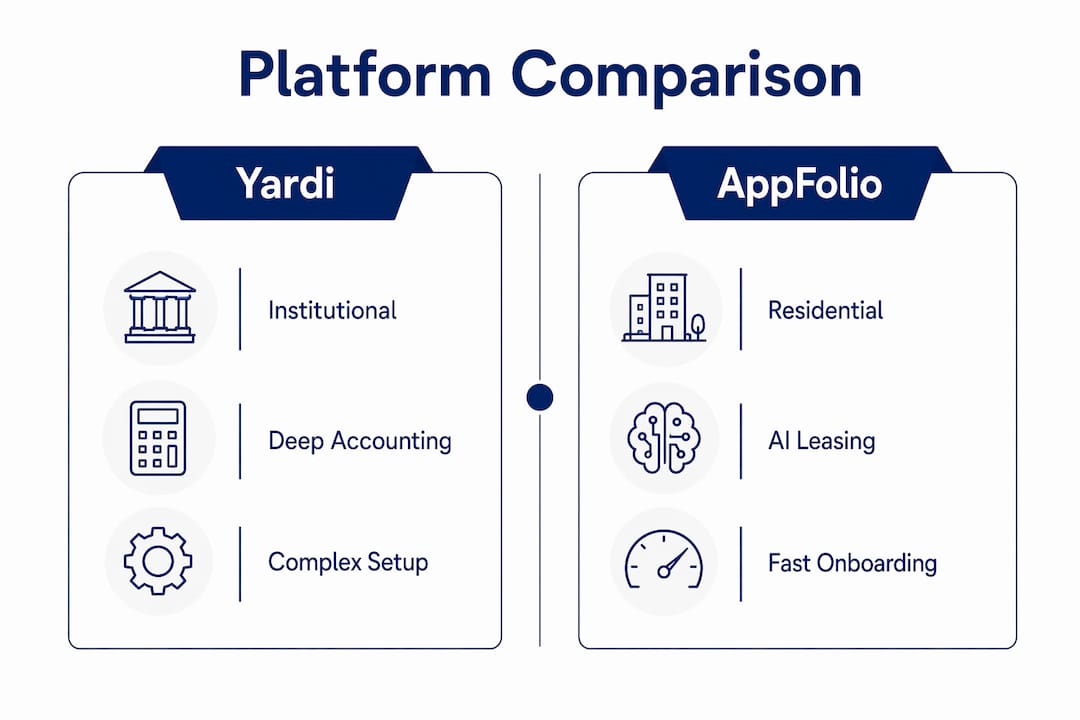
For Charlotte commercial investors managing complex leases, Yardi Voyager is the stronger platform. For residential-led portfolios where speed and automation matter more than CAM reconciliation depth, AppFolio wins on nearly every operational dimension.
The single biggest trade-off: institutional accounting depth versus modern, low-IT automation. You cannot fully have both.
- Commercial lease complexity: Yardi Voyager natively handles CAM reconciliation, percentage rent triggers, and multi-entity reporting. AppFolio’s commercial capability is real but limited by comparison.
- Automation and UX: AppFolio’s cloud-native platform leads on mobile-first UX, AI-driven leasing workflows, and onboarding speed. Its Performance Platform (Realm-X) automates lead qualification, tenant messaging, and maintenance triage.
- Implementation reality: Voyager typically requires several months of intensive configuration plus dedicated implementation partners. AppFolio deploys considerably faster with far less IT overhead.
TL;DR: Short-list Yardi Voyager for institutional commercial or mixed-use assets; short-list AppFolio for residential or smaller commercial portfolios. Either way, run a structured demo, pull customer references from comparable portfolios, and budget for an implementation partner before you sign.
Table of Contents
- How long does implementation take, and what does it cost?
- How do you choose? A practical checklist
- What should your evaluation process look like?
- Ardor CRE helps Charlotte investors navigate this decision
- Platform comparison
- Key Takeaways
How long does implementation take, and what does it cost?
Voyager’s complexity is the honest starting point. Expect 60–90+ days of intensive setup to configure CAM pools, percentage rent triggers, and multi-entity waterfalls. Third-party implementation costs can equal or exceed a full year of licensing fees. Yardi Voyager is custom-priced, with reported starting points from $1,200 per month upward before module and implementation fees.
AppFolio publishes tiered per-unit pricing with a core tier and a plus tier with higher minimums. Onboarding is faster, though one-time conversion fees, payment processing, and premium integrations add to total cost of ownership.
The hidden expense on the Voyager side is third-party implementation help. Migrations run 6–16 weeks end-to-end, with Voyager consistently on the longer side. Budget for that before comparing sticker prices.
How do you choose? A practical checklist
Start with these questions:
- Does your portfolio include commercial leases with CAM reconciliation, percentage rent, or multi-entity investor reporting? If yes, Voyager is the default candidate.
- What is your internal IT capacity? AppFolio minimizes IT overhead; Voyager typically requires in-house IT or a dedicated third-party implementer.
- Is leasing automation a daily operational priority? AppFolio’s Performance Platform and RentCafe AI Chat (Yardi’s enterprise chat and lead-capture tool) serve different scales and workflow models.
- What is your realistic implementation budget, including setup and migration, not just licensing?
Red flags to watch:
- A vendor who cannot provide references from portfolios similar in size and asset type to yours.
- An implementation timeline quoted under 30 days for Voyager. That is almost never realistic.
- AI feature claims without measurable outcomes. Ask vendors for concrete reductions in days-to-lease or manual ticket volume, not marketing language.
What should your evaluation process look like?
Run structured demos with your actual lease data, not vendor-supplied sample files. For Voyager, that means testing CAM pool configuration and percentage rent scenarios. For AppFolio, stress-test the Performance Platform’s agentic automation against your real leasing volume.
Pull at least two customer references from portfolios that match your asset type and unit count. Ask specifically about migration accuracy, post-go-live support quality, and whether the implementation timeline held.
Pilot data migration on a subset of your portfolio before full commitment. Voyager migrations in particular carry data-integrity risk when moving from legacy systems. A short pilot surfaces mapping errors before they become expensive corrections.

Ardor CRE helps Charlotte investors navigate this decision
Choosing between Yardi Voyager and AppFolio is a capital and operational commitment. Ardor CRE’s advisors work with Charlotte commercial investors and tenants daily on lease analysis, CAM reconciliation expectations, and owner reporting requirements specific to this market. That local context matters when evaluating which platform’s accounting depth actually fits your lease constructs.
Ardor CRE can help you short-list vendors, structure demo scenarios around your actual leases, and manage migration coordination so your team is not learning the platform and cleaning data at the same time. The Charlotte office market has specific CAM and lease structures that generic software demos rarely surface. Contact Ardor CRE to schedule a discovery conversation and get vendor-neutral guidance matched to your portfolio.
Platform comparison
| Platform | Best For | Accounting & Reporting Depth | Leasing & AI Automation | IT / Implementation | Pricing Model |
|---|---|---|---|---|---|
| Ardor CRE | Charlotte commercial investors needing advisory, vendor selection, and migration oversight | Local lease analysis, CAM review, owner reporting guidance | Vendor-neutral evaluation of AI leasing tools | Low — advisory engagement, not a software deployment | Advisory and brokerage fees |
| Yardi Voyager | Institutional commercial, mixed-use, multi-entity portfolios | Enterprise CAM reconciliation, percentage rent, multi-entity GL | RentCafe AI Chat for enterprise lead capture; Maintenance IQ for work order routing | High — 60–90+ days, requires implementation partners | Custom pricing, reported from $1,200/month+ |
| AppFolio Property Manager | Residential-led portfolios, small-to-mid teams | Solid for residential; limited for complex commercial leases | Performance Platform (Realm-X) automates leasing, messaging, maintenance triage | Low — cloud-native, fast onboarding | Per-unit tiers; Core ~$1.40–$1.50/unit, Plus ~$3.20/unit |
| AppFolio Performance Platform | Residential teams automating leasing and tenant engagement at scale | Residential-focused reporting | Agentic AI for lead qualification, communications, maintenance | Low — native to AppFolio | Included in Plus/Max tiers |
| RentCafe AI Chat | Large Yardi-integrated leasing teams needing enterprise chat and CRM | Integrated with Yardi GL and CRM IQ | AI chat, lead capture, marketing-to-lease workflow | High — requires Yardi ecosystem | Part of Yardi enterprise licensing |
| Maintenance IQ | Large multi-site portfolios needing automated vendor assignment and SLA tracking | Maintenance analytics within Yardi reporting | Automated work order routing, vendor management | High — Yardi ecosystem dependency | Part of Yardi enterprise licensing |
Key Takeaways
Yardi Voyager serves institutional commercial portfolios best; AppFolio wins for residential-led operations where automation speed and low IT overhead matter more than CAM reconciliation depth.
| Point | Details |
|---|---|
| Commercial lease depth | Yardi Voyager handles CAM reconciliation, percentage rent, and multi-entity reporting natively; AppFolio’s commercial support is limited. |
| Implementation timeline | Voyager typically requires 60–90+ days of setup; AppFolio deploys considerably faster with less IT overhead. |
| AI-driven automation capabilities | AppFolio’s Performance Platform automates leasing and tenant communications; Yardi counters with RentCafe AI Chat and Maintenance IQ for enterprise workflows. |
| Total cost of ownership | Voyager implementation costs can equal or exceed a year of licensing; AppFolio’s per-unit pricing is more predictable but adds up with integrations and minimums. |
| Ardor CRE advisory | Ardor CRE provides Charlotte-specific vendor selection, lease analysis, and migration oversight so investors choose the right platform for their actual lease constructs. |