
Choose spec when you need speed, flexibility, and lower upfront capital, especially with a shorter lease horizon. Choose build-to-suit when your operation depends on specialized infrastructure, a long-term lease or ownership stake, or a facility that has to work exactly one way for the next 10 to 20 years. More on how to make that call below.
TL;DR:
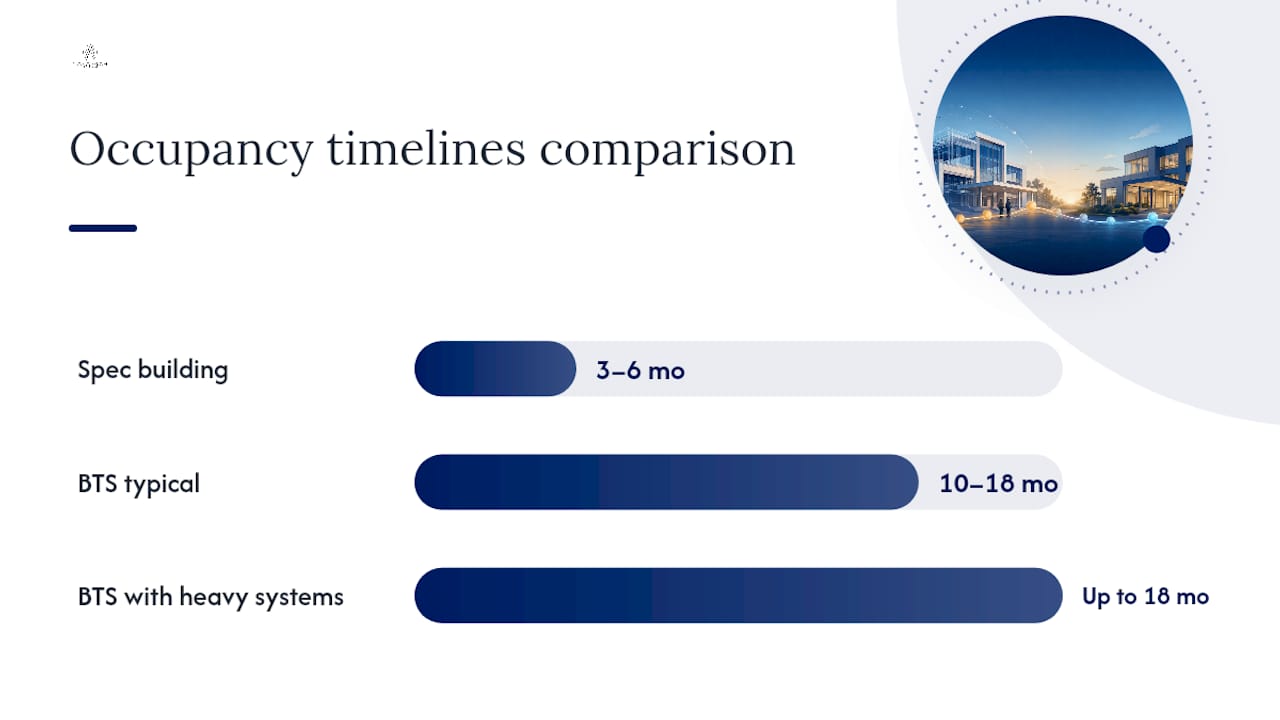
- Spec buildings offer faster occupancy, often within three to six months, and typically cost less upfront, with tenants paying market rent and negotiating tenant improvement allowances.
- Build-to-suit projects require 10 to 18 months to complete, involve higher initial costs, and are best suited for long-term tenants with specific operational needs.
- Retrofitting a spec building for specialized uses can incur significant hidden costs, making build-to-suit more economical for automation, heavy equipment, or specific layouts.
- Sector considerations influence the choice: industrial warehouses mostly suit spec unless automation or cold storage are involved, while medical and office spaces often demand custom build-outs.
- Before committing, tenants should evaluate operational requirements, timing flexibility, capital capacity, lease length, and site constraints, and compare retrofit costs against long-term benefits.
Table of Contents
- Build to Suit vs Spec: What a Spec Building Actually Offers
- Build to Suit vs Spec: What Changes With a Custom-Built Facility
- How Do the Trade-Offs Actually Play Out?
- Which Sector Rules of Thumb Actually Hold Up?
- What Should You Ask Before Committing?
- How Ardorcre Evaluates BTS vs Spec for Medical and Office Clients
- Sources
- FAQ
Build to Suit vs Spec: What a Spec Building Actually Offers
Speculative buildings, or “spec,” go up without a signed tenant in hand. Developers bet on demand, using standardized designs meant to appeal to the widest range of possible occupants: rectilinear floor plates, generic dock doors, and clear heights that split the difference between too low for logistics and too high to justify the cost.
That generic design is the whole point. It lets a developer market the space to almost anyone, and it lets tenants move in fast. Spec projects typically offer faster occupancy, often within 3 to 6 months of signing if construction is already underway, and sometimes immediately if the building is complete and vacant.
The financial profile favors flexibility over customization. You’re generally paying market rent, negotiating a tenant improvement allowance to fit the space to your needs, and putting far less capital on the table than a custom build would require.
Spec tends to suit:
- Growth-stage companies that don’t know what their footprint looks like in five years
- Tenants who need to be operational quickly, not in a year and a half
- Businesses without the balance sheet or appetite for large upfront capital commitments
- Operations where a generic layout with standard TI work covers 80% of the need
Build to Suit vs Spec: What Changes With a Custom-Built Facility
Build-to-suit (BTS) flips the equation. The building is designed around one tenant’s operational requirements from the first blueprint, whether that means reinforced floor loads for heavy equipment, medical-grade HVAC and negative-pressure rooms, cold storage refrigeration systems, or a dock configuration built around a specific fleet size.
That precision costs time. BTS projects typically run 10 to 18 months from design to occupancy, and permitting delays, complex sitework, or specialized mechanical and electrical systems can push that further out. A facility with heavy power requirements or specialty plumbing takes longer to permit than a shell building with standard utilities.
The financial trade runs the other direction from spec. Upfront costs are higher, and BTS leases commonly span 10 to 20 years, a horizon that only makes sense once you know exactly what you need long term.
BTS generally fits:
- Established firms with the operating history to commit to a decade-plus lease
- Operations where retrofitting a generic building later would cost more than building it right the first time
- Tenants who see a measurable productivity or efficiency gain from a purpose-built layout
- Companies using real estate as a branding or talent-attraction tool, not just square footage
How Do the Trade-Offs Actually Play Out?
The comparison boils down to who takes the risk and who pays for precision. Here’s how the two paths stack up on the factors that matter most to a decision:
- Occupancy speed. Spec wins outright, often by a year or more.
- Construction risk. Spec shifts that risk to the developer, who’s betting on future lease-up. BTS shifts it toward the tenant, who’s committing before the building exists.
- Capital structure. Spec tenants negotiate a TI allowance against market rent. BTS tenants (or owner-occupiers) fund a custom build, often at a premium, but with the cost baked into a longer-term lease or ownership structure.
- Total cost of ownership. Over a 15 to 20 year horizon, BTS can come out ahead once you factor in reduced maintenance, fewer retrofits, and operational efficiency from a layout built for the job.
- Hidden retrofit costs. A spec building that seemed like a bargain can rack up expensive change orders the moment you need something the generic design didn’t anticipate: extra power capacity, a reinforced slab, a cold room.
Consider two versions of the same warehouse decision. A standard regional distribution center with typical racking and dock doors is a textbook spec fit. An automated fulfillment center with robotics, higher power draw, and a custom conveyor layout is a textbook BTS candidate, because retrofitting automation into a generic shell after the fact usually costs more than designing around it from day one.
Pro Tip: Run the numbers on retrofit cost before you sign a spec lease for a specialized use. A cheap year-one rent number can hide a six-figure build-out gap once you account for the systems a generic building never had.
Which Sector Rules of Thumb Actually Hold Up?
Industrial, medical office, and corporate headquarters each lean a different direction, and the technical drivers explain why.
Industrial and warehouse. Standard logistics and distribution operations do fine in spec buildings, since dock doors and clear heights are largely interchangeable across tenants. Automation, cold storage, and specialty floor loads change that math, because those systems are expensive to bolt on after the fact.
Medical office. Exam room layouts, imaging equipment power needs, plumbing for specific procedures, and negative-pressure requirements push most serious medical practices toward BTS, or at minimum a heavy TI package inside an existing shell. A generic office suite rarely accommodates an operating room without extensive, costly rework.
Corporate office. Company strategy drives this one more than technical need. A headquarters meant to attract talent or project a brand identity often justifies BTS, while a satellite office or a company still finding its footprint usually does better leasing spec space.
The primary technical drivers, sector by sector:
- Industrial: power capacity, floor load, automation integration, cold chain
- Medical office: plumbing, HVAC filtration, imaging power loads, exam room configuration
- Corporate office: branding, amenity mix, talent attraction, long-term headcount planning
What Should You Ask Before Committing?
Before you sign anything, run through a structured checklist rather than defaulting to whichever option is faster to close.
- What’s your realistic occupancy timeframe, and can your operation absorb a 10 to 18 month wait?
- Do you have operational specs (power, floor load, HVAC, plumbing) that a generic building can’t meet?
- How much capital can you deploy upfront versus fund through a TI allowance?
- Are you planning to expand or contract footprint in the next 5 years?
- What lease term matches your business’s actual planning horizon?
- If your business changes direction, how flexible is your exit from this commitment?
- Are there site constraints (zoning, access, utilities) that limit your options?
- Do you face regulatory requirements (health, safety, environmental) that demand custom design?
On the financing side, construction loans for BTS projects typically carry different risk profiles than acquisition loans on existing spec buildings, and lenders will look closely at debt service coverage ratio, or DSCR, when sizing either. Rising volatility in materials and bid pricing has made pre-leased BTS deals more attractive to lenders precisely because a signed tenant reduces revenue risk on the developer’s side.
For owner-occupiers, SBA and conventional term loans come into play alongside construction financing, and TI financing is worth exploring separately from the base lease or purchase loan. On the negotiation side, your real leverage sits in the TI allowance amount, renewal option windows, and step-rent structures that phase in cost increases rather than hitting you with the full rent bump on day one.
Your next move should be a straightforward financial gut check: model both scenarios against your actual cash position, then bring in a broker or advisor to pressure-test the assumptions before you request cost and schedule estimates from a contractor.
How Ardorcre Evaluates BTS vs Spec for Medical and Office Clients
Advisors typically evaluate medical and office deals by considering site fit, underwriting, DSCR exposure, and lease-versus-buy comparisons before recommending a direction. For a growing medical practice, that often means comparing a lease vs buy breakeven against the specialized build-out a specific procedure or equipment set demands.
We also walk investors through when buying a multi-tenant building beats a single-tenant BTS play, since diversified tenancy spreads vacancy risk in a way a custom-built, single-tenant asset simply can’t. If you’re weighing whether to sell, refinance, or hold through a CMBS maturity, or trying to decide how a TI package should be structured, our full service list covers the advisory and transactional work behind each of those calls.
— Jim
Sources
- Build-to-Suit vs. Spec: Which Building is Right For a Specific Company? | CREDA
- Build-to-Suit vs. Spec: Which Building is Right For a Specific Company? | NAIOP
- Spec vs build-to-suit warehouses: which makes sense for your market | SteelCo Buildings
FAQ
Is Build-to-Suit Cheaper Than Buying?
Not usually upfront. BTS carries higher initial construction costs than buying an existing building, but it can lower total cost of ownership over a 15 to 20 year horizon through reduced maintenance and fewer retrofits. The math depends heavily on how long you plan to occupy the space.
What Does Build to Spec Mean?
“Build to spec” is a mix of two different concepts: speculative buildings, built without a signed tenant using standardized designs, and build-to-suit, built around one tenant’s specific requirements. Spec buildings favor speed and flexibility; build-to-suit favors customization and long-term fit.
Are Spec Buildings Cheaper to Build?
Generally yes, because standardized designs and generic systems cost less than custom engineering for a single tenant’s needs. The savings show up mainly for the developer’s construction budget, while tenants benefit through lower rent and smaller upfront capital requirements rather than a lower purchase price.
Who Pays for Build-to-Suit?
It depends on the deal structure. In many BTS arrangements, the developer funds construction and recoups the cost through a long-term lease, often 10 to 20 years, while in owner-occupier deals the tenant finances the build directly through a construction loan and takes ownership.