
Signage rights are the lease terms that decide whether, where and how your business can put its name in front of customers. Unless the lease says otherwise, the general rule is that a tenant may place signage on the outer walls of its own premises, subject to law and property restrictions. In practice, nearly every lease for a multi-tenant building does say otherwise. The landlord approves, limits or reserves almost everything. Get the details in writing before you sign, because a sign you cannot see from the road is a cost you pay every month.
TL;DR
- Signage rights are a contract term. Spell out the type, number, location, size, lighting and exclusivity of each sign in the lease itself.
- “Subject to landlord approval” with no standard behind it is the clause that causes disputes. Ask for pre-approved renderings before you execute the lease.
- Allocate cost for design, permits, installation, maintenance and removal. Shared monument and pylon panels often pass through CAM charges.
- In Charlotte, a sign permit is generally required for new or replaced signs, even when the landlord has already said yes.
- Raise signage at the letter of intent stage, not after the lease draft arrives.
Table of Contents
- What signage rights actually are
- Why each side cares
- The signage types your lease should address
- What a landlord can require
- Local rules sit on top of the lease
- How to negotiate signage, step by step
- Is a sign a fixed asset?
- Our perspective
- Getting help with your lease
- FAQ
- Sources
What signage rights actually are
A signage right is a permission, and it comes in layers. Your lease is one layer. Behind it sit the landlord’s sign criteria for the building or center, any recorded easements or covenants, and the city’s zoning and sign ordinance. A tenant needs all of them to line up.
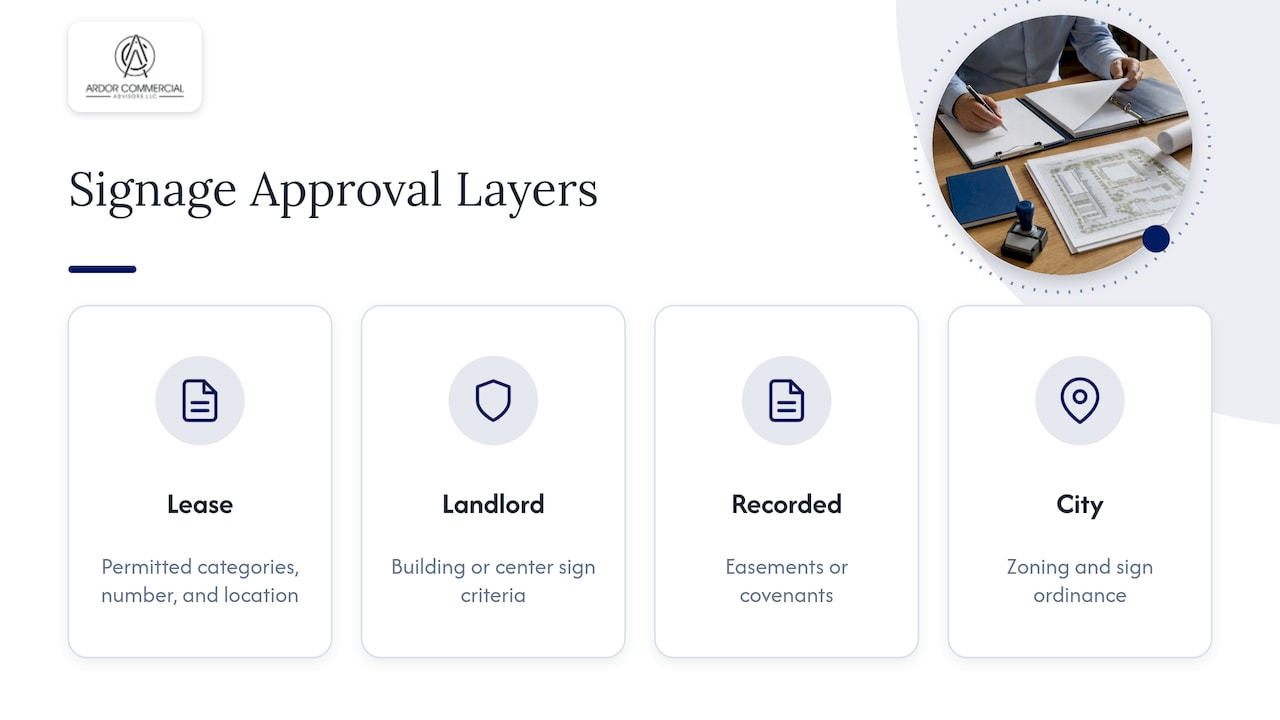
A complete clause covers the permitted categories of signage, the number, the general location, whether the rights are exclusive or shared, and size or illumination limits. That is the minimum. A clause that says only that the tenant may have “reasonable signage” leaves every one of those questions open.
McGuireWoods notes that signage and advertising rights are frequently poorly negotiated and a primary source of landlord-tenant disputes. The reason is simple. Both sides care a great deal, but neither thinks about it until the sign is being built.
Why each side cares
Landlords want a building or center that looks consistent and keeps its value. Control over signage helps maintain a project’s aesthetic character, and retail landlords often attach detailed sign exhibits to their form leases to enforce aesthetic and construction standards across a center.
Tenants need to be found. The same source points out that inadequate signage can harm a tenant’s business. That is true for a retail shop on a pad site, but it is just as true for a dental practice in a medical office building where patients circle the lot looking for the entrance.
Both concerns are legitimate. The goal of negotiation is to turn them into concrete terms.
The signage types your lease should address
Don’t negotiate “a sign.” Negotiate each location separately. The list below is the one we walk clients through.
| Sign type | What to pin down |
|---|---|
| Building-mounted (wall or fascia) | Which elevation, maximum size, uniform sign band, who picks the font and color |
| Monument or pylon panel | Which panel position, panel size, top-of-pole or lower slots, who pays to fabricate and swap it |
| Entry or suite sign | Door vinyl, blade sign, suite plaque, and who supplies it |
| Lobby or common-area directory | Your listing, how many lines, and who pays to update it |
| Window displays | Whether you may use window graphics and how much glass they can cover |
| Roof or parapet | Usually reserved by the landlord. Ask only if visibility depends on it |
| Temporary signs | “Coming soon” and grand opening banners, with a time limit |
The McGuireWoods guidance also lists franchise requirements, co-location with other tenants and relocation of signs among the points to consider. If you operate a franchise, your brand standards may require a sign the landlord’s criteria forbid. Find that conflict before you sign, not after.
Exclusive or shared
An exclusive right means no other tenant gets that position, such as the top panel on the monument. A shared right means you rank among others. Say which one you have. If the right is shared, ask what happens when a larger tenant arrives and wants to reshuffle the panels.
Visibility from the road
For tenants who depend on drive-by traffic, exterior and pole signs are often the single most valuable term in the lease. For shared or monument signage, tenants may negotiate specific inclusion rights, including the size and prominence of their name or logo. If your name will sit at the bottom of a panel stack, you should know that now.
What a landlord can require
Expect the landlord to keep several controls. Most are reasonable if they are written clearly.
- Approval of design and content. A landlord may require approval of sign content and set requirements for location, positioning, uniform sign bands and style.
- Compliance with criteria. The lease may incorporate a sign criteria exhibit. Read it before signing, because it can override the more generous language in the body of the lease.
- Compliance with recorded documents. A reciprocal easement agreement can set rules for sign size, location, lighting and materials. Lease terms should be consistent with it. If your landlord is a ground tenant or part of a larger development, ask for a copy.
- Cost and upkeep. In one publicly filed lease, the tenant is responsible for design, installation, maintenance and removal costs of the exterior sign, and for repairing the building after removal. That is a common allocation, not a universal one, and it is negotiable.
The vague approval trap
The most expensive phrase in signage is “subject to landlord’s approval in its sole discretion.” Hollander’s guidance advises negotiating specific signage rights rather than relying on vague approval clauses and pre-approving available renderings before the lease is executed. Replace “sole discretion” with “not to be unreasonably withheld, conditioned or delayed,” and add a deadline, such as a set number of business days, after which a submission is deemed approved or the tenant can escalate.
A published industry example shows what is at stake. One write-up describes a four-month approval process that ended with a sign 40% smaller, unlit and not visible from the parking lot. We cannot verify that case, but the pattern is familiar to anyone who has leased space.
Local rules sit on top of the lease
Landlord approval is not the same as government approval. Signage rights are subject to applicable laws and ordinances, including zoning, sign codes and historic district restrictions, and tenants are typically the party responsible for getting the municipal, electrical and zoning approvals.
What Charlotte requires
Under the City of Charlotte’s zoning ordinance, ordinary maintenance such as painting and cleaning does not need a sign permit. Structural, electrical, dimension, height or location changes are not ordinary maintenance. Unless a sign is exempt, installing, building, enlarging, moving or replacing it requires a sign permit. The same chapter says the city inspects reported zoning violations within three business days, and a valid violation produces a notice that must be corrected to close the case.
Two practical consequences for tenants:
- Make permit responsibility explicit. Decide in the lease who applies, who pays the fees and what happens if the permit is denied. A good clause lets the tenant terminate or adjust its sign rights if the city will not approve the agreed sign.
- Check lighting early. Illuminated signs add electrical and lighting limits to the approval process. This summary of Charlotte’s exterior lighting rules and permit checks is a useful starting point when your sign will be lit at night. Your sign vendor or an electrician should confirm the final numbers for your specific site.
Cities and counties across the Charlotte region have their own sign codes, and they differ. If your space is outside the city limits, confirm which jurisdiction applies before you order anything.
How to negotiate signage, step by step
Signs are easiest to win early. The Taft firm advises that tenants seeking exterior, pylon, monument or other retail-center signage raise it at the term sheet stage and seek pre-approval of sign content then, or at lease execution if that is not possible.
- Put signage in the letter of intent. List each sign type, location and size you need. Our retail lease negotiation guide shows how an LOI can lock down items like these before the lease draft arrives.
- Get the sign criteria and any REA. Ask for them with the first draft, not after.
- Attach a rendering. A scaled drawing showing your logo on the building or panel, signed or initialed by the landlord, removes most later arguments.
- Fix the cost split. Who pays for design, permit fees, fabrication, installation, electrical, maintenance and removal? Do not accept “as provided in the rules.”
- Address CAM. If you share a monument sign, ask whether electricity, repair and replacement costs flow through CAM charges. Our page on CAM charges and lease review explains how to check what you are being billed.
- Plan for exit. Decide whether you must remove the sign at lease end, who repairs the facade and whether your panel can be reassigned. If you may need to leave early, see how early lease termination interacts with those obligations.
- Tie it to the build-out. If the sign is part of the landlord’s work or an allowance, make sure it appears in the work letter.
Items that deserve extra protection
- Relocation. If the landlord can move your sign, require equal or better visibility and have the landlord pay for the move.
- Obstruction. Landlords sometimes plant trees, build pads or add signs that block yours. Ask for a covenant not to obstruct.
- Rebranding. If your name or logo changes, can you update the sign? Who approves it and who pays?
- Medical tenants. Practices typically want wayfinding in the lobby, a suite sign and a monument panel, because patients arrive stressed and often for the first time. Our guide to continuous operation clauses for medical and office leases is relevant if the lease also ties your signage to opening hours or operating covenants.
Is a sign a fixed asset?
The search results people click often raise this question. It depends on how permanent the sign is. A permanently affixed sign that cannot be removed without substantial damage is often treated as a leasehold improvement. The same page describes a simple vinyl decal as an immediate expense and a custom illuminated logo wired into the wall as a capitalized improvement.
Ownership is a separate question and the lease decides it. A sample pro-tenant alterations clause provides that alterations generally become the landlord’s property, while movable equipment and trade fixtures that can be removed without material harm remain the tenant’s. So write down whether your sign is a trade fixture you can take with you. For tax treatment, such as whether certain signage qualifies for shorter depreciation lives, ask your CPA. Cost segregation providers say some brand-related lighting may be classified as 5-year property, but that is a tax question to settle with your own advisor.
Our perspective
We see signage treated as an afterthought on almost every deal. The tenant is focused on rent, the build-out and the free-rent period, and the sign clause gets pasted in from the landlord’s form. Then the certificate of occupancy is near, the sign vendor submits a design, and everyone finds out what the lease did not say.
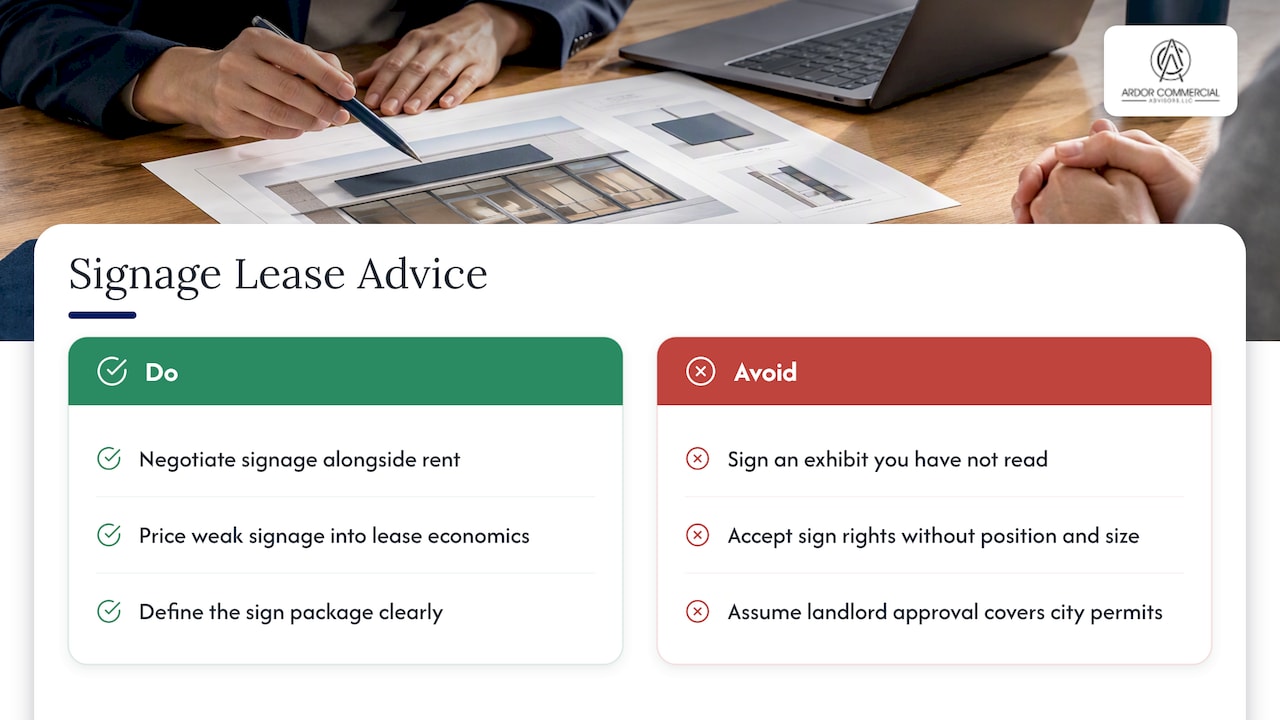
Our view is that signage belongs in the same conversation as rent. In Charlotte, where a tenant may choose between a street-front retail space, a medical office building with a shared monument and a suburban office park with a single entrance sign, visibility is part of what you are paying for. If a space has weak signage, that should show up in your economics, either as lower rent, a larger allowance or a stronger early-termination right.
Our advice to tenants is simple. Never sign a lease that refers to an exhibit you have not read. Never accept a sign right without a position and size. And never assume that the landlord’s yes covers the city’s permit. Landlords benefit from clarity too: a defined sign package means fewer arguments with tenants and a more consistent property.
— Jim
Getting help with your lease
If you are comparing spaces or reviewing a draft, our tenant representation advisors can help you build the signage package into the deal from the first LOI. Our lease review work covers sign exhibits and pass-through costs, and the leasing timeline for medical and office tenants shows where signage approval fits in a typical three to six months. You can also see everything we do on our services page.
FAQ
What are signage rights in a lease?
They are the lease provisions that define where, how and in what form a tenant may display its name and branding on and around the premises. A good clause covers sign type, number, location, size, lighting and whether the right is exclusive. It also covers who approves, pays for and maintains the sign.
Can a landlord refuse to approve my sign?
Yes, if the lease gives the landlord approval rights, and most multi-tenant leases do. That is why you should negotiate a reasonableness standard, a response deadline and pre-approved renderings before you sign. Without those, the landlord has more room to say no or to delay.
Do I need a permit even if my landlord approved the sign?
Usually, yes. Landlord approval and city approval are separate. In Charlotte, installing, enlarging, moving or replacing a non-exempt sign requires a sign permit, and tenants are typically the ones who obtain it. Ask the city planning department what applies to your address.
Who pays to remove the sign when the lease ends?
The lease decides. Many leases make the tenant pay for removal and for repairing the facade or panel afterward. If you want a different split, or want to keep the sign as your own trade fixture, negotiate it up front.
Sources
- Leasing Practice Point: Signage and Advertising (McGuireWoods)
- Leasing Practice Point: Signage and Advertising (Mondaq)
- A Tenant’s Guide to Negotiating Sign Rights in a Commercial Lease (Hollander)
- Signage Provisions in Commercial Leases (Hollander)
- The Art of the Commercial Real Estate Lease Term Sheet: Retail Leases
- Negotiating Signage Rights in the Retail Lease (Leasing Professional)
- Leases and REAs, COREAs and Operating Easements (American Bar Association)
- Sample lease exhibit (SEC filing)
- City of Charlotte zoning ordinance, Chapter 13
- Charlotte exterior lighting ordinance and permit checks
- Is Signage a Leasehold Improvement for Accounting?
- Sample Alterations Clause for Retail Leases (American Bar Association)
- Tenant Improvement and Leasehold Cost Segregation