
Yes, Charlotte has 17 designated Opportunity Zones from the 2018 federal round, covering roughly 58,000 residents across corridors north and west of downtown. The most urgent fact for anyone weighing a deal right now: gains rolled into a Qualified Opportunity Fund must land there within a 180-day window, and the window to defer previously realized gains closes at the end of 2026. Verify your tract on the official map, then talk to tax counsel or a QOF manager before you sign anything.
TL;DR:
- Investors must place eligible gains into a Qualified Opportunity Fund within 180 days of sale to qualify for deferral, with the deadline ending on December 31, 2026.
- Charlotte’s 17 Opportunity Zones cover approximately 58,000 residents, primarily in corridors near Uptown and industrial areas, with median incomes ranging from $19,000 to $60,000.
- The upcoming OZ 2.0 nomination process could reframe which tracts remain designated after 2026, affecting development priorities and land values.
- Asset classes like medical office and industrial properties tend to perform better within Opportunity Zones, especially near transit and logistics hubs.
- Proper due diligence, including boundary verification and community engagement, is critical to mitigate risks and maximize benefits in Charlotte OZ investments.
Table of Contents
- Charlotte Opportunity Zones: Official Map, Tract List, and Quick Stats
- How Do Opportunity Zone Tax Benefits Actually Work?
- North Carolina’s OZ 2.0 Timeline and Charlotte’s Overlay Programs
- Where Opportunity Zone Investing Pays Off by Asset Class
- What Should Your Deal Checklist and Timeline Look Like?
- Tax Impact Differences: North Carolina Versus Federal Rules
- What Successful Charlotte OZ Projects Actually Look Like
- How Might Policy Changes Affect Charlotte’s Opportunity Zones?
- Community Impact and Social Equity in Charlotte’s Opportunity Zones
- Priorities for Charlotte OZ Investing Right Now
- How Ardorcre Can Help You Move on a Charlotte OZ Deal
- Sources
- FAQ
Charlotte Opportunity Zones: Official Map, Tract List, and Quick Stats
Charlotte’s 17 designated Qualified Opportunity Zones sit mostly in corridors north and west of Uptown, tracking historic disinvestment patterns along the Statesville Avenue corridor, parts of West Boulevard, and pockets near the airport industrial belt.
That income spread matters. A tract at the low end often signals deeper redevelopment need and slower absorption; a tract near $60,000 median income might already have market-rate rents nearby, which changes your underwriting entirely.
Before writing an offer, confirm the parcel actually sits inside a zone. Boundaries can split a block in half.
- Pull the parcel address and cross-check it against the City of Charlotte’s Opportunity Zones dataset.
- Confirm the census tract number against the IRS tract list for North Carolina.
- Check for overlay districts (transit station areas, mixed-use zoning) that could affect entitlements.
- Screen for flood zones or brownfield status, both common in older industrial tracts.
| Metric | Figure |
|---|---|
| Designated OZ tracts in Charlotte | 17 |
| Estimated residents covered | ~58,000 |
| Share of city population | ~7% |
| Median household income range | $19,000–$60,000 |
| Designation year | 2018 |
How Do Opportunity Zone Tax Benefits Actually Work?
That structure is what unlocks the tax treatment. It is not enough to simply buy a building inside a zone boundary; the capital has to flow through a compliant fund.
The mechanics run on a strict clock. Investors must place eligible capital gains into a QOF within 180 days of the sale that generated them, which forces sellers to line up a fund or sponsor before closing, not after. Miss the window and the deferral opportunity is gone.
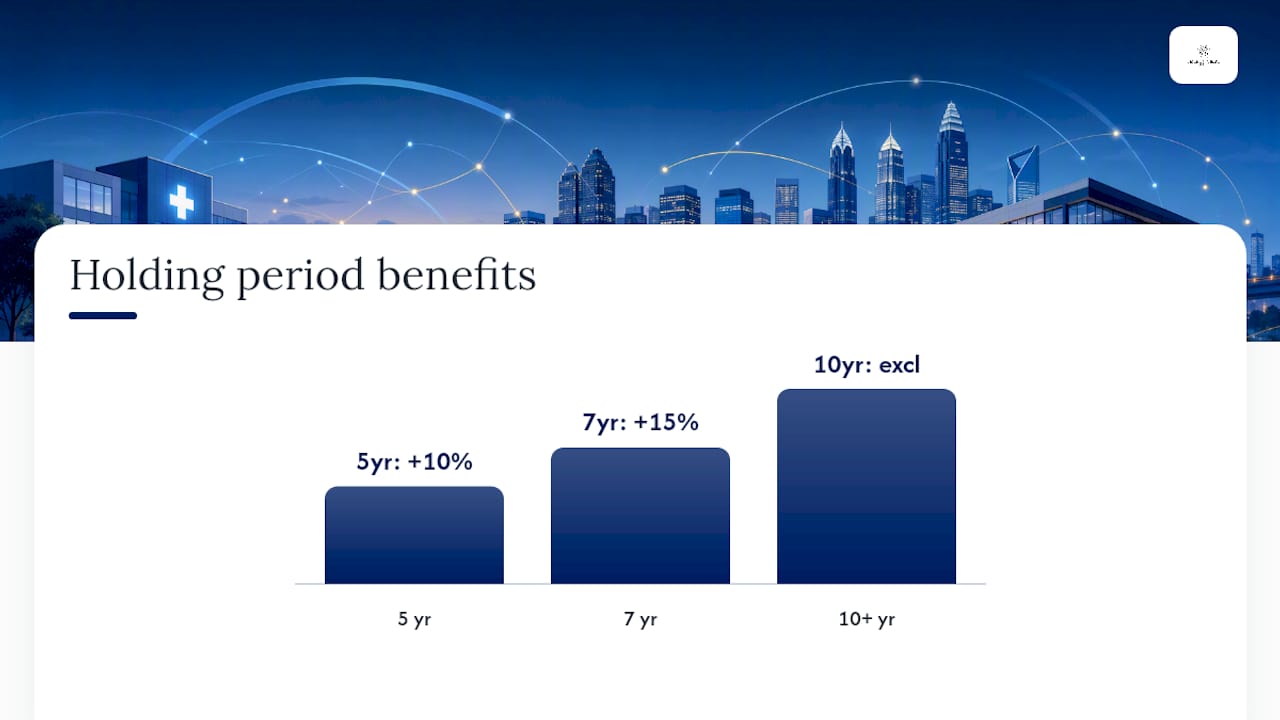
Pro Tip: Don’t confuse the deferral deadline with the exclusion benefit. The December 31, 2026 date only affects when you must reinvest older gains. The 10-year exclusion on a new QOF investment’s appreciation is a separate, long-term incentive that keeps working regardless of that date.
The basis step-up schedule works like this:
- Hold the QOF investment 5 years: 10% basis increase on the original deferred gain.
- Hold it 7 years: an additional 5% (assuming the investment predates late-round sunset rules).
- Hold it 10 years or longer: any capital gains from the QOF investment’s own appreciation are permanently excluded.
Investors report the deferral and later dispositions on Form 8997 each year, and neither residency nor a local business is required to participate. Get a CPA who has actually filed OZ returns before, not just read about them.
North Carolina’s OZ 2.0 Timeline and Charlotte’s Overlay Programs
North Carolina Commerce is running its own OZ 2.0 nomination process right now, with public comment periods feeding into new tract designations; for detailed market insights, see US Market Intelligence. Those new designations are expected to take effect January 1, 2027, meaning the 17 tracts designated in 2018 stay in force under their existing statutory terms while a fresh round gets layered on top.
That timing gap creates a strategic question worth sitting with: does a current tract stay a state priority, or does the next round shift attention elsewhere?
- Track NC Commerce’s published eligible-tract maps as the nomination process moves forward.
- Watch which Charlotte neighborhoods the governor’s office nominates, since that list shapes future development interest.
- Cross-reference OZ boundaries with the city’s Strategic Investment Areas and Applied Innovation Corridor, both of which route infrastructure dollars and often overlap with attractive OZ tracts.
Where Opportunity Zone Investing Pays Off by Asset Class
Not every property type benefits equally from OZ structuring, and Charlotte’s mix of tracts makes some asset classes clearly stronger bets than others.
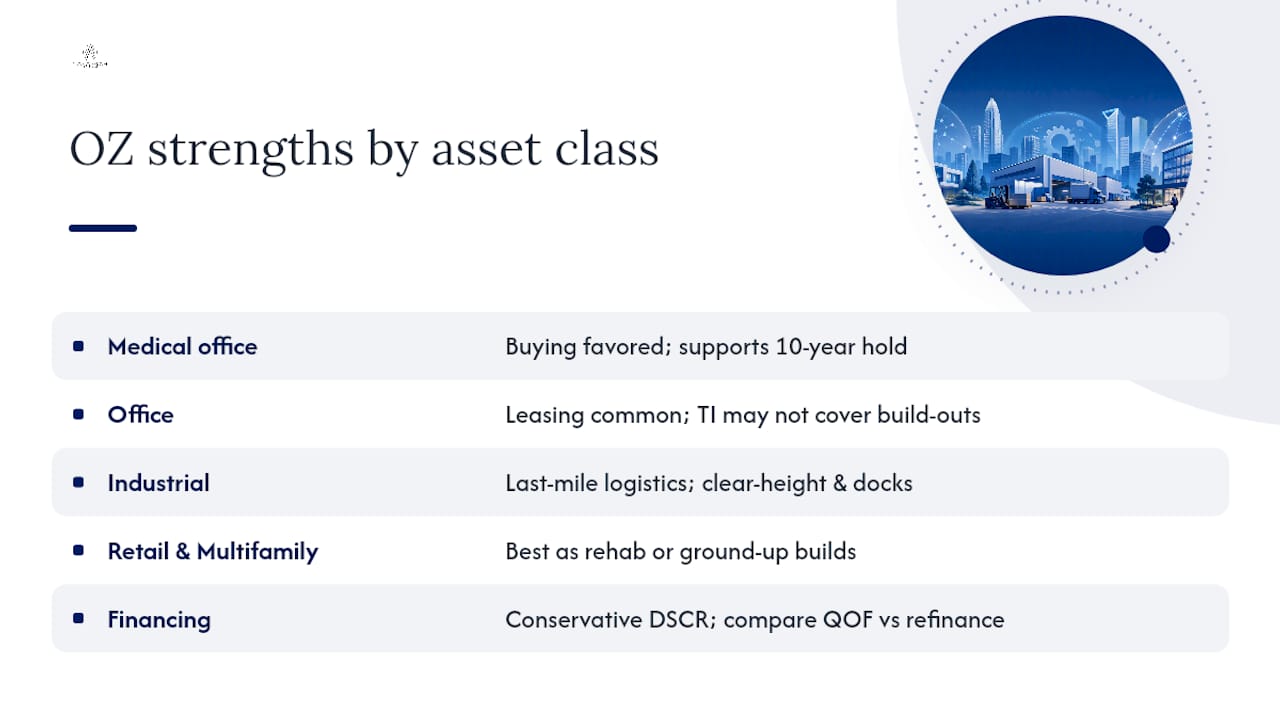
Medical office and office carry a leasing versus buying decision that hits differently for medical professionals than for a general office tenant. Leasing keeps capital free but exposes a practice to rent resets and TI allowances that rarely cover specialized build-outs like imaging suites or surgical infrastructure. Buying, particularly in a multi-tenant building, lets a physician group control build timing, credential their own building systems, and lease excess space to complementary practices for extra income. For an OZ deal, that longer hold period lines up neatly with the 10-year exclusion window. Review the practical timing for either path in our medical office leasing guide.
Industrial properties, especially last-mile and small-bay logistics, tend to perform well in Charlotte’s OZ tracts near the airport and rail corridors. Prioritize clear-height minimums, loading dock counts, and truck court depth before anything else.
Retail and multifamily work best in OZ tracts when the project is a genuine rehab or ground-up build rather than a light cosmetic flip, since the substantial improvement test rewards real capital investment.
On financing, a 1031 exchange and an OZ investment are not interchangeable, though sellers sometimes weigh one against the other on the same sale. DSCR loan sizing for OZ projects should assume conservative stabilized rents given the redevelopment risk, and CMBS holders nearing loan maturity should compare a straight refinance against a sale into a QOF before defaulting to the easiest option. Check loan sizing math against our DSCR guide before you commit to a structure.
What Should Your Deal Checklist and Timeline Look Like?
A disciplined screening process catches most OZ compliance problems before they become expensive.
- Confirm the parcel’s tract status against the city’s open data map and the IRS tract list.
- Verify zoning and permitted uses match your intended asset class.
- Check for overlapping city programs (SIA, AIC, transit station area) that add entitlement complexity or funding opportunities.
- Calculate the substantial improvement test: capex on the building (excluding land) must exceed the acquisition basis within 30 months.
- Secure site control and run title work early, since easement or lien issues surface late otherwise.
- Budget for permitting, which in Charlotte commonly runs 4 to 9 months depending on zoning complexity.
| Cost/Timeline Bucket | Typical Range |
|---|---|
| Entitlement and permitting | 4 to 9 months |
| Substantial improvement test window | 30 months from acquisition |
| Soft costs (legal, architecture, fund setup) | Often a small percentage of project budget |
| Common red flags | Title defects, community pushback, unresolved easements |
Community resistance shows up more often in tracts undergoing rapid change. Get ahead of it with early neighborhood outreach rather than waiting for a rezoning hearing to surface objections.
Tax Impact Differences: North Carolina Versus Federal Rules
North Carolina does not maintain a separate state-level capital gains exclusion mirroring the federal OZ program; the state generally follows federal adjusted gross income for individual income tax purposes, which means the federal deferral and exclusion mechanics largely flow through to your North Carolina return automatically. That is good news for simplicity, but it also means investors get no additional state-level sweetener for choosing an OZ tract over any other Charlotte property.
Where North Carolina genuinely diverges is in the designation process, not the tax code itself. The OZ 2.0 nomination round is a state administrative function layered on top of a federal tax framework, so North Carolina Commerce decides which tracts get proposed to the U.S. Treasury for 2027 designation, but it does not create its own parallel tax benefit structure. The actual tax treatment, including the 180-day rule and the 10-year exclusion, stays entirely federal.
This distinction trips up a surprising number of investors who assume “state opportunity zone” means a second layer of tax credit. It does not. What North Carolina does offer separately, and what often gets bundled into the same conversation, are local incentive tools like property tax abatements tied to Strategic Investment Areas or job-creation grants through Charlotte’s economic development office. Those programs run on entirely different eligibility rules than the OZ program itself, and they can stack with an OZ investment if a project qualifies for both. Treat them as two separate applications, not one combined benefit, when you’re building a pro forma.
What Successful Charlotte OZ Projects Actually Look Like
The strongest Charlotte OZ projects to date share a common trait: they didn’t rely on the tax benefit alone to make the deal work. Redevelopment along the North End, near the LYNX Blue Line extension, has drawn mixed-use and light-industrial interest specifically because investors overlaid OZ boundaries with transit investment and existing city redevelopment plans rather than chasing a tract in isolation.
That overlay approach, cross-referencing OZ tracts against transit corridors and city-led growth initiatives, tends to separate durable projects from speculative ones. A tract with a rail stop coming online in three years carries a fundamentally different appreciation story than a tract with no infrastructure investment planned.
Medical office has quietly become one of the more resilient plays inside Charlotte’s zones, particularly where a physician group buys a small multi-tenant building, occupies part of it, and leases the remainder to complementary specialties. The tax exclusion rewards the long hold that medical practices tend to want anyway, since relocating a clinical practice is expensive and disruptive regardless of OZ status. Industrial users converting older warehouse stock into small-bay distribution space have followed a similar logic: buy underused real estate in a corridor already seeing freight and logistics demand, hold it past the 10-year mark, and let both the operating business and the tax treatment compound together.
How Might Policy Changes Affect Charlotte’s Opportunity Zones?
The most consequential near-term change is not a tax rule at all. It’s the OZ 2.0 nomination process that could reshape which Charlotte tracts carry designation after the current round expires under its statutory framework. Investors should watch which neighborhoods North Carolina’s governor nominates for the 2027 nomination cycle, since a tract losing designation, or a new tract gaining it, can shift both development interest and land pricing quickly.
The second lever is the December 31, 2026 deferral deadline itself. Gains realized before that date and rolled into a QOF still qualify for deferral; gains realized after generally will not, unless Congress extends the program or passes new legislation. That creates a natural compression point: expect deal volume to accelerate through 2026 as sellers with older, unrealized gains rush to place capital before the door closes on that particular benefit.
None of this affects the 10-year exclusion for investments already made. An investor who placed capital into a Charlotte QOF in 2020 or 2021 keeps that exclusion clock running regardless of what happens in Washington or Raleigh in 2026 and 2027. The risk sits entirely with capital not yet deployed. Anyone still sitting on unrealized gains and weighing an OZ strategy should treat 2026 as a decision year, not a planning year.
Community Impact and Social Equity in Charlotte’s Opportunity Zones
The Opportunity Zone program was built around a specific premise: directing private capital into census tracts that historically saw less investment than the rest of the city. Charlotte’s 17 tracts, with median incomes as low as $19,000 in some areas, fit that original intent squarely. Whether the program has delivered on it is a fairer, harder question.
Critics of the federal program nationally have pointed out that OZ capital sometimes flows toward the least distressed corner of a qualifying tract rather than the areas that need it most, since investors chase the safest possible bet inside an eligible boundary. Charlotte is not immune to that dynamic. A tract’s boundary can include both a struggling block and an adjacent block already gentrifying, and capital predictably finds the latter.
For developers and investors weighing a Charlotte OZ project, community engagement early in the process is not just good ethics. It’s practical risk management. Projects that skip neighborhood outreach tend to hit rezoning objections, permitting delays, and local media scrutiny that slows timelines and adds cost. Projects that build in affordable unit set-asides, local hiring commitments, or genuine small-business retention plans tend to move faster through city approvals and generate less friction with the surrounding community. Given that OZ investments reward long holds anyway, building goodwill with the neighborhood you’re about to spend a decade in is simply good business.
Priorities for Charlotte OZ Investing Right Now
Overlay OZ maps with Strategic Investment Areas, the Applied Innovation Corridor, and planned transit projects before falling in love with any single tract. Underwrite conservatively around the 2026 deferral deadline and the 2027 state nomination cycle. Medical office and industrial deals tend to deliver both the tax mechanics and the operating fundamentals Charlotte’s growth actually supports.
— Jim
How Ardorcre Can Help You Move on a Charlotte OZ Deal
Ardorcre is the practical alternative to sorting through OZ mechanics alone. We work Charlotte’s medical office, office, and industrial markets daily, and that means we already know which tracts have real infrastructure momentum behind them versus which ones just look good on a map.
Whether you’re a physician group deciding between leasing and buying, an owner weighing financial options on a property, or a developer sizing a loan against a tight substantial improvement deadline, advisors can assist with site selection, underwriting, and landlord or tenant representation. If you’re a medical professional stuck on the leasing versus buying question, start with our medical office leasing guide for the 12 to 18 month timing most practices underestimate. If you’re weighing a 1031 exchange against a straight OZ reinvestment, our 1031 exchange timeline breaks down the sequencing question you need answered before you list. Reach out for a consultation and get guidance on your specific tract, asset class, and timeline before committing capital.
Sources
- Opportunity Zones in North Carolina | NC Commerce
- Opportunity Zones | City of Charlotte Open Data Portal
FAQ
Are There Opportunity Zones in Charlotte, NC?
Yes. Charlotte has 17 designated Opportunity Zones from the 2018 federal round, covering roughly 58,000 residents in corridors north and west of Uptown.
Where Are Opportunity Zones Located in North Carolina?
North Carolina’s OZ tracts are spread across the state’s metro areas, including Charlotte, Raleigh, and Greensboro, with the full eligible list published through NC Commerce. A new OZ 2.0 nomination round is underway that could shift or add tracts for a 2027 effective date.
Are Qualified Opportunity Zones Still Available for New Investment?
Yes, the existing 2018-designated tracts remain active, and investors can still place eligible gains into a Qualified Opportunity Fund within the 180-day window. The deferral benefit for previously realized gains applies only through December 31, 2026, though the long-term exclusion on new investments extends well beyond that date.
What Areas Should Investors Approach Carefully in Charlotte?
Rather than avoiding entire neighborhoods, screen individual tracts for title issues, flood risk, and unresolved easements before committing capital. Ardorcre’s advisors can help confirm entitlement status and site control on any specific Charlotte parcel you’re evaluating.