
For most brokers listing a mid-market asset, Crexi is the stronger starting point. For maximum public exposure on a high-profile property, LoopNet still has the widest consumer reach. Neither platform wins outright — the right call depends on your deal size, asset class, and whether you need active buyer engagement or passive inbound traffic.
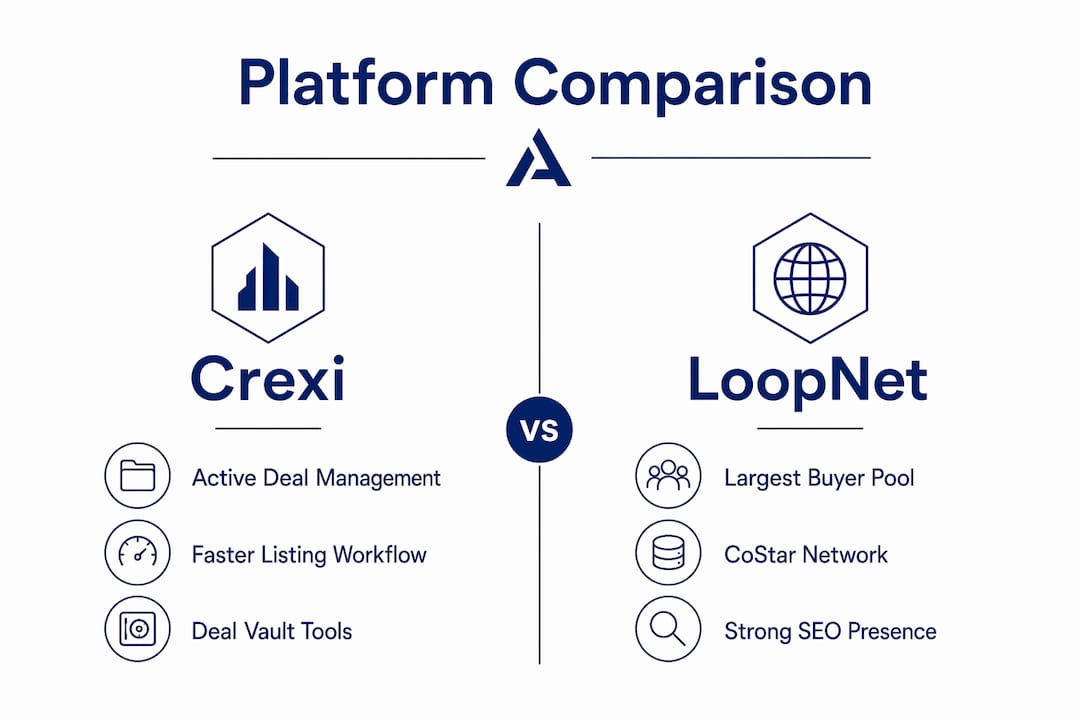
- Crexi wins on broker workflow: auction tools, deal rooms, NDA handling, and faster listing setup make it the go-to for active deal management on mid-market assets.
- LoopNet wins on raw visibility: as the public-facing marketplace built on CoStar’s data backbone, it still dominates consumer search traffic and SEO-driven inbound.
- CoStar is the institutional layer — essential for defensible comps and underwriting, but not a listing marketplace in the same sense.
- Ardorcre offers a managed alternative: local representation, targeted buyer outreach, and full transaction support for Charlotte MSA owners who want more than a self-serve listing.
Skip to the comparison table for a side-by-side view, or jump to the deal-size matrix if you already know your asset class.
Table of Contents
- How does Crexi vs LoopNet compare across the dimensions that matter?
- How do these platforms actually work day-to-day?
- What does it actually cost to list on Crexi or LoopNet?
- Who actually sees your listing on each platform?
- Which platform gives brokers the best deal-management tools?
- Which platform should you use for your deal size and asset class?
- How do you choose the right platform for your next deal?
- How Ardorcre applies this in the Charlotte MSA
- What legal and compliance support do these platforms offer?
- Platform performance in practice: what the evidence shows
- Key Takeaways
- The platform question misses the real decision
- Ardorcre handles the listing strategy so you can focus on the deal
- Useful sources and further reading
How does Crexi vs LoopNet compare across the dimensions that matter?
| Platform | Best For | Audience Reach & Buyer Mix | Listing Tools & Marketing | Pricing | Lead Management / Broker Tools | Data & Comps | Transaction Workflows | Ease of Use | Support & Integrations |
|---|---|---|---|---|---|---|---|---|---|
| Ardor CRE | Owners and investors wanting a managed, market-specific campaign with local Charlotte representation | Targeted outreach to qualified regional buyers and investors; not mass-market | Full-service listing, photography, marketing, and buyer outreach managed for you | Commission-based; no platform subscription required | Dedicated advisor handles all lead qualification and follow-up | Local market comps, lease analysis, and advisory included | Full transaction management: offers, NDAs, due diligence, closing | Fully managed — no platform learning curve | Direct advisor access; integrates with client’s preferred workflow |
| Crexi | Brokers and mid-market sellers needing active investor discovery and auction support | Active investor pool; strong in Sunbelt and secondary markets; broker-to-broker | Self-serve listing with deal vault, document upload, auction tools, and investor alerts | Free basic listing; paid tiers for enhanced visibility (pricing not publicly listed) | Deal room, NDA downloads, document tracking, audit trail, investor alerts | Market reports for 50+ metros; marketplace-level property data | Auction, offer management, NDA/document vault, deal workflow | Intuitive; faster onboarding than LoopNet per user reviews | Partner API access for licensed customers; CSV exports |
| LoopNet | Sellers prioritizing maximum public exposure and SEO-driven inbound | Broadest consumer and investor reach; strong institutional and retail mix | Listing syndication across CoStar network; paid tiers for featured placement | Free basic listing; premium tiers required for meaningful visibility; pricing negotiable | Basic lead capture; weaker broker-specific tooling per G2 reviews | Powered by CoStar data; deep analytics available via CoStar subscription | Standard offer/inquiry workflow; no native auction tools | Familiar interface; onboarding supported by account managers | CoStar ecosystem integrations; limited standalone API |
| CoStar | Institutional teams needing comprehensive comps and long-form market research | Institutional capital, REITs, large private equity; not a public buyer marketplace | Not a listing marketplace; analytics and research platform | Subscription-based; enterprise pricing; not publicly listed | Analytics dashboards, portfolio tracking, market forecasting | Deepest data in the industry; authoritative comp sets for underwriting | Not a transaction platform; supports underwriting workflow | Steep learning curve; designed for analysts | Extensive integrations with institutional tech stacks |
Biggest operational trade-offs
For sellers and brokers:
- Crexi’s deal room and auction tools reduce friction on mid-market deals; LoopNet’s premium tiers can carry significant monthly costs with less broker-specific functionality.
- LoopNet’s SEO footprint means passive inbound from buyers who search Google — Crexi’s active marketplace means buyers who are already logged in and looking.
- CoStar is not a listing platform; confusing it with LoopNet is a common and costly mistake.
For buyers and investors:
- LoopNet surfaces more off-market and consumer-facing inventory through its public search; Crexi surfaces more actively marketed deals with broker contact and deal-room access.
- CoStar’s comp depth is unmatched for underwriting, but the subscription cost is enterprise-grade.
- Ardorcre’s managed approach means buyers in the Charlotte MSA get curated deal flow and direct advisor access rather than sifting through a self-serve portal.
How do these platforms actually work day-to-day?
Listing creation and publishing
Crexi’s listing workflow is genuinely faster. Brokers can upload a property, add financials, attach an OM, and go live in under an hour. The platform allows the Crexi team to complete a listing on the broker’s behalf if preferred, which removes a common friction point for smaller shops. LoopNet’s process is more structured, with required fields and a review step that can add time — though the tradeoff is more consistent listing quality across the platform.

LoopNet syndicates listings across the CoStar network, which means a single upload reaches multiple CoStar-affiliated sites. Crexi’s syndication is more contained to its own ecosystem, though its active investor alerts push new listings directly to registered buyers.
Search, filters, and investor alerts
Both platforms offer property type, location, price, and cap rate filters. Crexi’s saved search and investor alert system is more granular — buyers can set alerts by asset class, deal size, and geography, and receive notifications when matching properties hit the market. LoopNet’s search is strong for consumer-facing browsing but has historically been weaker on broker-specific filtering tools, a gap G2 user reviews consistently flag.
Auction, offer handling, and document vaults
This is where Crexi pulls ahead for active deal management. Crexi’s deal vault handles NDA execution, document distribution, and buyer tracking in one place. Brokers can see who has downloaded the OM, who has signed the NDA, and who is actively engaged — information that shapes offer strategy. LoopNet has no native equivalent; brokers typically manage NDAs and document distribution through separate tools.
Data hygiene
Both platforms carry the usual marketplace problems: duplicate listings, missing cap rate data, and inconsistent NOI fields. Crexi’s active broker community tends to keep listings more current because the deal-room workflow incentivizes updates. LoopNet’s sheer volume means stale listings persist longer, particularly in secondary markets.
The practical gap: A broker using Crexi knows exactly which buyers have engaged with a listing. A broker using LoopNet knows how many people viewed it. That difference shapes every follow-up conversation.
What does it actually cost to list on Crexi or LoopNet?
Both platforms follow a free-to-browse, paid-to-promote model. Basic listing access is free on both sides, but free listings get minimal visibility. The real cost question is what you pay to move a listing from the bottom of search results to featured placement.
How the pricing tiers work
- Crexi offers free basic listings for brokers. Enhanced visibility, premium placement, and analytics access require a paid tier. Crexi is generally cited as more accessible on price than LoopNet, though exact rates are negotiated with account managers and vary by market and listing volume.
- LoopNet also starts with free basic listings, but premium placement — the tier that actually drives inbound leads — carries meaningful monthly costs. Forum discussions and seller-side accounts consistently flag LoopNet’s pricing pressure as a friction point, particularly for brokers managing multiple listings.
- CoStar is subscription-only, enterprise-priced, and not publicly listed. It is not a listing platform — the cost is for data access, not marketing exposure.
ROI by deal size
Stat to know: Published analyses note that Crexi is often considered more cost-accessible for mid-market deals, while LoopNet’s premium tiers are usually more appropriate for larger deals where the advertising spend is justified.
For a $1.5M retail strip center, paying LoopNet’s premium tier for three months may cost more than the incremental lead value it generates. For a $20M office building where one qualified buyer justifies the spend, LoopNet’s reach may be worth every dollar. The math changes by asset class and market.
Billing and onboarding
Both platforms use account managers who will contact you promptly after signup. Expect a sales call, a demo, and an offer of promotional credits or a trial period. Get the cancellation terms in writing before committing to an annual contract — both platforms have received feedback about auto-renewal and billing cadence surprises.
Who actually sees your listing on each platform?
The buyer pools on Crexi and LoopNet overlap but are not identical, and the difference matters more than most brokers expect.
LoopNet draws the broadest mix: retail investors, owner-users, institutional buyers, and consumers who found the listing through Google. Its SEO footprint is substantial — many LoopNet listings rank organically for property-specific searches, which means passive inbound from buyers who were not actively on the platform. That reach is strongest in primary gateway markets (New York, Los Angeles, Chicago) and for asset classes with high consumer interest (multifamily, retail).
Crexi skews toward active investors and brokers. Its registered buyer base is more engaged — these are people who have created accounts, set alerts, and are actively sourcing deals. Crexi’s growth across major U.S. metros has been rapid, and its Sunbelt and secondary market coverage is particularly strong. For a Charlotte-area industrial asset or a Southeast retail center, Crexi’s active buyer pool often surfaces qualified interest faster than LoopNet’s passive inbound.
Practitioner estimate: For assets under $3M in Sunbelt and secondary markets, Crexi tends to generate first qualified contact faster. For assets above $5M where institutional capital is the target buyer, the CoStar ecosystem — including LoopNet — carries more weight.
- Institutional buyers (REITs, private equity, family offices) tend to source through CoStar and LoopNet.
- Regional investors and 1031 exchange buyers are active on both, with Crexi showing stronger engagement in secondary markets.
- Owner-users and local tenants often find listings through LoopNet’s consumer-facing search or through a local broker like Ardorcre.
Which platform gives brokers the best deal-management tools?
For pure broker workflow, Crexi wins. The gap is meaningful enough to affect how you run a deal, not just how you list it.
Deal rooms, NDAs, and document tracking
Crexi’s deal vault is the standout feature for active transaction management. Brokers can upload the OM, set NDA requirements, track document downloads, and monitor buyer engagement — all inside the platform. That audit trail is useful for managing multiple offers and for demonstrating market activity to sellers. LoopNet has no equivalent; document management happens outside the platform, which means more manual coordination and more email chains.
Comps and analytics
CoStar is the authoritative source for defensible comps. If you are underwriting a deal for institutional capital or preparing a broker opinion of value, CoStar’s data depth is the standard. Crexi offers market reports for more than 50 metropolitan areas and marketplace-level property data, which is useful for deal screening but not a substitute for CoStar in formal underwriting. LoopNet’s analytics are powered by CoStar data but require a CoStar subscription to access the full depth.
Integrations and exports
Crexi provides partner and data API access for licensed customers, which means brokers and acquisitions teams can pull alerts and property data into internal CRMs or deal-tracking tools. CSV exports are available on both platforms. LoopNet integrates within the CoStar ecosystem but has limited standalone API functionality for teams outside that stack.
Pro Tip: Set up Crexi investor alerts and LoopNet saved searches to feed into a single shared market file — one spreadsheet or CRM record per submarket. Merging both feeds weekly takes 20 minutes and prevents you from missing inventory that only appears on one platform.
Which platform should you use for your deal size and asset class?
The honest answer is that using both platforms in tandem is the right call for most mid-market brokers. But when budget or bandwidth forces a choice, the matrix below gives a starting point.
| Deal Size | Asset Class | Recommended Platform | Notes |
|---|---|---|---|
| Under $3M | Retail, office, industrial | Crexi first | Active buyer pool; faster first contact in secondary markets |
| Under $3M | Multifamily | Both | LoopNet’s consumer reach adds value for owner-user buyers |
| $3M–$25M | Industrial, retail, office | Crexi primary + LoopNet for exposure | Crexi for deal management; LoopNet for institutional inbound |
| $3M–$25M | Multifamily | LoopNet + Crexi | LoopNet’s reach stronger for this asset class at this size |
| Over $25M | Any institutional asset | CoStar ecosystem + LoopNet | Institutional buyers source through CoStar; LoopNet for public layer |
| Any size | Charlotte MSA | Ardorcre managed campaign | Local buyer outreach, targeted marketing, full transaction support |
Short scenario examples
Small retail sale to an owner-user: A 4,000 SF strip center at $1.8M in a secondary Sunbelt market. List on Crexi first — the active investor and owner-user pool in that price range responds faster. Add a LoopNet basic listing for passive inbound. Expect first qualified contact within two to four weeks on Crexi if the pricing is market.
Mid-market multifamily auction: A 48-unit apartment complex at $7M. Use Crexi’s auction tools to create competitive tension among registered buyers. Run a simultaneous LoopNet premium listing to capture institutional inbound. The dual-surface approach is worth the cost at this deal size.
Institutional portfolio sale over $25M: CoStar is the primary sourcing channel for the buyer pool. LoopNet provides the public-facing layer. Crexi may add incremental reach but is not the primary vehicle at this size.
When to run one platform only: if budget is tight and the asset is under $2M in a market where Crexi has strong coverage, Crexi alone is defensible. For anything above $10M, the cost of a LoopNet premium listing is a small fraction of the commission and the reach justifies it.
How do you choose the right platform for your next deal?
Decision checklist
- Define your buyer. Is the likely buyer an institutional fund, a regional investor, an owner-user, or a 1031 exchange buyer? Match the platform to where that buyer actually sources deals.
- Size the deal. Under $3M leans toward Crexi. Over $25M leans CoStar/LoopNet. The $3M–$25M range benefits from both.
- Assess your workflow needs. Do you need NDA management, document tracking, and auction tools? Crexi. Do you need maximum passive inbound and SEO reach? LoopNet.
- Calculate the cost vs. expected lead value. Premium listing spend should be less than 0.5% of the expected commission on a single deal. If it is not, reconsider the tier.
- Check the data quality. Before committing to a platform for a specific submarket, search for comparable properties and assess listing freshness, cap rate data completeness, and broker contact quality.
Questions to ask account managers before signing
- What is the cancellation policy and notice period for annual contracts?
- Which syndication partners does my listing reach beyond your platform?
- What reporting will I receive on listing views, NDA completions, and buyer engagement?
- Is there a trial period or promotional credit for new accounts?
Red flags
- No ability to export lead data or buyer contact information.
- Missing broker contact fields on competitor listings in your target submarket.
- No NDA or document control for sensitive financial data.
- Auto-renewal clauses without email notification before billing.
30–90 day onboarding plan
- Days 1–14: List on Crexi with full financials, OM, and deal vault configured. Set up investor alerts for comparable assets.
- Days 15–30: Add LoopNet listing at the appropriate tier based on deal size. Sync both platforms’ lead data into a single CRM record.
- Days 30–90: Review engagement metrics monthly. If one platform is generating zero qualified contact, reassess the tier or consider a managed campaign through a local broker.
How Ardorcre applies this in the Charlotte MSA
The platform choice question looks different when you are working a specific market rather than a national portfolio. In Charlotte, the dynamics are worth knowing.
Third-party traffic and ROI analyses confirm what practitioners here see directly: Crexi’s active buyer pool performs well for industrial and flex assets in the Charlotte suburbs — Concord, Gastonia, and the I-85 corridor — where regional investors and owner-users are the primary buyer type. LoopNet’s consumer reach adds meaningful value for office and medical assets in the urban core, where institutional and out-of-state capital is more likely to be the buyer.
Ardorcre’s approach in the Charlotte MSA draws on both surfaces, combined with direct buyer outreach that no self-serve platform replicates. The Charlotte office market has seen meaningful shifts in tenant demand and cap rate compression — context that shapes which buyer pool to target and which platform reaches them.
- Industrial and flex under $5M: Crexi primary, LoopNet secondary.
- Office and medical in the urban core: LoopNet premium listing plus direct outreach to known institutional buyers.
- Retail, including repositioning plays: platform listing plus targeted marketing to active 1031 exchange buyers and local operators.
- Land and development sites: direct broker outreach is often more effective than either platform at this asset class in this market.
Charlotte market note: The retail sector shifts reshaping secondary markets nationally are visible in Charlotte’s suburban corridors. Buyers for repositioned retail are active on Crexi, but the most qualified ones are often reached through a broker’s direct network first.
What legal and compliance support do these platforms offer?
This is an area where the platforms vary significantly, and where brokers sometimes assume more protection than actually exists.
Crexi provides the most structured compliance support at the platform level. Its NDA workflow creates a documented record of which parties accessed confidential materials — useful for both legal protection and deal management. The document vault timestamps downloads and tracks user identity, which can matter in disputes over confidentiality breaches. Crexi does not provide legal advice or transaction-specific compliance guidance, but the audit trail it creates is a meaningful tool.
LoopNet offers standard terms of service and listing verification processes, but does not provide broker-specific compliance tooling. NDAs and document control happen outside the platform. For transactions involving sensitive financial data, that gap requires brokers to maintain their own document management systems.
CoStar operates under institutional data licensing agreements with significant contractual compliance requirements. Its data use policies are detailed and enforced — brokers and analysts using CoStar data in marketing materials or public reports need to review those terms carefully.
None of these platforms substitute for a licensed broker’s compliance obligations under state law. Disclosure requirements, agency relationships, and transaction-specific legal obligations remain the broker’s responsibility regardless of which platform is used. Brokers handling transactions with lender diligence requirements should ensure their document management workflow meets lender standards, not just platform defaults.
This article is general information, not legal or compliance advice. Confirm current platform terms and your state’s brokerage requirements with a qualified professional for your specific transaction.
Platform performance in practice: what the evidence shows
The most useful signal on platform performance comes from practitioners, not marketing pages.
Crexi’s growth trajectory is the clearest data point. From a standing start in 2015, Crexi has grown to become one of the most active commercial real estate marketplaces in the U.S., with substantial on-market listing value across major metros. Brokers in secondary and Sunbelt markets report faster first-contact timelines on Crexi compared to LoopNet for assets in the sub-$10M range.
LoopNet’s SEO dominance is documented and durable. Its listings rank organically for property-specific searches, which means buyers who are not active platform users still find listings through Google. For high-profile assets in primary markets, that passive inbound is a real advantage.
CoStar’s institutional role is not in question. The platform’s data depth is the standard for institutional underwriting, and its buyer pool — REITs, large private equity, family offices — sources deals through CoStar before they look anywhere else.
Ardorcre’s managed approach produces a different kind of result. Rather than waiting for platform algorithms to surface a listing, a managed campaign combines platform presence with direct buyer outreach, targeted marketing, and local market knowledge. The Century House listing illustrates how that approach works in practice for Charlotte-area commercial assets.
Key Takeaways
For most mid-market brokers and investors, the right answer is Crexi for active deal management and LoopNet for public exposure — used together, not as substitutes.
| Point | Details |
|---|---|
| Crexi wins on broker workflow | Deal rooms, NDA handling, and auction tools make Crexi the stronger platform for active deal management under $25M. |
| LoopNet wins on public reach | LoopNet’s SEO footprint and CoStar-backed syndication deliver the broadest passive inbound, especially in primary markets. |
| Deal size drives the choice | Assets under $3M lean Crexi; over $25M lean CoStar/LoopNet; the $3M–$25M range benefits from running both platforms. |
| CoStar is not a listing platform | CoStar provides institutional-grade comps and analytics — essential for underwriting, but separate from the listing marketplace question. |
| Ardorcre offers a managed alternative | For Charlotte MSA owners who want targeted buyer outreach and full transaction support, Ardorcre’s managed campaign replaces the self-serve approach. |
The platform question misses the real decision
The Crexi vs. LoopNet debate is worth having, but it is not the most important question a Charlotte-area owner or investor should be asking. Both platforms are tools. The question is whether a self-serve listing campaign — even a well-executed one — reaches the right buyer pool for your specific asset in your specific submarket.
Platform algorithms optimize for engagement, not for your deal. A Crexi listing gets seen by active investors who are browsing. A LoopNet listing gets found by people who searched Google. Neither platform knows that your industrial flex building in Concord has a tenant mix that makes it attractive to a specific type of 1031 buyer, or that your medical office in South End is priced for a quick close. That context lives with a broker who knows the market.
The brokers who consistently close faster are not the ones who pick the right platform. They are the ones who use the platforms as one layer of a broader outreach strategy — and who have the local relationships to reach buyers before they ever log into a portal.
Ardorcre handles the listing strategy so you can focus on the deal
Choosing between Crexi and LoopNet is a real decision, but it is only one piece of a listing campaign. Ardorcre handles the full picture for commercial property owners and investors in the Charlotte MSA: platform listing, targeted buyer outreach, marketing materials, and transaction management from first contact through closing.
The difference between a self-serve listing and a managed campaign is not just convenience. It is access to a buyer pool that does not browse portals, pricing strategy grounded in local comps, and an advisor who qualifies leads before they reach you. For office, medical, retail, industrial, and investment properties across the Charlotte region, Ardorcre’s commercial real estate services cover every stage of the transaction.
If you are deciding where to list next or evaluating whether a platform subscription makes sense for your asset, contact Ardorcre for a complimentary listing assessment. The conversation takes 20 minutes and gives you a clear picture of which approach fits your deal.
Useful sources and further reading
- Crexi vs. LoopNet on G2 — User review aggregates comparing feature scores for listing management, broker tools, and support.
- CoStar vs. Crexi vs. LoopNet: CRE Marketplace & Listing Coverage Compared — Covers the CoStar/LoopNet ownership relationship and Crexi’s API access for licensed customers.
- LoopNet vs. Crexi: Which Commercial Real Estate Platform Is Better? — Practitioner-level breakdown of deal vault, NDA handling, and the case for using both platforms.
- LoopNet vs. Crexi 2026: Cost, Traffic & ROI Comparison — Pricing accessibility comparison and ROI framing for different deal sizes.
- LoopNet Alternatives for CRE Brokers and Appraisers — CompStak’s overview of Crexi’s market presence and coverage across U.S. metros.
- LoopNet Competitors & Alternatives — SharpLaunch’s side-by-side including founding dates, employee counts, and feature comparisons.
- Crexi or LoopNet? Broker forum discussion — Seller-side accounts of LoopNet pricing pressure and platform selection factors.
- Ardorcre Commercial Real Estate Services, Charlotte NC — Ardorcre’s service overview for listing, leasing, and advisory in the Charlotte MSA.