
You have exactly 180 calendar days from the date your relinquished property closes to complete a 1031 exchange, and a 45-day identification window runs inside that same 180-day period. Miss either deadline, or let proceeds touch your hands, and the exchange fails. The tax bill lands immediately.
- Day 0: The sale closes and title transfers. Both clocks start simultaneously.
- Day 45: Written identification of replacement property must reach your Qualified Intermediary (QI) by midnight.
- Day 180: You must close on the replacement property by this date (or your tax return due date, whichever comes first).
- Immediate action: Hire a QI before you close on the relinquished property.
Never receive sale proceeds. The QI must hold all exchange funds from Day 0 through closing on the replacement property. Taking control of proceeds at any point is treated as taxable boot and typically triggers recognition of the entire gain.
Table of Contents
- How the 1031 exchange timeline actually works: day counting and concurrency
- Which identification rules apply and how to use them
- Your practical 1031 exchange checklist: pre-close through Day 180
- Why the Qualified Intermediary role is non-negotiable
- Common pitfalls that kill exchanges and how to prevent them
- Three example timelines that show how the rules play out
- How Ardorcre helps Charlotte investors protect their exchange
- Key Takeaways
- The part most investors get wrong
- Ardorcre can help you execute your Charlotte 1031 exchange
- Useful sources
How the 1031 exchange timeline actually works: day counting and concurrency
The 45-day and 180-day periods both start on the date the relinquished property sale closes — not when you list it, not when you sign a contract. They run concurrently. After Day 45, you have only 135 days left to close, not a fresh 180.
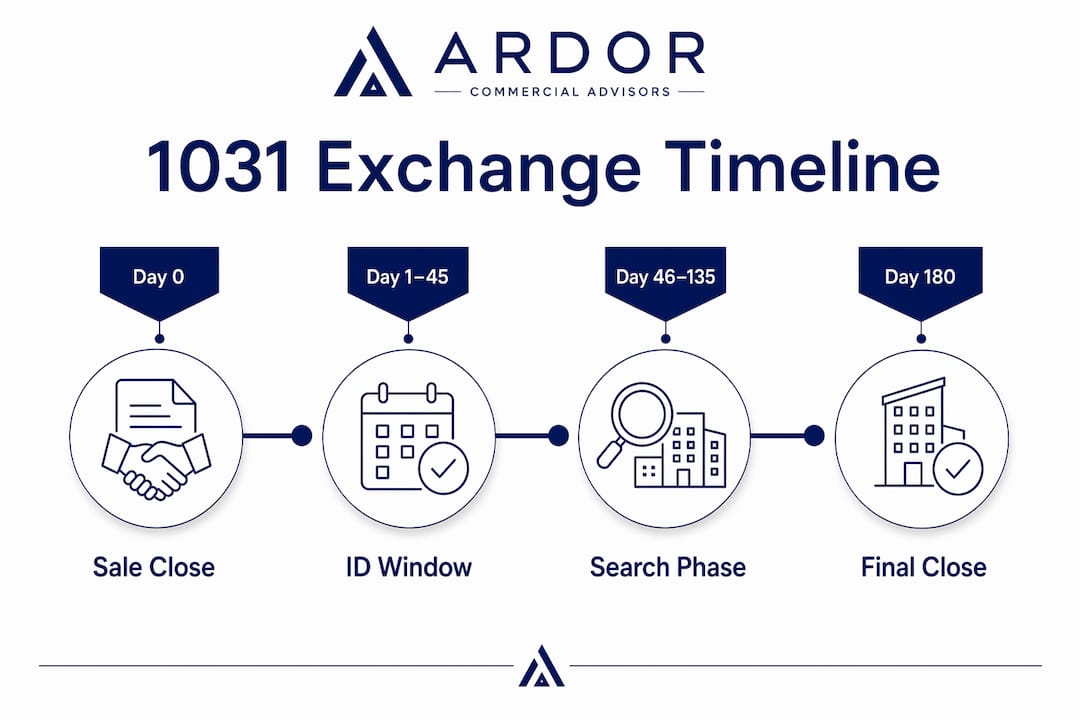
Every day counts as a calendar day. Weekends, federal holidays, Christmas — none of them shift the deadline. If Day 45 falls on a Sunday, your identification is still due that Sunday by midnight.
One exception matters for late-year sellers. The 180-day window ends on the earlier of Day 180 or the due date of your federal income tax return for the year of sale. Sell after mid-October without filing an extension, and your exchange window shrinks to your April return deadline. Filing Form 4868 (individuals) or Form 7004 (most entities) before the original return due date restores the full 180-day window.
Pro Tip: Start identifying replacement properties before you list the relinquished property. There is no penalty for early identification, and having candidates lined up on Day 0 gives you the full 45 days for due diligence instead of property hunting.
Which identification rules apply and how to use them
Identification must be in writing, signed by you, and delivered to the QI or another permitted non-agent party before midnight on Day 45. Telling your broker, attorney, or CPA does not count unless that person is serving as your QI.
Three frameworks govern how many properties you can name:
- 3-Property Rule: Identify up to three properties of any value. Most straightforward for single-asset swaps.
- 200% Rule: Identify more than three properties, provided their combined fair market value does not exceed 200% of the relinquished property’s sale price. Example: sell a $2M industrial building, identify properties totaling no more than $4M.
- 95% Rule: Identify any number of properties at any value, but you must actually acquire at least 95% of their aggregate fair market value. Rarely practical — it is a high bar.
Acceptable identification formats include a street address, legal description, or parcel ID number. “The retail strip center on South Boulevard” is not sufficient. “1234 South Boulevard, Charlotte, NC 28203, Parcel ID 123-456-789” is.
Your identification list can be revised any time before midnight on Day 45. After that, the list is final — no additions, no substitutions. Send revisions to the same party who received the original notice, in writing, signed.
Your practical 1031 exchange checklist: pre-close through Day 180
Plan and sign exchange documents before you close. That single step prevents the most common disqualifying error.
Before closing (pre-close):
- Select and engage a QI — get the exchange agreement signed before the deed transfers.
- Assemble your property documentation (title reports, surveys, leases, environmental reports).
- Pre-identify candidate replacement properties and open conversations with sellers.
- Contact lenders early; confirm financing timelines against your 180-day window.
Days 0–45:
- Confirm the QI has received sale proceeds directly from the closing agent.
- Finalize your identification list and submit it in writing to the QI before midnight on Day 45.
- Notify the sellers of identified replacement properties that you intend to acquire their property as part of a 1031 exchange.
- Revise the list if needed — but lock it before Day 45 ends.
Days 46–180:
- Execute purchase agreements on identified properties.
- Complete inspections, environmental reviews, and due diligence.
- Confirm lender commitments and lock rates; coordinate title and escrow.
- Coordinate with the QI to direct exchange funds to the closing agent at settlement.
- Close on the replacement property before Day 180 (or your earlier tax return deadline).
Pro Tip: Coordinate your lender, title company, and QI at least 30 days before your Day 180 deadline. Last-minute closings that slip past midnight on the final day are unrecoverable.
Why the Qualified Intermediary role is non-negotiable
You must use a QI for a standard deferred exchange. Exchange funds must stay with the QI from the moment the relinquished property closes until the replacement property closes. There is no workaround.
A critical restriction: if your CPA, attorney, or broker serves as QI, they cannot provide other services for that same transaction. The separation preserves the exchange’s tax-deferred status. Most investors use a dedicated QI firm precisely to avoid this conflict.
When selecting a QI, check for:
- Membership in the Federation of Exchange Accommodators (FEA) and Certified Exchange Specialist (CES) designation
- Fidelity bonding and errors-and-omissions insurance
- Segregated escrow accounts (your funds should not commingle with the QI’s operating funds)
- Bankruptcy-remote protections for held funds
- Client references from commercial transactions of similar size
If a QI fails or misappropriates funds mid-exchange, the IRS does not grant relief. The exchange fails and the tax liability falls on you. Vetting your QI is not a formality.
Common pitfalls that kill exchanges and how to prevent them
The most common fatal errors are missing Day 45, missing Day 180, taking possession of funds, and delivering identification to the wrong party.
| Issue | Prevention |
|---|---|
| Late or missing identification | Submit ID list to QI by Day 45; confirm receipt in writing |
| Proceeds touching your account | Instruct closing agent to wire directly to QI at sale closing |
| ID delivered to wrong party | Send only to QI, replacement property seller, or settlement agent |
| Financing delay past Day 180 | Lock lender commitment by Day 180; have backup replacement property identified |
| Tax return shortens window | File Form 4868 or 7004 before original return due date for late-year sales |
| Ambiguous property description | Use full street address plus parcel ID on every identification notice |
No general IRS provision extends the 45-day or 180-day deadlines for financing delays or personal hardship. The only recognized extension comes through federally declared disaster relief under Rev. Proc. 2018-58, and only when the IRS issues a specific postponement notice tied to that disaster.
If you sell multiple relinquished properties in the same exchange, both clocks start from the earliest transfer date among those properties.
Three example timelines that show how the rules play out
1. Simple forward exchange (single office building)
Sale closes March 1. Day 45 falls on April 15. Day 180 falls on August 28. After identification on April 15, the investor has 135 days to close on the replacement property. If the investor is an individual and does not file a tax extension, the April 15 return due date coincides with Day 45 — filing Form 4868 immediately preserves the full window through August 28.

2. Multi-property ID using the 200% rule
Investor sells a $3M retail center. Under the 200% rule, identified replacement properties may total up to $6M. The investor identifies a $2.5M medical office and a $3.2M industrial flex building ($5.7M combined, within the cap). Both are submitted to the QI by Day 45. The investor then has until Day 180 to close on one or both.
3. Reverse and improvement exchanges
In a reverse exchange, the replacement property is acquired first through an Exchange Accommodation Titleholder (EAT). The safe harbor parking period is 180 days, and the same 45-day identification rule applies to the relinquished property. Improvement exchanges must complete all construction within the 180-day window — work not finished by Day 180 does not count toward the exchange value.
Reverse and improvement exchanges require pre-arranged documentation and a specialist QI before any property transfers. Attempting to structure one after the fact is not possible. Escalate to a tax attorney and specialist QI early.
How Ardorcre helps Charlotte investors protect their exchange
Involve a broker and QI before you list. Ardorcre coordinates this for commercial investors across the Charlotte MSA, covering office, medical, retail, and industrial properties.
Concrete services Ardorcre provides for 1031 exchanges:
- Pre-listing exchange planning and timeline mapping
- Replacement property sourcing from active Charlotte MSA listings, including available commercial properties across property types
- Lender introductions and coordination to keep financing on track within the 180-day window
- Closing coordination with QIs and title companies to prevent last-minute deadline failures
- Landlord and tenant representation for lease-encumbered properties entering or exiting an exchange
Charlotte’s commercial market moves fast across all four asset classes. Ardorcre’s local relationships with lenders, title companies, and property owners shorten the friction that kills exchanges in the final weeks.
Key Takeaways
The 1031 exchange timeline is 180 calendar days from sale, with a concurrent 45-day identification window — missing either deadline or receiving proceeds ends the exchange and triggers immediate tax liability.
| Point | Details |
|---|---|
| Concurrent deadlines | The 45-day ID window and 180-day close window both start on Day 0 and run at the same time. |
| Calendar days only | Weekends and holidays do not extend either deadline; Day 45 is Day 45 regardless of the day of the week. |
| Tax return exception | Late-year sellers must file a tax extension to preserve the full 180-day window. |
| QI holds all funds | Exchange proceeds must stay with the QI throughout; any constructive receipt triggers taxable boot. |
| Ardorcre for Charlotte | Ardorcre sources replacement properties and coordinates closings across the Charlotte MSA to protect your exchange timeline. |
The part most investors get wrong
The 45-day and 180-day periods are not sequential. After Day 45, you do not get a fresh 180 days — you have 135 days left. That misconception is the single most expensive mistake I see in commercial exchanges.
The second underestimated risk is QI selection. Investors spend weeks negotiating purchase prices and 20 minutes picking a QI. A failed QI means a failed exchange, full stop. The IRS does not care that your intermediary went bankrupt. Vet the QI the same way you vet a lender: check bonding, insurance, escrow controls, and references from transactions at your deal size.
Charlotte’s commercial market adds a timing wrinkle worth noting. Industrial and medical office deals here often involve longer due diligence periods because of environmental reviews and certificate-of-occupancy requirements. Build that into your Day 46–180 plan from the start, not as an afterthought when Day 160 arrives.
Ardorcre can help you execute your Charlotte 1031 exchange
Replacing a commercial property under a hard deadline is a different challenge than a standard acquisition. Ardorcre works with Charlotte investors from the pre-listing stage through replacement property closing, coordinating the moving parts that most commonly cause exchanges to fail: lender timing, title delays, and replacement property availability.
Whether you are selling an office building, a medical suite, or an industrial asset, Ardorcre’s advisors can identify replacement properties across the Charlotte MSA, make lender introductions to keep commercial financing on schedule, and coordinate with your QI and title company to close before your deadline. Contact Ardorcre to schedule a consultation and start your replacement property search before Day 0 arrives.
Useful sources
Check these primary sources when you need legal certainty on 1031 exchange rules.
- IRS Fact Sheet FS-2008-18 — IRS guidance on identification requirements, written notice rules, and QI restrictions.
- IPX1031 Deadlines and Identification Requirements — Plain-language summary of the 45-day and 180-day rules, identification methods, and Rev. Proc. 2018-58 disaster relief.
- Anchor1031 Timeline and Deadlines Guide — Detailed breakdown of concurrency rules, calendar-day counting, and the identification revision window.
- Start1031 180-Day Rule Explained — Covers the tax-return earlier-deadline exception, extension filing strategy, and reverse/improvement exchange safe harbors.
- First American Exchange Timeline — QI fund-holding requirements and constructive receipt rules.
- Ardorcre 1031 Exchange Resources — How 1031 exchanges support commercial growth and best practices for Charlotte investors.
This article is general information, not legal or tax advice. Confirm current rules and their application to your specific transaction with a qualified tax advisor or attorney.